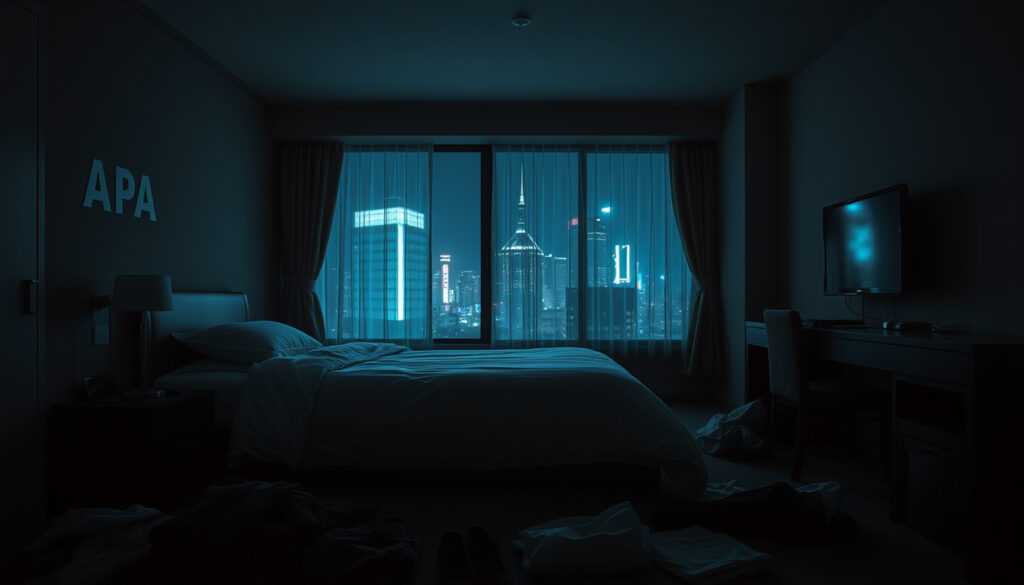
APA Hotel Man Under Bed: Shocking Tokyo Incident Details
When Natali Khomenko spotted two eyes staring back at her from beneath a hotel bed in Tokyo, she assumed exhaustion was playing tricks on her. The 32-year-old Ukrainian model had spent the evening eating ramen and figured she was seeing things — until the figure beneath the mattress rose and fled the room. Khomenko’s subsequent account, posted to TikTok and Instagram on April 25, 2025, and corroborated by police who found a USB cable and power bank under the bed, has since drawn coverage from outlets including One Mile at a Time, Tokyo Weekender, and Dimsum Daily. The incident at APA Hotel & Resort Ryogoku Eki Tower raises uncomfortable questions about hotel security standards in one of the world’s most-traveled cities.
Hotel Chain: APA Hotel · Location: Tokyo, Japan · Victim: Ukrainian model · Items Found: USB cable and power bank · Police Response: Searched room
Quick snapshot
- Eyes seen under bed (Tokyo Weekender)
- Police found USB cable and power bank (One Mile at a Time)
- Identity of man (Dimsum Daily)
- Whether man was caught (Dimsum Daily)
- March 30, 2025 intrusion (Latin Times)
- Public TikTok post April 25, 2025 (Must Share News)
- No suspect apprehended as of May 2025 (Dimsum Daily)
- Hotel stated matter under police investigation (One Mile at a Time)
Key details from the incident at a glance:
| Label | Value |
|---|---|
| Incident Date | March 30, 2025 |
| Check-in Date | March 29, 2025 |
| Hotel | APA Hotel & Resort Ryogoku Eki Tower, Tokyo |
| Victim | Natali Khomenko, 32, Ukrainian model |
| Findings | USB cable, power bank |
| Refund Offered | $600 |
| Compensation Requested | $1,600 |
| Suspect Status | Not apprehended |
| Police Report Filed | By hotel, not victim |
What does APA mean in hotels?
The name APA derives from the company’s founding philosophy — a play on “Always Pleasant Amenities” — though the chain has evolved into one of Japan’s largest hospitality operators with more than 200 properties nationwide. Founded by Toshio Motoya, APA Group positions itself as a mid-range business hotel brand targeting cost-conscious travelers, particularly domestic business visitors. The chain operates primarily in urban centers including Tokyo, Osaka, and Kyoto, with flagship properties like the Akihabara and Shinjuku locations drawing steady foot traffic from both Japanese and international guests.
APA Group origins
The company’s expansion accelerated significantly over the past two decades, with the Ryogoku Eki Tower location — where the March 2025 intrusion occurred — representing a newer generation of APA properties designed to maximize guest capacity in dense urban areas. Unlike independent boutique hotels, APA’s standardized model prioritizes operational efficiency over architectural distinction. The brand’s ubiquity in major train station areas means millions of travelers pass through APA properties annually, making security standards a matter of public interest that extends beyond any single incident.
Hotel chain overview
APA Hotels occupies a specific niche in Japan’s hospitality landscape: above hostel-level accommodations but below luxury properties, with nightly rates typically ranging from ¥8,000 to ¥15,000 depending on location and season. Room sizes reflect Japan’s space-conscious urban development, with standard doubles offering efficient use of limited square footage. The chain’s prevalence near major transit hubs — Ryogoku station sits on the Toei Oedo subway line and serves visitors to the nearby Tokyo Dome and Skytree areas — means these properties host significant numbers of solo travelers, including women traveling alone who face distinct safety considerations.
Is APA a budget hotel?
By Western standards, APA Hotels would fall into the “budget-friendly business hotel” category, though the descriptor requires context. The chain offers functional, standardized accommodations at price points that compete with capsule hotels and business-hostel hybrids, but amenities and room quality typically exceed bare-minimum budget offerings. A stay at an APA property generally includes in-room toilet facilities, air conditioning, and basic toiletries — conveniences that distinguish the chain from lower-tier options in Japan’s fragmented hospitality market.
Pricing and amenities
The three-night reservation that Khomenko booked for approximately $600 (¥80,000) illustrates APA’s positioning: sufficient for a short urban stay without straining a travel budget, but not so inexpensive that guests expect premium security or concierge-level service. This middle-market positioning creates an implicit trade-off that the March 2025 incident has made explicit: guests pay for location and consistency rather than heightened security measures. The hotel’s refusal to approve Khomenko’s $1,600 compensation claim, while offering a full refund, reflects the chain’s preference for transactional resolution over acknowledging systemic concerns about guest safety protocols.
Target audience
APA’s primary demographic skews toward domestic business travelers — salespeople, consultants, and municipal workers making routine trips between cities — alongside budget-conscious international visitors who prioritize location and price over boutique character. This customer base typically includes a higher proportion of solo travelers than family-oriented resort properties, which means single occupancy rooms represent a significant share of nightly bookings. The March 2025 incident has prompted scrutiny of whether APA’s target audience expectations align with actual security provisions, particularly for women traveling alone who constitute a notably vulnerable demographic.
Is APA Hotel a 3 star hotel?
Rating systems vary, but most travel platforms classify APA properties as equivalent to 3-star accommodations — functional and reliable but without the service depth or amenities of higher-rated properties. The KAYAK listing for APA Hotel Akihabaraeki-Denkigaiguchi, for instance, places the chain squarely in the mid-tier category, while TripAdvisor ratings for various APA locations cluster around the three-star mark with consistent complaints about room size rather than service quality or safety concerns. This consistent positioning suggests the chain has successfully calibrated guest expectations to match actual service delivery.
Star ratings
What the star rating system obscures, however, is the distinction between quality ratings and safety standards. A hotel can receive three stars for clean rooms, functional amenities, and reasonable service without meeting heightened security expectations that travelers — particularly women traveling alone — now consider baseline requirements. The March 2025 incident has exposed this gap: APA’s three-star pricing structure does not automatically include security provisions commensurate with the risks that solo female travelers face, a discrepancy that rating systems fail to capture.
Specific properties
The Ryogoku Eki Tower location where Khomenko’s incident occurred opened as part of APA’s newer-generation inventory, with modern exterior aesthetics and updated room designs that align with contemporary expectations for mid-tier Japanese hotels. The property’s proximity to Ryogoku — a neighborhood known for sumo venues and yakatabune river cruises — means it hosts a mix of tourists, business travelers, and event attendees who may represent different risk profiles than APA’s standard business traveler demographic. This customer diversity underscores the challenge of designing security protocols that accommodate varied guest expectations within a standardized hospitality model.
What happened when a woman found a man under her hotel bed?
The timeline begins on March 29, 2025, when Khomenko checked into room 1218 at APA Hotel & Resort Ryogoku Eki Tower for what she anticipated would be a routine three-night stay in Tokyo. She had traveled from Thailand, where she works as a creative producer, to Japan for a promotional appearance — a trip that would take a profoundly different shape than she had prepared for.
Incident details
On her second night in the room, approximately 7:30 PM after returning from dinner, Khomenko noticed an unusual smell — described in her account as “like a dead animal covered in sugar” or “rotten like a dead animal but sweet.” The odor grew stronger as she moved toward the bed. When she leaned down to investigate, she saw two eyes watching her from beneath the mattress. As she looked closer, the figure beneath the bed rose up, and both she and the intruder screamed. The man fled the room immediately, leaving Khomenko alone with the realization of what had just occurred.
The victim’s account — delayed disclosure, trauma-consistent behavior, corroborating physical evidence — carries patterns that forensic psychologists associate with credible reports rather than fabrication, which becomes relevant when evaluating the hotel’s and police’s subsequent handling of the case.
Victim’s account
Khomenko documented her account initially through private channels before deciding to go public via TikTok and Instagram on April 25, 2025 — approximately one month after the incident. She waited, she explained, not because the experience was fabricated, but because processing a traumatic intrusion takes time that doesn’t fit neatly into viral news cycles. Her decision to contact the Ukrainian Embassy after the incident reflects the added dimension of being a foreign national navigating an unfamiliar legal system while dealing with a frightening personal experience.
“Like a dead animal but a sweet odor.”
— Natali Khomenko, describing the smell that prompted her to investigate under the bed
What is the APA hotel man under bed incident?
The incident represents a convergence of individual trauma and systemic vulnerability: one woman’s frightening experience in a Tokyo hotel room, combined with questions about how hotel security, police response, and hospitality industry standards intersect when a guest is victimized. What makes the case particularly significant is not just the intrusion itself but the subsequent response from the hotel, which acknowledged the incident to J-CAST News but characterized it as “under investigation by authorities” and declined further comment — a posture that left the victim seeking accountability without institutional support.
Police findings
Tokyo police arrived at Khomenko’s room shortly after she called to report the intrusion. Officers searched the space and found a USB cable and power bank beneath the bed — items that, combined with the layout of APA rooms which feature under-bed luggage storage, suggest the intruder had prepared equipment rather than opportunistically entered the room. However, the police response showed notable gaps: officers took Khomenko’s passport and email but did not take a detailed description of the suspect at that time, which Khomenko later identified as a critical failure that hindered identification efforts.
The hotel filed the police report in the company’s name rather than the victim’s, which may have complicated her ability to track investigation progress or obtain documentation for insurance and legal purposes — a procedural detail that significantly affected her path to resolution.
Aftermath
Following the incident, Khomenko relocated to a different hotel for safety reasons rather than remaining in a room where someone had accessed her space undetected. The booking platform Agoda initially offered $178 in coupons, which the victim characterized as inadequate given the severity of what she experienced. APA Hotel ultimately provided a full refund for the three-night booking ($600) but rejected her $1,600 compensation demand, a disparity that Khomenko attributed to the hotel’s desire to contain costs rather than acknowledge the incident’s seriousness. The hotel has stated the matter remains under police investigation, though no suspect has been publicly identified as of May 2025 reporting.
Incident Timeline
The sequence of events spanning from check-in through public disclosure:
| Date | Event | Source |
|---|---|---|
| March 29, 2025 | Khomenko checks into APA Hotel & Resort Ryogoku Eki Tower | One Mile at a Time |
| March 30, 2025 | Intrusion discovered around 7:30 PM; police find USB cable and power bank | Latin Times |
| April 25, 2025 | Khomenko posts account on TikTok and Instagram | Must Share News |
| May 15, 2025 | Unrelated Kagawa Prefecture hotel employee arrested for similar assault | Dimsum Daily |
What We Know vs. What Remains Unclear
Confirmed facts
- Eyes seen under bed by victim
- Police confirmed presence of USB cable and power bank
- Hotel acknowledged incident to media
- Intruder fled before police arrived
- No suspect apprehended as of March 2025
- Hotel lacks cameras on premises
- Police reportedly did not take suspect description from victim
What’s unclear
- Intruder’s identity or method of room access
- Whether USB/power bank were for recording or other purposes
- Status of police investigation as of mid-2025
- Whether similar incidents have gone unreported
- Hotel internal investigation results
- How key card access was circumvented or misused
Expert Perspectives
“The matter is under investigation by authorities, and we cannot comment further.”
— APA Hotel, official statement to J-CAST News
“Without permission, I entered the room and touched the sleeping woman’s legs.”
— Hotel employee, Kagawa Prefecture arrest statement
Looking Ahead
The pattern emerging from the Khomenko incident and the separate Kagawa arrest reveals systemic gaps rather than isolated failures: mid-range Japanese hotels with limited security infrastructure, police responses that prioritize report filing over active investigation, and compensation structures that treat guest safety incidents as customer service disputes rather than legal liabilities. Whether these conditions produce accountability reforms or remain the operational norm depends partly on whether victims like Khomenko secure legal counsel, file civil claims, or leverage diplomatic channels through embassies — paths that require resources, time, and risk tolerance that most traumatized individuals cannot mobilize quickly.
A civil claim or formal complaint through the Ukrainian Embassy could force APA into a more substantive response than the current posture of acknowledging investigation while declining accountability — particularly if the victim’s documentation of police procedural gaps becomes part of a formal record.
Related reading: The Regency at Tiong Bahru · Beds for Queen Size
Frequently asked questions
What items were found under the bed at APA Hotel?
Police who responded to the scene found a USB cable and power bank beneath the bed — items that the victim believes were intended for recording purposes, though authorities have not confirmed this interpretation.
Where did the APA hotel man under bed incident occur?
The incident took place at APA Hotel & Resort Ryogoku Eki Tower in Tokyo, Japan, on March 30, 2025. The victim had checked in the previous day for a three-night stay.
Who reported the man under the bed in APA Hotel?
Ukrainian model Natali Khomenko, 32, reported the incident after discovering eyes watching her from beneath the bed when she investigated an unusual smell in her room around 7:30 PM.
Did police catch the man hiding under the APA Hotel bed?
No suspect has been apprehended in connection with the incident as of March 2025. Police reportedly did not take a detailed suspect description from the victim at the time of their initial response.
Why did the woman notice something under the bed?
Khomenko investigated after noticing a strong, unusual smell in the room described as “like a dead animal covered in sugar” or “rotten like a dead animal but sweet” — an odor she attributed to the intruder’s presence.
What happened after the APA Hotel incident?
Khomenko relocated to a different hotel for safety, posted her account on social media on April 25, 2025, contacted the Ukrainian Embassy, and sought compensation from the hotel. APA offered a $600 refund but rejected her $1,600 compensation demand. The hotel stated the matter is under police investigation.
Is the APA Hotel incident related to other hotel safety concerns in Japan?
The Tokyo incident is part of a pattern of Japanese hotel security gaps. A separate case in Kagawa Prefecture on May 15, 2025 involved a hotel employee arrested for assaulting a sleeping woman — demonstrating that both external intruders and internal staff pose risks when security protocols are insufficient.
More related posts
 Wedding Gown Rental Singapore: Costs and Best Places
 Cek Resi J&T Cargo: Track Your Shipment Easily
 Harris Resort Waterfront Batam: Reviews, Rates & Guide
 Am I Gay Quiz: Honest Guide & Best Free Tests
 Samsonite Interlace Spinner 67/24 EXP – Full Specs Features Comparisons
 India Women vs Australia Women: Semi-Final Record & Rivalry
 Batam Marriott Hotel Harbour Bay: Is It Worth Your Stay?
 Sakura Gardens by the Bay 2026: Cherry Blossom Season Guide
