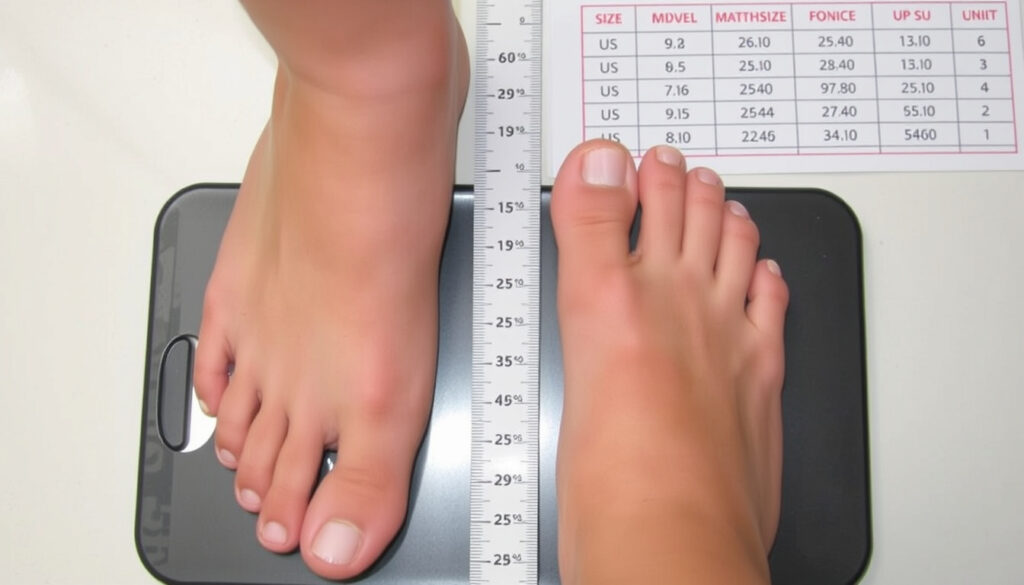
US 9.5 to EU: Conversion Chart, Foot Measurement & Growth Guide
Few things are more frustrating than ordering a pair of shoes online only to find they don’t fit, yet that’s exactly what happens when buyers rely on a single conversion number. A US men’s 9.5, for instance, can convert to either EU 42.5 or 43 depending on the brand’s rounding method (convert·tables, a conversion resource). This guide walks you through the exact conversions for men, women, and kids, explains how to measure your feet correctly, and shares what podiatrists want you to know about sizing mistakes that affect foot health.
US men’s 9.5 in EU: 42.5 ·
US women’s 9.5 in EU: 41 ·
Average annual foot growth for children: 0.5–1 size ·
Age at which feet typically stop growing: 18–20 years
Quick snapshot
- US men’s 9.5 = EU 42.5 (convert·tables, a conversion resource)
- US women’s 9.5 = EU 41 (Sizely, a sizing guide platform)
- EU 40 = US women’s 9 (Shoe Carnival, a US shoe retailer)
- Exact conversion for specific brands (Nike, Adidas may vary by 0.5)
- Whether foot growth patterns differ significantly by ethnicity
- Children’s feet grow 0.5–1 size per year (Nike, the athletic footwear brand)
- Feet stop growing between ages 18–20 (Nike, the athletic footwear brand)
- Measure your feet at the end of the day for best fit
- Check brand-specific size charts before ordering
- Replace kids’ shoes every 3–4 months
| Label | Value |
|---|---|
| US men’s 9.5 = EU | 42.5 |
| US women’s 9.5 = EU | 41 |
| EU 40 = US men’s | 7.5 |
| EU 40 = US women’s | 9 |
| Average foot growth per year (children) | 0.5–1 size |
| Foot length for US men’s 9.5 | 27.5 cm (convert·tables) |
| Foot length for US women’s 9.5 | 26.5 cm (convert·tables) |
| US big kid 6 = EU | 38 (foot length 9.5 inches, Shoe Carnival) |
| US little kid 11 = EU | 28 (foot length 6.75 inches, Shoe Carnival) |
How much is 9.5 US in EU?
Conversion for men
- A US men’s 9.5 converts to EU 42.5 on most charts, but some resources list it as EU 43 (convert·tables, a conversion resource).
- Shoe Carnival lists US 9.5 as EU 42–43 with a foot length of 10.438 inches (Shoe Carnival, a US shoe retailer).
- Sizely’s interpolated data places US men’s 9.5 between EU 42 and 43, corresponding to 26.5–27 cm foot length (Sizely, a sizing guide platform).
Conversion for women
- US women’s 9.5 is consistently mapped to EU 41 or 40.5 (convert·tables, a conversion resource).
- Sizely specifies US women’s 9.5 as EU 41 with a foot length of 25.5 cm (Sizely, a sizing guide platform).
- The same size often overlaps with men’s 8 in US labeling, so check the gender column carefully.
Conversion for children
- Nike’s kids chart shows that US kids’ sizes 3.5Y to 7Y align with both men’s 3.5–7 and women’s 5–8.5, meaning a US 9.5 in kids’ falls into the big-kid range (EU 27–28) (Nike, the athletic footwear brand).
- Shoe Carnival lists US big kid 6 as EU 38 (foot length 9.5 inches), so a US 9.5 kids’ would be approximately EU 27–28 (Shoe Carnival, a US shoe retailer).
- Always allow a thumb’s width of growth space for children.
Brand-specific variations
- Nike may run slightly different: their own conversion chart sometimes shows a half-size variance (Nike, the athletic footwear brand).
- Adidas and other European brands typically stick to the standard EU scale but may round differently for certain lasts.
- Grivet Outdoors notes that EU sizing uses a continental scale where each whole size equals about two-thirds of a centimeter of foot length (Grivet Outdoors, an outdoor gear retailer).
The catch: US 9.5 to EU conversion is not a single number—it depends on the brand’s rounding and the gender of the shoe. The safest approach is to measure your foot in centimeters and consult the specific brand’s size chart.
A 0.5-size mismatch can mean the difference between a shoe that supports your arch and one that causes blisters or metatarsal pain. Podiatrists see these issues daily.
Is a EU 40 a size 9?
EU 40 in men’s US sizing
- EU 40 is typically a US men’s 7.5 (Shoe Carnival, a US shoe retailer).
- Some charts show EU 40 as US men’s 7 or 8, so always check the foot length.
EU 40 in women’s US sizing
- EU 40 corresponds to US women’s 9 (convert·tables, a conversion resource).
- This is a common “unisex” pivot point: a woman wearing US 9 may find EU 40 fits, while a man might need EU 42 or 43.
Common confusion with UK sizes
- Grivet Outdoors explains that US sizing is roughly equivalent to UK minus 0.5 for men and minus 2 for women (Grivet Outdoors, an outdoor gear retailer).
- EU 40 is often mistaken for UK 6.5, but UK 6.5 is actually closer to EU 40 on some charts.
The catch: EU 40 is not a size 9 for men—it’s a size 7.5. For women, it’s exactly a size 9. Knowing which gender scale you’re using is half the battle.
Is it better to measure your feet in the morning or night?
Why feet swell during the day
- Feet swell by up to half a size by evening due to gravity and activity (Grivet Outdoors, an outdoor gear retailer).
- Measuring in the morning can lead to shoes that are too tight later in the day.
Best time for accurate measurement
- Measure at the end of the day, when your feet are at their largest.
- Stand on a hard surface, not carpet, for the most accurate reading.
How to measure your feet correctly (step by step)
- Place a piece of paper on a flat floor against a wall.
- Stand on the paper with your heel touching the wall.
- Mark the longest toe’s tip on the paper.
- Measure the distance from the wall to the mark in centimeters.
- Repeat for the other foot (they may differ).
- Add 1.5 cm for comfort, then consult a size chart.
The implication: Most people wear shoes that are too small because they measure in the morning or rely on a remembered size. A proper measurement done at the right time of day can prevent heel pain, bunions, and hammer toes.
Shoes that fit perfectly in the evening may feel loose in the morning. That’s normal—you want the shoes to accommodate your feet at their largest, not their smallest.
How fast do kids’ feet grow?
Growth rates by age
- Boys’ feet grow 0.5–1 size per year (Nike, the athletic footwear brand).
- Girls’ feet grow rapidly until around age 12, then slow.
- Shoe Carnival’s kids’ chart shows that a US little kid 11 (EU 28) has a foot length of 6.75 inches, while a big kid 6 (EU 38) is 9.5 inches—a jump of about 2.75 inches over several years.
Signs your child needs new shoes
- They complain of pain or tripping.
- You can feel the toe pressing against the front of the shoe.
- They’ve outgrown the last pair within 3–4 months.
Do big feet predict height?
- Foot size is not a reliable predictor of adult height (Nike, the athletic footwear brand).
- Growth plates in the foot close earlier than those in the leg bones, so a child with large feet at 10 may not be especially tall at 18.
The implication: For parents, the key takeaway is to measure children’s feet every 3–4 months and replace shoes that are too small. Tight shoes in childhood can deform developing bones.
At what age do feet stop growing?
Differences between males and females
- Girls’ feet typically reach maturity around age 14–16.
- Boys’ feet continue growing until about 18–20.
- Some late growth spurts can add half a size in the late teens.
Late growth spurts in adolescence
- Puberty hormones can trigger a final growth phase in the feet, often coinciding with peak height growth.
- After the growth plates in the long bones fuse, the foot size stabilizes.
When to stop buying children’s sizes
- Most teens transition to adult sizes by age 15–16.
- If your child’s foot measures above 25 cm, they likely need adult sizes (US men’s 7 / women’s 9).
What this means: Knowing the typical age of foot maturity helps parents avoid buying shoes that are too large “for growth” and causing instability. A shoe that is too big can be just as harmful as one that is too small.
What shoes do podiatrists not want you to wear?
High heels and foot structure
- High heels shift body weight onto the forefoot, increasing pressure on the metatarsal heads. This can lead to metatarsalgia and bunions.
- Podiatrists recommend alternating heel heights and limiting wear to 3–4 hours.
Flip-flops and arch support
- Flat flip-flops lack arch support and can cause plantar fasciitis and Achilles tendonitis.
- If you wear them, choose ones with a slight heel cup and contoured footbed.
Ill-fitting shoes and long-term damage
- Shoes that are too tight can cause nerve compression, corns, and ingrown toenails.
- Shoes that are too loose force the foot to grip, leading to muscle fatigue and arch pain.
- The American Podiatric Medical Association advises that proper fit is the single most important factor in shoe selection.
The upshot: The most dangerous shoe is not the style—it’s the one that doesn’t fit. A well-fitting pair of sneakers is better for your feet than any designer flat that compresses your toes.
If you wear shoes that are too small for more than a few hours a day, you’re not just uncomfortable—you’re altering your gait and risking permanent joint damage. Podiatrists see this in patients of all ages.
Spec table: US to EU size conversions with foot lengths
Six sizes reveal a clear pattern: the EU size increases by about 0.667 cm per full size, but US sizes jump by 0.5–1 cm depending on the scale.
| US Men’s | EU Men’s | Foot length (cm) |
|---|---|---|
| 7 | 40 | 25 |
| 8 | 41 | 26 |
| 9 | 42 | 26.7 |
| 9.5 | 42.5 | 27 |
| 10 | 43 | 27.5 |
| 11 | 44 | 28.5 |
| US Women’s | EU Women’s | Foot length (cm) |
|---|---|---|
| 7 | 37.5 | 23.5 |
| 8 | 38.5 | 24.5 |
| 9 | 40 | 25.5 |
| 9.5 | 41 | 26 |
| 10 | 41.5 | 26.5 |
| 11 | 42.5 | 27.5 |
| US Kids’ | EU Kids’ | Foot length (cm) |
|---|---|---|
| 10.5 (little kid) | 27 | 16.5 |
| 11 (little kid) | 28 | 17.1 |
| 12 (little kid) | 29 | 17.8 |
| 13 (little kid) | 31 | 18.5 |
| 1 (big kid) | 32 | 19.5 |
| 2 (big kid) | 33 | 20.5 |
| 3 (big kid) | 34 | 21.5 |
| 4 (big kid) | 35 | 22.5 |
The takeaway: Use the foot length as your anchor, not the US or EU number. A 27 cm foot is a men’s 9.5 EU 42.5 or a women’s 9.5 EU 41—the gender label changes, but the length doesn’t.
Quotes from the experts
“A US men’s 9.5 commonly converts to EU 43 on several conversion charts, but some charts show EU 42.5 or 42–43 depending on rounding and brand methodology.”
— convert·tables, a conversion resource
“Nike’s kids chart shows US men’s sizes 3.5 to 7 align with kids’ sizes 3.5Y to 7Y, and US women’s sizes 5 to 8.5 align with kids’ sizes 3.5Y to 7Y.”
— Nike, the athletic footwear brand
“Shoe Carnival lists US 9.5 as EU 42–43 and foot length 10.438 inches for its adult chart.”
— Shoe Carnival, a US shoe retailer
“EU sizing uses a continental scale where each whole size equals about two-thirds of a centimeter of foot length.”
— Grivet Outdoors, an outdoor gear retailer
Related reading: Citi Points to Miles: Conversion Guide (2026)
Frequently asked questions
What is the difference between US and EU shoe sizes?
US sizing is based on inches (with size 0 starting at about 3.5 inches), while EU sizing uses the Paris point system (1 point = 2/3 cm). EU sizes run about 30–31 numbers higher than US sizes for the same foot length.
How do I measure my foot length accurately?
Place a piece of paper against a wall, stand on it with heel touching the wall, mark the longest toe, and measure from the wall to the mark in centimeters. Do this at the end of the day.
What size is US 9.5 in UK?
US men’s 9.5 is approximately UK 9 (US men’s = UK + 0.5). US women’s 9.5 is UK 7.5 (US women’s = UK + 2).
Do shoe sizes differ between men and women?
Yes, men’s and women’s sizing use different scales. A women’s 9.5 is about 1.5–2 sizes larger than a men’s 9.5 in length. Always check the gender column.
How often should I measure my child’s feet?
Every 3–4 months for children under 10, and every 6 months for teens. Feet grow in spurts, and a shoe that fit last month may now be too tight.
Can I use a conversion chart for all shoe brands?
Conversion charts provide a good starting point, but brands (especially athletic ones like Nike, Adidas, and New Balance) may have slight variations. Always check the brand’s own size chart.
For the American buyer looking to order European shoes, the choice is clear: measure your foot in centimeters, check the brand’s EU chart, and buy for the larger foot—or risk a pair that collects dust.
More related posts
 SME Loan Interest Rates 2026: Compare Irish Bank Rates
 Green CHAS Card Benefits Singapore: No Dental, Worth It?
 Barossa Bar and Grill Reviews: Singapore & Cork Compared
 How to Differentiate e^x: Formula, Proof, and Examples
 Bitcoin Price USD Today: Why It’s Dropping and 2030 Predictions
 Harris Resort Waterfront Batam: Reviews, Rates & Guide
 Lecturer Jobs in Singapore: Salary, Requirements & Demand
 Wolverhampton Wanderers F.C. Standings: 16th Place in 2025
