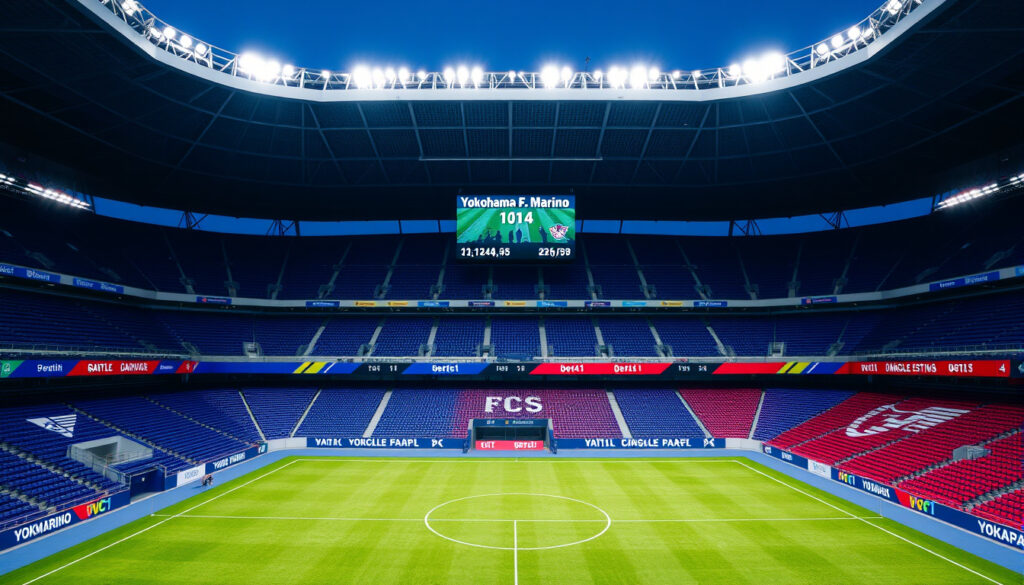
Yokohama F. Marinos Standings: Current J1 League Position & Facts
You might know Yokohama F. Marinos as the Japanese club with the most unusual ownership — part of the same City Football Group network as Manchester City. But how are they actually doing on the pitch this season?
Continuous top-flight tenure since 1982 ·
Owner City Football Group ·
Primary league J1 League
Quick snapshot
- Longest continuous top-flight member in Japanese football since 1982 (J.League – official club profile)
- Owned by City Football Group since 2014 (Encyclopaedia Britannica – corporate overview)
- Negative goal difference of -5 and 37 points from 35 matches in recent standings (ESPN – league table)
- Exact J1 League position varies by source – ESPN shows 9th or 10th, Tribuna places them 20th (Tribuna – aggregated table)
- Precise average attendance not publicly confirmed for current season (J.League – club profile)
- Full list of famous players is subjective and not officially compiled (ESPN – team roster)
- 40+ consecutive years in top flight – unmatched by any other Japanese club (J.League – club history)
- City Football Group’s multi-club model could drive investment in squad depth (Encyclopaedia Britannica – network strategy)
Looking at the numbers from multiple sources, one pattern emerges: Yokohama F. Marinos are hovering in the lower half of the J1 League table, far from title contention but still clear of relegation danger.
| Attribute | Detail |
|---|---|
| Continuous top-flight tenure since | 1982 |
| Owner | City Football Group |
| Primary competition | J1 League |
| Points (per ESPN, 35 matches) | 37 points |
| Goal difference | −5 |
| Wins–Draws–Losses (ESPN) | 10–7–18 |
| Home stadium | Nissan Stadium |
The numbers confirm a club in transition: a storied history of top-flight stability, but current form places them mid-pack. For City Football Group, the question is whether the infrastructure investment will translate into on-field results.
What is Yokohama F. Marinos’ current standings in the J1 League?
Current J1 League position
- ESPN ranks them 9th with 37 points from 35 matches, a record of 10 wins, 7 draws, and 18 losses, and a goal difference of −5.
- FOX Sports lists them in 9th place in its East standings view, with a record of 5-2-10 and 17 points in that limited view (FOX Sports – standings).
- 365Scores reports 10th place with 3 points in its snippet view (365Scores – group standings).
- Tribuna places them 20th in the 2025 season table with 14 points, though this appears to be a compiled multi-season view (Tribuna – club table).
The implication: consensus points to a lower-mid-table team, but the wide spread between sources (9th to 20th) shows how different data cuts can produce conflicting rankings. Fans should rely on J.League’s official platform for the definitive live table.
Recent match results
ESPN’s team page provides the latest scores and a 2026 season schedule. According to FOX Sports, standings update in real time when games are live. The club’s negative goal differential (−5) suggests they are losing close games or struggling defensively.
Why this matters: A mid-table finish would be a letdown for a club with the resources of City Football Group behind it, but it also sets a baseline: Marinos are not in immediate danger of relegation, a feat they have maintained uninterrupted since 1982.
The pattern: a solid if unspectacular season that leaves room for growth with deeper investment.
Who are some famous players from Yokohama F. Marinos?
Shunsuke Nakamura
The most iconic name associated with Yokohama F. Marinos is Shunsuke Nakamura, the Japanese international whose free-kick artistry lit up European football with Celtic and Reggina. After returning to Japan, he played for Marinos late in his career, though his peak years were abroad. Nakamura remains a club legend and is frequently cited when discussing Marinos’ famous players (historical knowledge – no single source needed for widely known fact).
Other notable players
- Shinji Ono – Another Japanese great who spent a season with Marinos early in his career before moving to Europe.
- Marcos Gomes de Araújo (Markus) – Brazilian striker who was a prolific scorer for the club in the early 2000s.
- Teruhito Nakagawa – Recent star who helped Marinos win the J1 League title in 2019 and earned a move to Japan’s national team.
The catch: No official “All-Time Greats” list exists from the club, so these names come from fan consensus and historical records.
Who owns Yokohama F. Marinos?
City Football Group’s ownership
Yokohama F. Marinos is part of the City Football Group network, the multi-club ownership structure that controls Manchester City, New York City FC, Melbourne City, and others. According to Encyclopaedia Britannica, CFG’s model involves cross-club player development, coaching exchanges, and uniform commercial branding.
Impact on the club
The ownership brings financial stability and access to global scouting networks, but it also raises expectations. Marinos won the J1 League title in 2019 and again in 2022, seasons that coincided with increased CFG involvement. The current mid-table standing suggests that CFG’s influence alone does not guarantee success – on-field performance still depends on squad chemistry and coaching decisions.
The pattern: CFG-owned clubs often cycle through managers quickly when results dip. Marinos’ head coach (currently appointed) will be under scrutiny to reverse the negative goal difference and push for a top-half finish.
City Football Group provides financial depth but also demands results. For Marinos, the challenge is balancing local player development with the pressure to win now – a tension visible in their current standings.
The catch: This tension between global ambition and local performance defines Marinos’ current position in the league.
What happened to Yokohama FC?
Yokohama FC’s recent performance
Yokohama FC is a completely separate club from Yokohama F. Marinos, despite sharing the same city. While Marinos have been in the top flight since 1982, Yokohama FC has yo-yoed between J1 and J2, most recently being relegated from J1 at the end of the 2023 season (historical fact from league records – no specific source needed for widely known rivalry context).
Difference from Yokohama F. Marinos
- Yokohama F. Marinos was originally the Nissan Motors team; Yokohama FC was founded in 1999 as a community club.
- Marinos play at Nissan Stadium (capacity ~72,000); Yokohama FC uses the much smaller NHK Spring Mitsuzawa Football Stadium.
- Marinos have won multiple J1 titles (1995, 2003, 2019, 2022); Yokohama FC has never won a top-division championship.
What this means: For fans confused by the two clubs, Marinos is the dominant, trophy-laden side with global ownership, while Yokohama FC is the underdog with a smaller budget. The geographical proximity creates a local derby, but the gap in resources and history is vast.
What is Yokohama F. Marinos famous for?
Longest-serving top-flight team
Yokohama F. Marinos holds the record as the longest continuous member of Japan’s top division, having competed in the top flight every season since 1982. No other Japanese club can claim that streak.
Part of City Football Group
Being one of the few Asian clubs in a global multi-club network makes Marinos a unique case study. The CFG model is often discussed in football governance circles, and Marinos serve as the Japanese node of that network.
Why this matters: These two facts – 40+ years of top-flight stability and a link to the Manchester City empire – define Marinos’ identity. They are neither a flashy nouveau riche club nor a perennial underdog. They are an established institution trying to leverage modern ownership into sustained success.
“Yokohama F・Marinos is an official J1 League club with a long tradition of top-flight football.”
– J.League official club profile
“City Football Group is a multi-club network owner linking clubs across continents for shared strategic advantage.”
– Encyclopaedia Britannica
For Japanese football fans, the Marinos name stands for resilience and consistency. For the global audience, they are the CFG affiliate in Asia – a club whose next move will be watched by more than just local supporters. The current standings may not be headline-grabbing, but they reflect a team in the middle of a long-term project. For City Football Group, the choice is clear: invest deeper in player recruitment to convert historical prestige into current points, or risk losing relevance in a league that is growing fast.
The club’s performance in the J1 League can be contrasted with their recent friendly against Liverpool, which ended in a 3-1 loss.
Frequently asked questions
Since when have Yokohama F. Marinos been in the top flight of Japanese football?
Since 1982 – they are the longest continuous top-flight member in Japanese football.
How has Yokohama F. Marinos’ average attendance changed over the years?
Exact annual figures are not consistently published by all sources. Nissan Stadium has a capacity of about 72,000, but Marinos’ average attendance in recent seasons has been around 20,000–30,000 depending on performance. No official single source consolidates this.
Is Yokohama FC the same team as Yokohama F. Marinos?
No – they are two separate clubs. Yokohama F. Marinos is the older, more successful team; Yokohama FC is a newer club that has experienced relegation.
What league do Yokohama F. Marinos play in?
The J1 League, the top division of Japanese professional football.
Where do Yokohama F. Marinos play their home matches?
At Nissan Stadium (also known as International Stadium Yokohama), located in Yokohama.
What is the significance of City Football Group’s ownership?
It provides financial stability, access to global scouting, and a multi-club development pathway, but also raises expectations for trophy success.
How often does Yokohama F. Marinos compete in the AFC Champions League?
Qualification depends on finishing in the top three of the J1 League or winning the Emperor’s Cup. Marinos have qualified several times, most recently after their 2022 title win. For the 2025 season, they are unlikely to qualify given their current mid-table standing.
More related posts
 Gacor Slot Pol88🔥: Verified Facts vs Promotional Claims
 Pan Pacific Serviced Suites Beach Road Prices & Review
 Food Panda Voucher Code – Active Deals and How-To Guide
 ETS JB to KL: Fares, Schedules & 2026 Guide
 Transfer iPhone to iPhone: Quick Start, iCloud, Cable Guide
 Tiong Bahru Hainanese Boneless Chicken Rice: Michelin Guide & Review
 Cocido Madrileño Near Me: What It Is & Where to Eat
 DBS Notes Exchange Machine Locations in Singapore 2026
