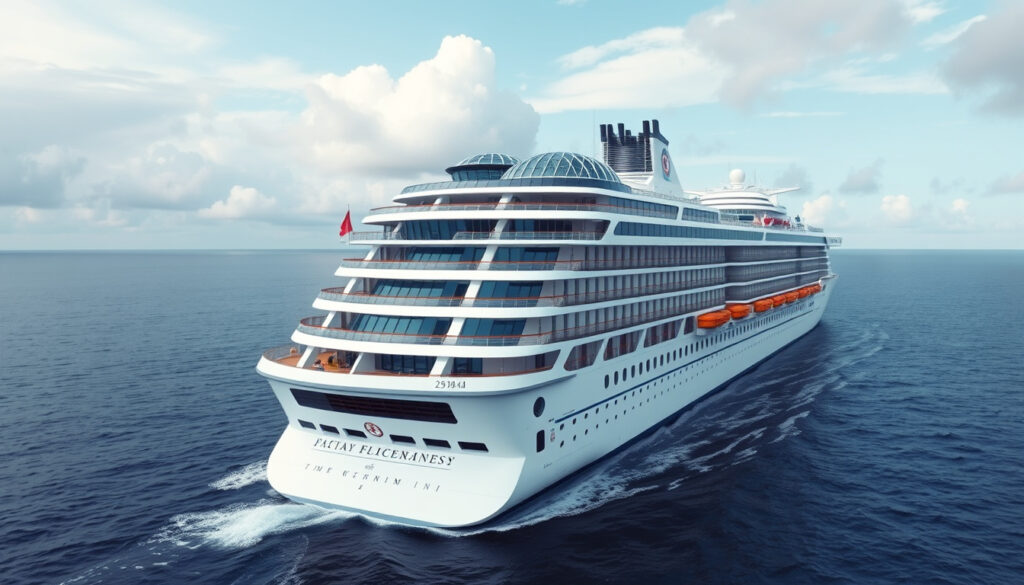
Icon of the Seas: Cost, Size, Features & Itinerary Guide
If you’ve seen the headlines about a cruise ship so big it makes the Titanic look like a ferry, you’re in the right place. Icon of the Seas is Royal Caribbean’s newest flagship, and it has genuinely rewritten the rulebook on what a ship can hold — seven pools, over 40 places to eat, and enough deck space to fit 7,600 people without feeling like a sardine can. This article covers the costs, the size records, the features that actually matter, and whether a ship this huge feels crowded or just spacious.
Year launched: 2024 ·
Gross tonnage: 250,800 GT ·
Maximum passengers: 7,600 ·
Length: 1,198 feet ·
Number of decks: 20 ·
Starting price per day: $272
Quick snapshot
- Starting from $272 per day on select 2026-2028 sailings (Royal Caribbean (official pricing))
- Promotional seven-night family cruise reported as low as £2,663 total (The Sun (UK travel desk))
- World’s largest cruise ship as of 2024 (Port Economics, Management and Policy (maritime analysis))
- 250,800 GT, length 1,198 ft (USA Today (travel desk))
- Seven pools, six water slides (People (lifestyle coverage))
- Over 40 dining venues on board (Royal Caribbean (official site))
- Maximum 7,600 passengers (USA Today (travel desk))
- Crew of 2,350 (Royal Caribbean (official specs))
Here are the core specifications of the ship.
| Specification | Icon of the Seas |
|---|---|
| Built | 2024 (Wikipedia (neutral encyclopedia)) |
| Operator | Royal Caribbean International (Wikipedia (neutral encyclopedia)) |
| Class | Icon class (Wikipedia (neutral encyclopedia)) |
| Gross tonnage | 250,800 GT (Royal Caribbean (official specs)) |
| Length | 1,198 ft (USA Today (travel desk)) |
| Beam | 213 ft (HowStuffWorks (science & tech explainer)) |
| Decks | 20 (Wikipedia (neutral encyclopedia)) |
| Max passengers | 7,600 (USA Today (travel desk)) |
| Crew | 2,350 (Royal Caribbean (official specs)) |
How much will it cost to go on the Icon of the Seas?
Pricing for a ship this big runs a wide gamut. The cheapest option in the system — an interior cabin on a promotional 2026-2028 sailing — starts at $272 per day according to Royal Caribbean’s official pricing (operator’s booking system). For a family of four, The Sun (UK travel desk) reported one promotional seven-night cruise at around £2,663 total including food and basic entertainment.
Price per day
- Starting from $272 per day (promotional, 2026-2028 window) — Royal Caribbean (official pricing system)
- Varies by cabin class: interior, ocean-view, balcony, suite tiers
- Year-round pricing on Royal Caribbean’s main booking channel
What is included in the fare
- All main dining rooms, buffet, select casual venues — Royal Caribbean (official inclusions page)
- Basic beverages (water, coffee, juice at meals)
- Most shows, pools, water slides, and deck activities
- Specialty dining, drinks packages, shore excursions, and gratuities are extra
Seasonal variations
- Peak winter/spring-break sailings command higher per-night rates
- Shoulder-season (September, October) often sees discounts
- Promotional “cruise sale” periods (2026-2028) have the lowest baseline — The Sun (UK travel desk)
The headline $272/day rate works well for budget-focused families who book early and choose interior cabins on less popular weeks. Anyone wanting a balcony or suite on a Christmas sailing should expect 3-4x that — and book at least 18 months out.
The pattern: the lowest per-day pricing hooks promotional attention, but the real cost for a family of four with a balcony and a drink package lands closer to $1,200-$1,500 per day total. That’s still competitive when you consider lodging, food, and transport are bundled — but the gap between marketing price and true outlay is real.
TL;DR: Budget-conscious families can book interior cabins on promotional 2026-2028 sailings for $272/day, but a typical balcony-plus-drinks cruise for four runs $1,200–$1,500 per day. The difference is significant.
Is Icon of the Seas the biggest ship?
Yes — as of its January 2024 debut, Icon of the Seas holds the title of the world’s largest cruise ship by gross tonnage. Port Economics, Management and Policy (maritime analysis) confirms it displaced previous Oasis-class vessels that had held the record for over a decade.
Here is how it stacks up against other large ships.
Size comparison with other ships
| Ship | Gross tonnage | Length (ft) | Year |
|---|---|---|---|
| Icon of the Seas | 250,800 GT | 1,198 | 2024 |
| Wonder of the Seas (Oasis class) | 236,857 GT | 1,188 | 2022 |
| Symphony of the Seas (Oasis class) | 228,081 GT | 1,188 | 2018 |
| Titanic (historical) | 46,328 GT | 882 | 1912 |
Gross tonnage and dimensions
- Gross tonnage: 250,800 GT — Royal Caribbean (official specs)
- Length: 1,198 feet (about 365 meters) — USA Today (travel desk)
- Beam: 213 feet (66 meters) — HowStuffWorks (science explainer)
- 20 passenger decks total
World record status
The ship was built as the lead vessel in Royal Caribbean’s new Icon class and entered service as the largest passenger ship ever constructed. Wikipedia (neutral encyclopedia) notes it is about 5% larger by tonnage than the previous record-holder, Wonder of the Seas.
The implication: Icon of the Seas is not just marginally bigger — it’s the first ship to break the 250,000 GT mark, which represents a genuine engineering leap. That extra 14,000 GT over the Oasis class translates into room for an extra pool, a full water park, and more open deck space rather than more cabins.
For travelers who found Oasis-class ships already too large, Icon adds another 5% of scale. But for families who want more amenities without sailing on a smaller ship that lacks the newest attractions, Icon’s size enables experiences — like a massive onboard water park — that no other ship can fit.
The catch: While the size is impressive, the additional space is used for amenities rather than passenger capacity, meaning the guest density remains similar to Oasis-class ships.
TL;DR: Icon of the Seas is the largest cruise ship ever built at 250,800 GT, 5% bigger than the previous record-holder. The extra mass funds amenities like a water park and seventh pool, not more cabins.
What is so special about the Icon of the Seas?
Royal Caribbean markets Icon of the Seas as “a first-of-its-kind adventure for the whole family” (Royal Caribbean (official marketing)). But the features that stand out go beyond taglines.
Seven pools
- Seven distinct swimming pools, including the largest pool ever on a cruise ship — People (lifestyle coverage)
- Pools spread across multiple decks to reduce crowding
- Family pool, adults-only pool, swim-up bars, and an infinity pool
Thrills and attractions
- Six water slides, including a family raft ride — HowStuffWorks (science explainer)
- Category 6 water park, the largest water park at sea
- FlowRider surf simulators, rock climbing walls, and a full-sized ice rink
Dining options
- Over 40 dining venues on board — Royal Caribbean (official dining list)
- Includes complimentary main dining, buffet, and specialty restaurants
- Cuisine types: Asian, Italian, American, seafood, steakhouse, and more
Family accommodations
- 28 different cabin types, including multi-room family suites — The Sun (UK travel desk)
- Three-story Ultimate Family Townhouse suite
- Connecting cabins and dedicated family neighborhoods
The catch: Icon’s family-focused design means that childless couples or solo travelers may find the vibe a bit loud during school holidays. Royal Caribbean loaded this ship for families first, and the adults-only areas are smaller than on competitors like Virgin Voyages or Celebrity’s newer ships.
TL;DR: Icon of the Seas packs seven pools, six water slides, over 40 dining venues, and 28 cabin types, all designed for families. The trade-off is fewer adults-only spaces.
Is Icon of the Seas too crowded?
At maximum capacity of 7,600 passengers, the question of crowding is valid. But the ship’s design philosophy tries to mitigate it.
Passenger capacity
- Double occupancy: 5,610 guests — Royal Caribbean (official specs)
- Maximum capacity: 7,600 passengers — USA Today (travel desk)
- That’s a density of about 3.9 passengers per 100 GT — roughly comparable to Oasis-class ships
Crew ratio
- Crew of 2,350 — Royal Caribbean (official specs)
- That’s a guest-to-crew ratio of about 3.2:1 at max capacity
- Industry standard for mega-ships is around 3:1 to 4:1
Design for crowd distribution
- Seven pools spread across decks 15-17 rather than clustering them
- Multiple dining neighborhoods rather than one main buffet
- Split boarding and disembarkation zones — Royal Caribbean (deck plans)
What this means: Icon of the Seas is about as dense as other modern mega-ships. The extra 14,000 GT over Oasis class buys more amenity space, not more berths. For the traveler, that translates to less line-cramming at peak times — but the main pool deck and buffet can still feel busy on sea days.
TL;DR: With 7,600 passengers and 2,350 crew, Icon’s density matches Oasis-class ships. The extra space goes to amenities, so peak times like sea days on the main pool deck can still feel crowded.
What is the Icon of the Seas capacity and itinerary?
Capacity and where the ship actually sails are two sides of the same coin for planning your trip.
Capacity details
- Maximum capacity: 7,600 passengers — USA Today (travel desk)
- Crew: 2,350 — Royal Caribbean (official specs)
- 28 cabin types across 20 decks
Itinerary information
- Homeport: PortMiami — Wikipedia (neutral encyclopedia)
- Primary routes: 7-night Western Caribbean sailings
- Typical ports: Costa Maya, Cozumel, Roatán, and Royal Caribbean’s private island Perfect Day at CocoCay
- Occasional Eastern Caribbean routes as seasonal alternates
Current location
- The ship sails year-round from Miami as of 2024 — HowStuffWorks (science explainer)
- No plans for repositioning to other homeports in the short term
- Real-time tracking available through marine traffic services
The pattern: Icon of the Seas is essentially a Miami-based Western Caribbean cruiser. That makes it well-suited for US East Coast and European travelers flying into Florida, but less practical for West Coast, Asian, or Australian cruisers who’d need a long-haul flight to board.
TL;DR: Icon of the Seas sails year-round from Miami on 7-night Western Caribbean itineraries, with occasional Eastern Caribbean routes. It’s ideal for East Coast US and European travelers but less convenient for others.
How does Icon of the Seas compare to the Titanic?
The comparison is mostly historical curiosity, but the numbers are staggering.
Here is a side-by-side look at the key dimensions.
Size differences
| Dimension | Icon of the Seas | Titanic | Ratio |
|---|---|---|---|
| Length | 1,198 ft | 882 ft | 1.36× |
| Gross tonnage | 250,800 GT | 46,328 GT | 5.4× |
| Passenger capacity | 7,600 | 2,435 | 3.1× |
| Crew | 2,350 | 892 | 2.6× |
| Decks | 20 | 10 | 2× |
Amenities comparison
- Icon has seven pools, six water slides, ice rink, carousel, multiple theaters — People (lifestyle coverage)
- Titanic had one swimming pool, a Turkish bath, a gym, and squash court
- Icon has 40+ dining venues vs Titanic’s 12 dining rooms and cafes
Historical context
- Icon is 5.4× larger by tonnage than Titanic — USA Today (travel desk)
- Modern safety features include dual-fuel engines, advanced lifeboats, and SOLAS-compliant safety systems (the post-Titanic international safety convention)
- Titanic had 20 lifeboats for 2,435 passengers and crew; Icon carries lifeboat capacity for everyone aboard plus extra inflatable rafts
Why this matters: The Titanic comparison is a useful visual anchor — Icon is more than five Titanic’s worth of ship. But the comparison is also a stark reminder of how much maritime safety has evolved. Modern mega-ships like Icon are designed with multiple redundant systems, segregated fire zones, and mandatory safety drills that make a Titanic-style scenario virtually impossible today.
TL;DR: Icon of the Seas is 5.4 times larger than Titanic in tonnage and carries 3.1 times more passengers. The comparison underscores both the scale of modern cruise ships and the vast improvements in maritime safety.
Royal Caribbean describes Icon of the Seas as “a first-of-its-kind adventure for the whole family” — the company’s framing of the ship as a destination rather than transportation.
— Royal Caribbean International (official marketing page)
Wikipedia notes that Icon of the Seas entered service on 27 January 2024 and is the lead ship of the Icon class, replacing Oasis-class vessels as the world’s largest passenger ship.
— Wikipedia (neutral encyclopedia)
Confirmed facts
- Launched 27 January 2024 — Wikipedia
- Gross tonnage 250,800 GT — Royal Caribbean
- Maximum capacity 7,600 passengers — USA Today
- Operated by Royal Caribbean International — Wikipedia
- Seven pools on board — People
What’s unclear
- Exact future pricing after the 2028 promotional window ends
- Long-term passenger satisfaction beyond initial review cycles
- Exact number of daily onboard activities and how many are included
For the family considering a vacation on Icon of the Seas, the choice is clear: book during the promotional 2026-2028 window if budget is tight, and pick a shoulder-season sailing to avoid the summer peak crowds. The alternative is paying premium rates for a winter holiday sailing, where the price gap could fund a second vacation entirely.
jagranjosh.com, cruisemummy.co.uk, youtube.com, cruiseagency.com.au, en.wikipedia.org
Frequently asked questions
What year was Icon of the Seas launched?
Icon of the Seas entered service on 27 January 2024 from PortMiami, Florida (Wikipedia).
How many pools does Icon of the Seas have?
The ship has seven distinct swimming pools, including one described as the largest pool on any ocean vessel (People).
What is the top speed of Icon of the Seas?
Icon of the Seas has a service speed of 22 knots (about 25 mph). Official top speed figures are not published by Royal Caribbean, but typical cruise ship max speeds are around 25-27 knots.
Which company owns Icon of the Seas?
The ship is owned and operated by Royal Caribbean International, a subsidiary of Royal Caribbean Group (Wikipedia).
Does Icon of the Seas have a water park?
Yes — the ship includes Category 6, the largest water park at sea, with six water slides and a family raft ride (HowStuffWorks).
What is the dining experience like on Icon of the Seas?
The ship offers over 40 dining venues, ranging from complimentary main dining rooms and buffet to specialty restaurants covering Asian, Italian, American, seafood, and steakhouse cuisines (Royal Caribbean).
How do I book a cruise on Icon of the Seas?
Bookings are made directly through the Royal Caribbean website or via travel agents. Promotional rates for 2026-2028 sailings are available on the official site (Royal Caribbean).
What is the best time of year to cruise on Icon of the Seas?
Shoulder-season months (September, October) typically offer lower prices and fewer families. Winter holidays and spring break are peak pricing and occupancy periods. The ship sails year-round from Miami (Wikipedia).
More related posts
 100 SGD to Thai Baht: Live Rates and Exchange Tips for Travelers
 Kata Kata Hari Ini – Wise, Motivational, Popular Quotes
 Marina Bay Financial Centre Tower 3: MRT, Floors & Parking
 Am I Gay Quiz: Honest Guide & Best Free Tests
 160 cm to Feet: Exact 5′ 2.99in, Rounds to 5’3″ Guide
 Best Mobile Plan Singapore 2026: Compare Coverage & Costs
 Legend of the Female General: Watch, Episodes, Cast & Ending
