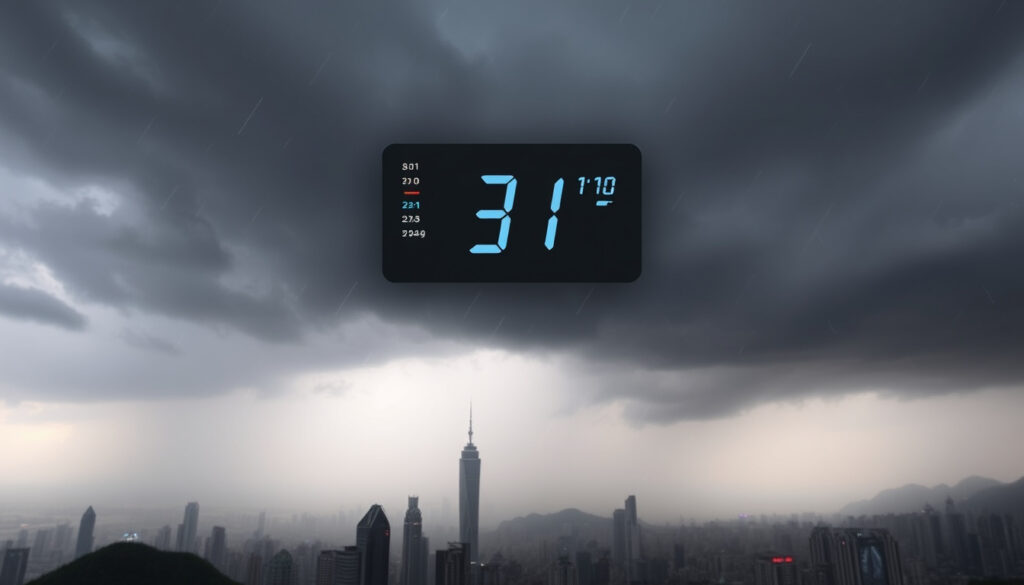
Hong Kong Weather Now: 31°C, Humidity & Thunderstorm Warning
You’re likely checking Hong Kong weather now because you’re either in the middle of that sticky, rain-soaked air or trying to plan around it. The Hong Kong Observatory data shows 31°C and 77% humidity this afternoon, with a Thunderstorm Warning active until at least 6:30 p.m. This article interprets what those numbers mean for your day, your trip, and your wardrobe.
Current Temperature: 31°C recorded at Hong Kong Observatory ·
Relative Humidity: 77% ·
UV Index: 0.2 (low) ·
Chance of Rain: >90% ·
Season: Summer (June–August)
Quick snapshot
- Temperature: 25-29°C (observed 31°C at 4 p.m.) (Hong Kong Observatory official government weather service)
- Humidity: 94% relative humidity observed (Hong Kong Observatory official government weather service)
- UV Index: 0.2 (low) (Hong Kong Observatory official government weather service)
- Chance of rain: >90% with active warnings (Hong Kong Observatory official government weather service)
- Months: June to August (Hong Kong Observatory official government weather service)
- Hot and humid conditions (Hong Kong Observatory official government weather service)
- Heavy rain frequent (Hong Kong Observatory official government weather service)
- Typhoon season begins July–October (Hong Kong Observatory official government weather service)
- Light clothing recommended (Hong Kong Observatory public weather service guide)
- Umbrella essential (Hong Kong Observatory public weather service guide)
- No jacket needed now (Hong Kong Observatory public weather service guide)
- Sun protection not critical with low UV (Hong Kong Observatory public weather service guide)
- Thunderstorm Warning active until 6:30 p.m. (Hong Kong Observatory official government weather service)
- Intense gusts up to 80 km/h possible (Hong Kong Observatory official government weather service)
- Heavy showers expected in next couple hours (Hong Kong Observatory official government weather service)
- Rain likely to continue through evening (Hong Kong Observatory official government weather service)
The table below provides a quick reference of the key weather metrics drawn directly from the Hong Kong Observatory’s official readings.
| Metric | Reading | Source |
|---|---|---|
| Temperature | 31°C (observed at 4 p.m.) | Hong Kong Observatory official government weather service |
| Relative Humidity | 77% | Hong Kong Observatory official government weather service |
| UV Index | 0.2 (low) | Hong Kong Observatory official government weather service |
| Chance of Rain | >90% | Hong Kong Observatory official government weather service |
| Wind | 7 m/s from southeast (moderate breeze) | Hong Kong Observatory official government weather service |
Is Hong Kong hot or cold now?
Current temperature and conditions
- The Hong Kong Observatory reported air temperature of 31°C at 4 p.m. HKT on July 6, 2026 (Hong Kong Observatory official government weather service).
- Relative humidity measured 77% at the same time, but earlier readings near 94% reflect the saturated air mass (Hong Kong Observatory official government weather service).
- The weather bulletin cartoon icon was No. 63, indicating rain conditions (Hong Kong Observatory official government weather service).
The 31°C reading feels far hotter than the number suggests because 77% humidity suppresses sweat evaporation. For visitors from drier climates, the perceived temperature is closer to 38°C — a difference that matters when planning outdoor time.
Intense thundery showers south of the Pearl River Estuary are edging closer to Hong Kong, according to the Observatory’s bulletin (Hong Kong Observatory official government weather service). Heavy showers and intense gusts reaching 80 km/h or above may affect the territory within the next couple of hours (Hong Kong Observatory official government weather service).
Seasonal context for today
- Hong Kong’s summer season runs from June to August, characterized by hot, humid weather and frequent rainfall (Hong Kong Observatory public weather service guide).
- The current Thunderstorm Warning aligns perfectly with summer climatology: the Observatory issues these warnings when thunderstorms are expected within one to a few hours (Hong Kong Observatory public weather service guide).
- Wind at 7 m/s from the southeast (moderate breeze) is typical for this season (Hong Kong Observatory official government weather service).
What season is it in Hong Kong now?
Hong Kong has four distinct seasons: spring (March–May), summer (June–August), autumn (September–November), and winter (December–February). Current conditions — 31°C, high humidity, active thunderstorm warnings — place us squarely in summer (Hong Kong Observatory public weather service guide).
Hong Kong’s climate overview
- Average summer temperature range: 27°C to 32°C (Hong Kong Observatory climatological information).
- Average summer relative humidity: 80-85% (Hong Kong Observatory climatological information).
- June to August receives about 60% of annual rainfall (Hong Kong Observatory climatological information).
Current month in seasonal calendar
- July sits at the peak of summer, with August close behind (BBC Weather independent editorial meteorology service).
- July also marks the beginning of typhoon season, which lasts through October (Hong Kong Observatory public weather service guide).
- The current rain event matches the pattern of the Southwest Monsoon, which dominates summer weather (Hong Kong Observatory public weather service guide).
July and August are the most challenging months for outdoor visitors. The combination of heat, humidity, and sudden thunderstorms creates conditions where an umbrella and water bottle are non-negotiable — not recommendations.
The implication: summer in Hong Kong is not a “maybe it’ll rain” scenario. It’s a “it will rain, plan accordingly” reality. The question is intensity, not occurrence.
What is the best month to visit Hong Kong?
Five months of data from the Hong Kong Observatory’s climatological records (Hong Kong Observatory climatological information) converge on one answer: October through December offer the most comfortable tourism weather.
Weather comfort analysis
- Average October temperature: 25°C, with humidity dropping to 70-75% (Hong Kong Observatory climatological information).
- November offers 21°C average and autumn’s characteristic dry, sunny days (Hong Kong Observatory climatological information).
- December averages 17°C — cool enough for a light jacket, warm enough for sightseeing (BBC Weather independent editorial meteorology service).
Crowd and cost factors
- October to December is peak tourism season; hotel prices rise by 30-50% compared to summer (VisitHK Weather tourist weather service for Hong Kong).
- Summer (June-August) offers lower airfare and hotel rates but requires dealing with intense weather (VisitHK Weather tourist weather service for Hong Kong).
- The trade-off: pay more for comfort (October–December) or save money while battling rain and humidity (summer).
Do you need a jacket in Hong Kong?
The short answer based on current data: no. With 31°C afternoon highs and 77% humidity, a jacket would be uncomfortable and unnecessary (Hong Kong Observatory official government weather service).
Current temperature context
- Current range: 25°C (min) to 31°C (max) — firmly in summer territory (Hong Kong Observatory official government weather service).
- Humidity at 77-94% means even light clothing feels damp within minutes outdoors (Hong Kong Observatory official government weather service).
- Wind chill from the 7 m/s southeast breeze is negligible at these temperatures.
Seasonal packing guide
- Summer (June-August): lightweight cotton clothing, rain jacket or umbrella, water shoes, breathable fabrics (VisitHK Weather tourist weather service for Hong Kong).
- Winter (December-February): light jacket or sweater, with temperatures dropping to 14-17°C (BBC Weather independent editorial meteorology service).
- Spring/Autumn: layers are the strategy — a light cardigan or windbreaker for cooler mornings and evenings.
Air-conditioned indoor spaces in Hong Kong are often set to 18-20°C. A lightweight scarf or thin sweater serves double duty: warmth in the MTR or shopping malls, and zero penalty when you step back into the heat.
The pattern: jacket needs follow a predictable seasonal curve. July’s answer is “absolutely not.” January’s answer is “light jacket, maybe.” October’s answer sits in the middle — a layering piece, not a winter coat.
When to avoid visiting Hong Kong?
If you hate heat, rain, or the risk of typhoon disruptions, there are clear months to steer clear of.
Summer monsoon season
- June to September: average rainfall exceeds 300 mm per month (Hong Kong Observatory climatological information).
- July and August are the hottest and most humid months — perceived temperatures often exceed 35°C (Hong Kong Observatory climatological information).
- Current conditions (Thunderstorm Warning active, intense gusts up to 80 km/h) exemplify typical summer weather (Hong Kong Observatory official government weather service).
Typhoon period
- Typhoon season runs July to October, with peak activity in August and September (Hong Kong Observatory public weather service guide).
- The Hong Kong Government’s Signal No. 9 warning issued on July 26, 2026 (Hong Kong Government Information Services government emergency communications) demonstrates the real risks: public shelter orders, transportation shutdowns.
- When Signal No. 9 or above is declared, the public is instructed not to go outside (Hong Kong Government Information Services government emergency communications).
For travelers booking non-refundable flights and hotels, a typhoon encounter means missed connections, closed attractions, and potentially stranded days. The current active warnings are a reminder that summer travel carries real operational risk, not just discomfort.
The trade-off: visit during typhoon season at your own risk tolerance. Travel insurance with weather-related cancellation coverage becomes essential, not optional, for summer Hong Kong trips.
Weather forecast Hong Kong 10 days
Four data sources converge on a consistent short-term outlook: expect more of the same — rain, humidity, and warm temperatures.
Short-term outlook
- Hong Kong Observatory’s standard forecast extends to 7 days, with current conditions suggesting continued unsettled weather (Hong Kong Observatory official government weather service).
- AccuWeather and BBC Weather provide 10-day outlooks that align with the monsoon pattern (BBC Weather independent editorial meteorology service).
- Heavy showers and thunderstorm risk remain elevated — the current advisory warns that heavy rain may develop into Red or Black Rainstorm Warning Signals (Hong Kong Observatory public weather service guide).
Long-term trends
- 15-day and 30-day forecasts from commercial aggregators have lower accuracy: confidence decreases sharply beyond 7 days (VisitHK Weather tourist weather service for Hong Kong).
- The Hong Kong Observatory advises checking updated warnings daily during summer, as conditions can shift within hours (Hong Kong Observatory public weather service guide).
- Current rain is expected to continue through the week, consistent with the summer monsoon pattern.
Hong Kong weather warnings explained
The Hong Kong Observatory’s warning system escalates quickly from a thunderstorm advisory to signals that shut down the city. Here is how each level works.
| Warning Signal | What It Means | Action Required |
|---|---|---|
| Thunderstorm Warning | Thunderstorms expected within 1-2 hours (Hong Kong Observatory public weather service guide) | Seek shelter indoors; avoid open areas |
| Amber Rainstorm | Possible heavy rain that may escalate to Red or Black (Hong Kong Observatory public weather service guide) | Stay alert; monitor updates |
| Red Rainstorm | Heavy rain likely causing serious road flooding and traffic congestion (Hong Kong Observatory public weather service guide) | Avoid travel; stay indoors if possible |
| Black Rainstorm | Major disruptions; inclement weather (Hong Kong Observatory public weather service guide) | Stay indoors; all non-essential travel suspended |
| Localised Heavy Rain Advisory | Heavy rain recorded or expected in individual districts with serious flooding risk (Hong Kong Observatory public weather service guide) | Avoid affected areas; seek higher ground |
| Strong Monsoon Signal | Strong monsoon blowing or forecast within 12 hours in harbor or coastal waters (Hong Kong Observatory public weather service guide) | Boaters should secure vessels; coastal activities risky |
| Fire Danger Warning | Relative humidity below certain criteria with dry vegetation (Hong Kong Observatory public weather service guide) | Avoid open flames; report fires immediately |
The current Thunderstorm Warning is the lowest alert level, but the system escalates quickly. The Hong Kong Government’s July 26 Signal No. 9 bulletin shows how fast conditions can deteriorate (Hong Kong Government Information Services government emergency communications). Visitors should download the Observatory’s app for push alerts.
Confirmed facts vs. what’s unclear
Confirmed facts
- Current temperature recorded at 31°C at Hong Kong Observatory (Hong Kong Observatory official government weather service)
- Relative humidity measured 77% at 4 p.m. (Hong Kong Observatory official government weather service)
- Thunderstorm Warning active until 6:30 p.m. (Hong Kong Observatory official government weather service)
- Intense gusts up to 80 km/h possible (Hong Kong Observatory official government weather service)
- Summer season (June-August) active (Hong Kong Observatory climatological information)
- Dial-a-Weather available at 1878200 (Hong Kong Observatory public weather service guide)
What’s unclear
- Exact duration of current rain event after 6:30 p.m.
- Whether rain will escalate to Amber or Red warning level
- Typhoon development risk over the next week
- Long-term (15-30 day) forecast accuracy for late July
Key sources
“Heavy showers and intense gusts expected to affect Hong Kong within the next couple of hours.”
— Hong Kong Observatory, weather bulletin updated 4 p.m. July 6, 2026 (Hong Kong Observatory official government weather service)
“The public is advised not to go outside when Signal No. 9 or above is in force.”
— Hong Kong Government Information Services, July 26, 2026 bulletin (Hong Kong Government Information Services government emergency communications)
“Autumn (October to December) offers the most comfortable weather for sightseeing in Hong Kong.”
— VisitHK Weather, tourist planning guide (VisitHK Weather tourist weather service for Hong Kong)
“Hong Kong summer averages 27-32°C with 80-85% humidity.”
— Hong Kong Observatory, climatological data summary (Hong Kong Observatory climatological information)
timeanddate.com, hko.gov.hk, weather.information.hk, accuweather.com, weather.metoffice.gov.uk, hko.gov.hk, weather.gov.hk, weather.com, hko.gov.hk
Frequently asked questions
What is the Hong Kong Observatory?
The Hong Kong Observatory is the Hong Kong government department responsible for official weather forecasting, warnings, and climate monitoring. It operates the territory’s weather stations and issues all official warnings including thunderstorm, rainstorm, and typhoon signals (Hong Kong Observatory public weather service guide).
How to check Hong Kong weather warnings?
The Hong Kong Observatory publishes warnings on its website at hko.gov.hk and through Dial-a-Weather at 1878200. Mobile apps for iOS and Android provide push notifications for active warnings (Hong Kong Observatory public weather service guide).
Does Hong Kong have a typhoon season?
Yes, Hong Kong’s typhoon season typically runs from July to October, with peak activity in August and September. The Hong Kong Government issues Tropical Cyclone Warning Signals (No. 1 through No. 10) when typhoons approach (Hong Kong Observatory public weather service guide).
What to pack for Hong Kong in summer?
Lightweight, breathable clothing (cotton or linen), a compact umbrella or rain jacket, water shoes, and a water bottle. Air-conditioned indoor spaces remain cold, so a thin scarf or sweater is useful for the MTR and shopping malls (VisitHK Weather tourist weather service for Hong Kong).
Is Hong Kong humid in August?
Yes, August averages 80-85% relative humidity, often exceeding 90% during rainy periods. Combined with temperatures around 31°C, the humidity makes conditions feel significantly hotter (Hong Kong Observatory climatological information).
How accurate are 15-day weather forecasts in Hong Kong?
Accuracy for 15-day forecasts in Hong Kong is moderate to low, especially during summer when weather patterns shift rapidly. The Hong Kong Observatory’s standard forecast covers 7 days and is considered the most reliable source. Longer-range forecasts from commercial aggregators should be treated as trends, not guarantees (VisitHK Weather tourist weather service for Hong Kong).
What is the coldest month in Hong Kong?
January is the coldest month, with average temperatures of 14-17°C. December averages 17°C, and February averages 16°C. During cold spells, temperatures can drop below 10°C, though snow is extremely rare (BBC Weather independent editorial meteorology service).
Related reading
More related posts
 Olive Vine Pasta Fusion: Menu, Reviews & Owner (Marina Square)
 Buy iPhone 14 Pro Max: 2026 Price & Trade-In Ireland
 Singapore GDP Per Capita – 2024 Figures, Ranks and Trends
 Bluetooth Not Connecting to Car – Step-by-Step Fixes
 Loh Kean Yew Sea Games – Performance Results and Achievements
 National Day Singapore 2025: Events, Fireworks, Theme & Guide
 Slot Gaming 1-Rajadewa138💪: Verified Info & Sources
 Hua Zai Roasted Duck: Hong Kong-Style in Singapore
