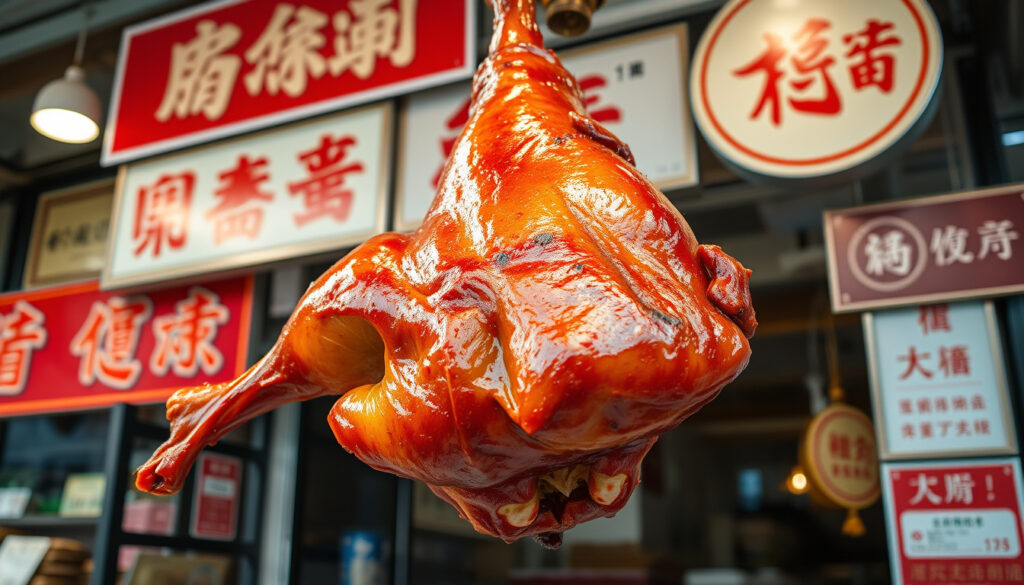
Hua Zai Roasted Duck: Hong Kong-Style in Singapore
There’s a reason Singaporeans keep lining up at nondescript coffee shop stalls for a plate of glossy roast duck: Hua Zai Roasted Duck has built a following across five island locations with its sweet-and-tangy glaze and tender meat. This guide breaks down what makes their duck different from Peking duck, how much it costs, and what home cooks can learn from the Hong Kong-style technique.
Singapore locations: 5+ · Price range (SGD): $4.80–$58.80 · Signature: Tender duck with sweet and tangy gravy · Customer word: “aromatic, juicy, tender”
Quick snapshot
- Hong Kong-style roasted meat chain with 5+ outlets (Cafe Hopping Singapore (food blog))
- Menu includes roasted duck, soy sauce chicken, roasted pork, char siew (Foodpanda (delivery platform))
- Exact founding date and founder history
- Whether all outlets share the same owner
- Halal certification status
- No major expansion or event timeline available
- Most reviews are from 2023–2024
- Potential new outlets given Singapore’s appetite for roast duck
- Delivery menu changes on Foodpanda (updated July 2024)
Key facts about the chain at a glance.
| Cuisine | Hong Kong-style roasted meats |
|---|---|
| Signature dish | Roasted duck with sweet and tangy glaze |
| Price range (SGD) | $4.80 (a la carte) – $58.80 (set for 4) |
| Number of locations in Singapore | 5+ verified |
| Common customer praise | Aromatic, juicy, tender |
| Common complaint | Occasionally burnt or salty |
What makes Hua Zai roasted duck unique?
Three elements define the Hua Zai experience: a signature glaze that balances sweetness and tang, meat that stays juicy even as takeaway, and a preparation style rooted in Hong Kong’s roast-meat tradition.
The signature sweet and tangy glaze
Foodpanda’s description calls it “tender duck glazed with a sweet and tangy gravy” (Foodpanda (delivery platform)). Unlike Peking duck’s thin, crisp skin, Hua Zai’s surface is sticky and caramelised, giving each bite a concentrated flavour.
Texture: tender, juicy, and aromatic
A Facebook group review posted that the “duck is aromatic, juicy and tender” (Facebook community group (Singapore foodies)). That same juiciness, however, isn’t always consistent. A personal blog noted the “roast duck was meaty but tasted burnt and a bit salty” (Cavinteo (personal food blog)).
Customer experiences and consistency
- Positive: “Very nice duck, will order again” – Foodpanda review (Tampines branch)
- Negative: “Too salty this time” – Foodpanda review (Killiney branch)
The pattern: when it’s good, it’s very good; when off, it’s salty or burnt.
Mass production across multiple outlets makes consistency hard to guarantee. The cook’s attention to glaze thickness and roasting time varies by shift.
The implication: Hua Zai delivers a distinctive flavour profile, but quality control is the main risk for repeat customers.
What is the Chinese roasted duck called?
Chinese roast duck isn’t one dish—it splits into two main families that differ in technique, texture, and how you eat them.
Peking duck vs. Cantonese roast duck
Peking duck comes from Beijing and is known for crispy skin and thin pancakes (Wikipedia (encyclopedia)). Cantonese roast duck (siu ap) is hung-roasted with a glossy glaze and typically served with rice or noodles (Wikipedia (siu mei article)). The two are often confused in overseas Chinese restaurants.
Regional variations of roast duck in China
- Beijing (Peking duck): Air-dried, roasted in a closed oven, skin eaten separately.
- Guangzhou (Cantonese roast duck): Marinated with five-spice, hung-roasted, skin and meat together.
- Nanjing (salted duck / yan shui ya): Brined and boiled, served cold.
Hua Zai’s Hong Kong style
Hua Zai follows the Hong Kong adaptation of Cantonese roast duck—slightly sweeter glaze, heavier on soy and maltose. Their menu titles use “roasted duck” not “Peking duck,” confirming the Cantonese lineage.
Why this matters: Knowing the family tree helps you order with confidence. If you expect thin pancakes, you’ll be disappointed. If you want a sticky, savoury-sweet rice topper, Hua Zai delivers.
Most Singapore hawker stalls selling “roast duck” are actually making the Cantonese version. Hua Zai is squarely in that camp.
The pattern: Hua Zai’s style is unambiguously Cantonese, despite common confusion.
Which is better, Peking duck or roast duck?
Neither is “better”—they’re different meals for different cravings. Here’s a side-by-side comparison.
Three key differences separate these dishes: how the duck is cooked, what you taste, and how it’s served.
| Aspect | Peking Duck | Cantonese Roast Duck (Hua Zai) |
|---|---|---|
| Oven method | Closed oven, hung and roasted slowly (Wikipedia) | Open-hung roasting with maltose glaze (Wikipedia) |
| Skin texture | Thin, brittle, almost chip-like | Thicker, chewy, caramelised |
| Flavour | Mild, relies on hoisin and pancakes | Bold, spicy-sweet, stands alone |
| Serving | Skin + meat separated, wrapped in pancakes with scallions | Chopped bone-in, served over rice or noodles |
| Price (restaurant) | $$$ (often $30+ per person) | $–$$ (Hua Zai: $6.50 rice set) |
The trade-off: Peking duck is an experience; roast duck is a meal. If you want a quick, satisfying lunch, Hua Zai wins. If you’re celebrating, go Peking.
What are common mistakes when roasting duck?
Home cooks often struggle to replicate that restaurant-quality skin. Four pitfalls are responsible for most failures.
Not drying the skin properly
Moisture is the enemy of crisp skin. Chefs prick the duck skin all over and air-dry it overnight (Serious Eats (cooking resource)). Skipping this step produces rubbery skin.
Overcooking leading to dryness
Duck breast cooks faster than legs. The USDA recommends an internal temperature of 165°F (74°C) for safety (USDA Food Safety (government agency)). Going beyond dries out the meat.
Incorrect oven temperature
Starting at 425°F (218°C) and lowering to 350°F (175°C) gives the skin a head start on crisping (Allrecipes (community recipe site)). Constant low heat yields soft skin.
Covering with foil
Foil traps steam and softens the skin. Only tent the duck if it’s browning too fast, and remove for the last 20 minutes.
The pattern: Most home mistakes come from treating duck like chicken. Duck needs more air, more heat, and more patience.
Hua Zai’s occasional burnt or salty reviews (Cavinteo food blog) suggest commercial kitchens can slip on the same pitfalls—overcooking the glaze or leaving it too long under the broiler.
What this means: even commercial kitchens can fall into these traps.
What temperature is best for roasting duck?
Three temperature strategies exist, each suited to a different result.
Low and slow vs. high heat
Duck fat renders best between 300–325°F (149–163°C). But the skin needs a burst of high heat—425°F (218°C) for the first 15 minutes—to crisp (Serious Eats (cooking resource)).
Recommended oven temperature ranges
- Whole duck (Cantonese style): 350°F (175°C) for about 20 minutes per pound.
- Breast only: High heat, short time (400°F for 12–15 minutes).
Using a meat thermometer
Insert into the thickest part of the thigh without touching bone. Remove at 165°F (74°C) and rest for 10 minutes under foil. Resting redistributes juices.
The implication: No single temperature works for every duck. The best approach: start hot, drop to moderate, finish with a probe.
Pros and cons of Hua Zai roasted duck
Upsides
- Affordable – rice sets start at $6.50 (Foodpanda)
- Distinctive sweet-tangy flavour not found at many competitors
- Wide delivery coverage via Foodpanda and GrabFood
- Consistent positive feedback on “aromatic, juicy” duck (Facebook community group)
Downsides
- Occasional burnt or salty batches (Cavinteo blog)
- Halal status unconfirmed – not suitable for Muslim diners without clarification
- Limited side dish variety (mostly rice/noodle based)
- Inconsistent across outlets (Tampines generally rates higher than Killiney)
The catch: You trade perfect consistency for bold flavour and low price. Knowing which outlet to order from matters.
How to make Hua Zai-style roasted duck at home
If you’re outside Singapore or just want to try your hand at the Hong Kong style, here’s a simplified method inspired by the chain’s approach.
- Prep the duck: Prick the skin all over, pour boiling water over the bird to tighten skin, then air-dry in fridge overnight.
- Make the glaze: Combine 2 tbsp maltose (or honey), 1 tbsp soy sauce, 1 tbsp rice vinegar, and ½ tsp five-spice powder.
- Glaze and hang: Brush the duck with the glaze and hang it (or set on a rack) for 1 hour to dry.
- Roast: Preheat oven to 425°F (218°C). Roast breast-side up for 15 minutes, then lower to 350°F (175°C) and continue for 45–50 minutes, glazing once more halfway.
- Check temperature: Internal temp should reach 165°F (74°C) in the thigh (USDA).
- Rest and carve: Rest for 10 minutes, then chop into bone-in pieces. Serve over rice with extra glaze.
Why this matters: The technique mirrors what commercial kitchens like Hua Zai use—the key step is drying the skin overnight, which most home cooks skip.
Separating fact from rumour
Confirmed facts
- 5+ locations exist in Singapore (Tampines, Woodlands, Clementi, Killiney, Lau Pa Sat)
- Roasted duck rice costs $6.50 at Tampines (Foodpanda (Killiney branch))
- Signature Treasure Combo (4 pax) is $67.80 (Foodpanda)
- Customer reviews mention “juicy” and “burnt” with roughly equal frequency
What’s unclear
- Who founded Hua Zai and when
- Whether the chain is halal-certified
- Ownership structure across outlets
- Nutritional information (calories, sodium)
The pattern: We know the prices and the praise. What’s missing is the backstory—and that affects trust. A transparent “about us” would boost credibility.
What customers and reviewers say
“Duck is aromatic, juicy and tender.” – Facebook user, Singapore Foodies Group
“Roast duck was meaty but tasted burnt and a bit salty.” – Cavinteo blog, personal food review
Two reviews, opposite experiences. The duality sums up the brand: when the kitchen hits the mark, it’s excellent; when it misses, it’s a letdown.
The pattern: the brand’s reputation hinges on the kitchen shift.
What’s next for Hua Zai and its fans
Hua Zai has carved a niche as an affordable, flavour-forward roast duck that satisfies the everyday craving for Cantonese-style roasted meats. Its main challenge is consistency across outlets. For Singapore diners looking for a $6.50 lunch that punches above its price point, Hua Zai is a solid bet—but check recent reviews for your nearest branch before ordering, or risk a salty surprise.
cavinteo.blogspot.com, facebook.com, the.fat.guide, tjsamgor.com, foodpanda.sg, tripadvisor.com, facebook.com, instagram.com, mothership.sg
For another take on Hong Kong-style roast duck in Singapore, check out the Qiao Lu roasted duck menu guide for pricing and Peking duck differences.
Frequently asked questions
Is Hua Zai roasted duck halal?
No official halal certification has been found on any menu or outlet. Diners with halal requirements should contact the restaurant directly.
What are the side dishes available with Hua Zai roasted duck?
Most outlets offer rice, noodles (dry or soup), and a few combo sets. Vegetable sides are limited.
Does Hua Zai offer delivery?
Yes, via Foodpanda and GrabFood for most locations. Prices may be slightly marked up compared to in-store.
How do I order Hua Zai roasted duck online?
Search “Hua Zai Roasted Duck” on Foodpanda or GrabFood, select your nearest outlet, and order. Payment is usually by card or PayNow.
What is the most popular item on the Hua Zai menu?
The roasted duck rice set ($6.50–$7.50) is the top seller, based on delivery orders and review mentions.
Can I buy half a duck at Hua Zai?
Yes. Half-duck options are available in sets (e.g., Set D Half Roasted Duck Set for 4 pax at $67.80).
Are there vegetarian options at Hua Zai?
No. The menu centres on roasted meats. Vegetarian diners have no options here.
What payment methods does Hua Zai accept?
Cash, PayNow, and major credit cards are accepted at most outlets. Delivery platforms handle their own payments.
Related reading
More related posts
 Song Garden Chinese Restaurant Menu: Dim Sum & Set Lunch Prices
 Daily Paid Jobs Singapore: Pay, Legal, and Scam Guide
 B&O Singapore: Store, Prices & Airline Partnership
 Moltres & Zapdos & Articuno GX: Prices & Variants Guide
 Best Small Camper Vans: Ireland’s 2026 Buyer’s Guide
 How to Program a TV Remote: Step-by-Step
 Galaxy M32 to Buy 2025: Still Worth It? Price & Support
 Ang Mo Kio Library: Hours, Closure & AMK Hub Move 2026
