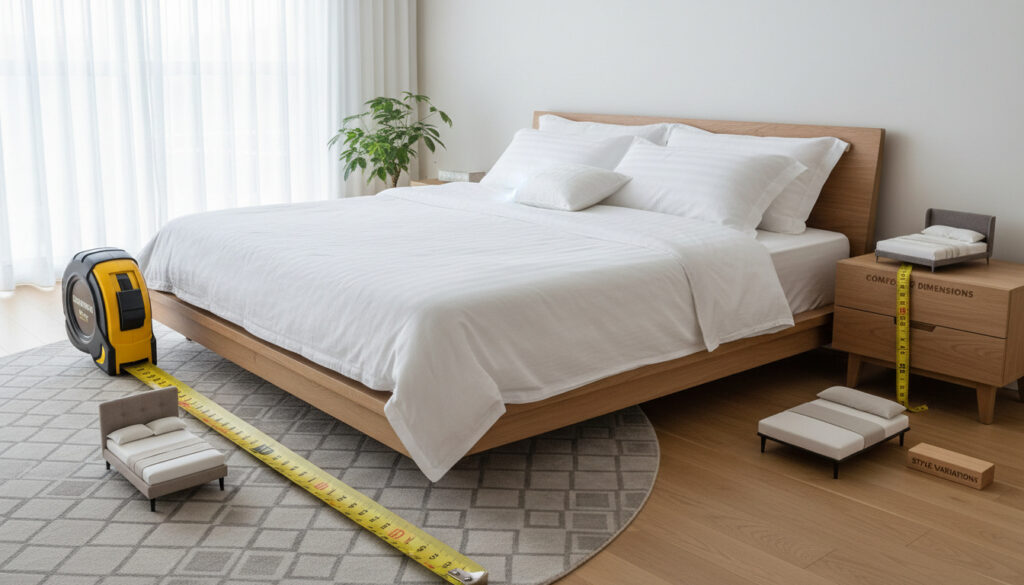
Beds for Queen Size – Dimensions, Types and Buying Guide
Queen size beds dominate the American bedroom market, offering a balance of spacious comfort and practical room fit. The standard mattress measures 60 inches wide by 80 inches long, providing 33.3 square feet of sleep surface—sufficient for couples or individuals who prefer extra space.
Selecting the appropriate frame requires understanding dimensional tolerances, structural requirements, and material variations. While the mattress follows strict industry standards, frame dimensions vary by design, with upholstered and wooden models often extending beyond the sleeping surface to accommodate headboards and side rails.
This guide examines standardized measurements, frame typologies, weight tolerances, and budget considerations based on manufacturer specifications and bedding industry standards.
What Are the Standard Queen Size Bed Dimensions?
60″ x 80″ (152 x 203 cm)
Platform, Upholstered, Metal, Wood
$100–$2,000+
Matches mattress plus 2–5″ per side
- The mattress standard remains fixed at 60 inches by 80 inches across all major US manufacturers, providing 33.3 square feet of surface area.
- Frame dimensions typically expand to 62–65 inches wide and 82–85 inches long to accommodate structural rails and bedding overhang.
- Minimum room size recommendations start at 10 feet by 10 feet, though 10 by 14 feet provides optimal clearance for nightstands and circulation.
- Specialty variants include the Olympic Queen (66 x 80 inches) and California Queen (60 x 84 inches), though these require specific sheet sizing available from limited retailers like FloBeds.
- Support slats must maintain spacing of three inches or less to prevent mattress sagging, particularly critical for foam mattresses.
- Total weight capacity should accommodate 500 to 800 pounds, including mattress and occupants.
- Platform designs eliminate the need for box springs, reducing overall bed height by 8 to 12 inches compared to traditional setups.
| Specification | Standard Measurement |
|---|---|
| US Mattress Dimensions | 60 in x 80 in (152 x 203 cm) |
| Frame Width Range | 62–65 in (157–165 cm) |
| Frame Length Range | 82–85 in (208–216 cm) |
| Minimum Room Size | 10 ft x 10 ft |
| Weight Capacity (Average) | 500–1,000 lbs |
| Slat Spacing Maximum | 3 inches |
| Box Spring Required | No (for platform frames) |
| Mattress Weight | 120–160 lbs |
Detailed specifications vary by region. While the United States and Australia share the 60 x 80 inch standard, European markets approximate 63 x 79 inches (160 x 200 cm), and the UK “King” measures 60 x 78 inches—slightly shorter than the American queen. For exact US standards, consult Queen Bed Dimensions.
What Types of Queen Size Bed Frames Are Available?
Platform Foundations vs. Box Spring Systems
Platform frames utilize solid or slatted bases that support the mattress directly, promoting airflow and eliminating the need for box springs. These designs accommodate memory foam and hybrid mattresses particularly well, offering firmer support and longer-lasting structural integrity.
Box springs add 8 to 12 inches of height and provide bounce, but they compress over time and are unnecessary with most modern platform designs. Bassett Furniture notes that platform frames offer superior longevity when slats are properly spaced.
Material Comparisons: Metal, Wood, and Upholstered
Metal frames offer industrial aesthetics and lightweight assembly, often priced under $200. They assemble quickly but may produce noise if bolts loosen. Wood constructions provide thermal mass and acoustic dampening but require more labor to assemble and transport. Solid hardwood exceeds 600 pounds in weight capacity, while engineered wood offers budget alternatives at 500 pounds.
Upholstered frames wrap platform bases in fabric for a softened, hotel-style silhouette. These models suit master bedrooms with low traffic but stain easily and require regular vacuuming. Fabric selection determines longevity, with synthetic blends outperforming natural fibers in high-humidity environments.
Frames must include a center support leg spanning the 60-inch width to prevent mid-span sagging. Slat spacing should not exceed three inches, particularly for foam mattresses that require continuous support surfaces.
What Are the Best Queen Size Beds and How Much Do They Cost?
Price Ranges and Value Tiers
Entry-level metal platforms range from $100 to $200, accommodating weights between 500 and 700 pounds. Mid-tier wood slat constructions cost $150 to $400, while upholstered and solid hardwood models exceed $600, reaching $2,000 for designer brands. Split adjustable bases for couples typically start at $1,200, providing independent articulation for each 30-inch sleeper zone.
Budget Options Under $200
Metal platform frames dominate the sub-$200 segment, with brands like Zinus and Amazon Basics offering tool-free assembly in 20 to 30 minutes. These units typically support 600 pounds total weight and include center support bars. Wood slat alternatives in this price range support approximately 600 pounds but require occasional tightening of hardware.
Market variability prevents fixed 2025 pricing standards. Metal frames remain the most price-stable category, while upholstered and sustainable wood options fluctuate based on textile and lumber markets.
What Is the Weight Limit and Assembly for Queen Beds?
Load Capacity Specifications
Standard queen frames support 500 to 800 pounds combined load, including the 120 to 160-pound mattress. DreamCloud emphasizes verifying center leg inclusion, as span distances over 60 inches require mid-point reinforcement to prevent structural failure. Heavy-duty models accommodate up to 1,000 pounds, suitable for family bed-sharing or heavier sleepers.
Assembly Requirements and Timeframes
Metal platforms typically require 15 to 45 minutes with pictorial instructions and no tools. Wood frames demand longer setup periods and occasional hex-key or screwdriver use. Weight distribution matters: placing the mattress before center leg installation can warp slats or cause collapse. If you’re looking for the best electric toothbrush, you can find a comprehensive guide with the $Bästa eltandborsten test.
Always install center support legs before placing the mattress. A queen mattress weighs 120–160 pounds and can stress incomplete frames, causing slat fracture or collapse.
Regional Standards and Measurement Certainties
Established Standards
- US Queen mattress: 60 x 80 inches (152 x 203 cm)
- Frame perimeter adds 2–5 inches per side
- Slat spacing ≤3 inches required
- Minimum 500 lbs support capacity
Variable Factors
- UK “King” measures 60 x 78 inches—shorter than US Queen
- European standards approximate 63 x 79 inches (160 x 200 cm)
- International naming conventions create retail confusion
- Exact pricing unavailable due to market volatility
According to international bedding standards, only the United States and Australia share identical queen dimensions, while European and UK markets use different nomenclature and measurements.
Room Fit and Lifestyle Considerations
Queen beds occupy 33 square feet of floor space, but frames and circulation paths demand rooms no smaller than 10 by 10 feet. Tampa Mattress recommends 10 by 14 feet for couples requiring nightstand access on both sides.
Style selection impacts longevity. Upholstered frames suit master bedrooms with low traffic but degrade quickly in rental or high-use scenarios. Metal platforms offer superior durability for guest rooms and temporary housing. Wood constructions provide the quietest sleep experience, eliminating the squeak potential of bolted metal joints.
Budget allocation should prioritize structural integrity over aesthetics. Frames under $200 perform adequately for weights under 600 pounds, but heavier couples or family bed-sharing situations require reinforced slat systems or solid platforms.
Industry Standards and Expert Testing
Frames must provide center support across 60-inch width to avoid sagging, with slats spaced no more than three inches apart for optimal mattress longevity.
Sleep Foundation Engineering Standards
Platform bases have emerged as the dominant recommendation for foam mattresses, replacing box springs in the majority of new queen bed purchases.
Consumer Reports Bedding Analysis
Final Selection Guidelines
Queen bed selection hinges on dimensional accuracy, support specifications, and material durability. Verify that frames accommodate the 60 by 80 inch mattress with adequate perimeter support and center leg reinforcement. For comprehensive measurement comparisons, consult the Mattress Sizes and Dimensions Chart to ensure compatibility with existing room layouts.
Common Questions
What are queen size bed dimensions?
US standard queen mattresses measure 60 inches wide by 80 inches long (152 x 203 cm), occupying 33.3 square feet.
What size bed frame for queen mattress?
Frames typically measure 62–65 inches wide and 82–85 inches long to accommodate the 60 x 80 inch mattress plus structural components.
Queen vs king bed size?
Queen measures 60 x 80 inches; King measures 76 x 80 inches. King provides 42.2 square feet versus queen’s 33.3 square feet.
Do queen beds need box springs?
Platform frames do not require box springs. Box springs add 8–12 inches of height but are unnecessary for most modern mattresses.
Queen size bed weight limit?
Standard frames support 500–800 pounds total, including the mattress. Heavy-duty models accommodate up to 1,000 pounds.
How to assemble queen bed frame?
Metal frames typically require 15–45 minutes with no tools. Wood frames require tools and longer assembly time. Always install center support legs first.
Affordable queen size beds under $200?
Metal platform frames from brands like Zinus and Amazon Basics cost $100–$180, support 500–700 pounds, and include tool-free assembly.
Metal vs wood queen bed frames?
Metal offers lightweight, affordable, industrial style but potential noise. Wood provides quiet, warm aesthetics but heavier weight and higher cost.
More related posts
 Yokohama F. Marinos Standings: Current J1 League Position & Facts
 USB-A to USB-C Adapter: Compatibility, Charging & Tips
 Adidas Chinese New Year Jacket: Viral Design & Buying Tips
 Singapore Telecom Share Price – Live Z74 Chart and Key Metrics
 Translation Chinese to English: 6 Free Tools & Tips
 Moltres & Zapdos & Articuno GX: Prices & Variants Guide
 Flight to Sabah from Singapore: Cheap Direct Flights & Times
 Jung Kyung-ho and Sooyoung Breakup: 14-Year Relationship Ends
