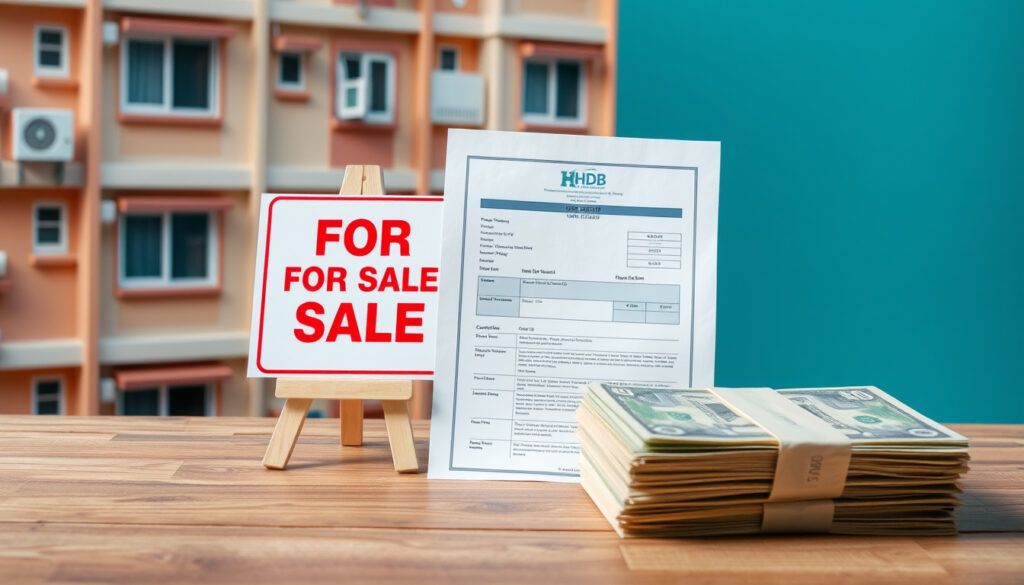
HDB Intent to Sell: Registration, CPF Refund & Cash Proceeds
Anyone who has tried to sell a flat in Singapore quickly meets a quiet rule: the resale process starts before the first viewing, not after you find a buyer. It starts with a free online declaration called the Intent to Sell, and it carries a seven-day waiting period before you can grant an Option to Purchase (Housing & Development Board (official OTP guidance)). What most sellers discover later is that the real financial story sits in the CPF refund and the timing of the cash payout.
Intent to Sell validity: 12 months ·
Official platform: HDB Resale Portal (hdb.gov.sg) ·
Cost to register: Free ·
Cash proceeds: typically within 4 weeks after completion ·
CPF refund: all used CPF + accrued interest
Quick snapshot
- Intent to Sell is a mandatory online declaration before you can grant an OTP (Housing & Development Board (official OTP guidance)).
- It is free to submit and valid for 12 months. (Housing & Development Board (official OTP guidance))
- Sale proceeds follow a fixed order: outstanding home loan first, CPF refund second, other costs third (Central Provident Fund Board (sale proceeds order)).
- Exact cash-proceeds timing depends on HDB processing speed and bank clearance. (CPF Board (CPF Housing Scheme terms))
- Your precise accrued-interest amount depends on your CPF usage history (CPF Board (CPF Housing Scheme terms)).
- HDB’s official note does not call the 7-day wait a “cooling-off” period; that framing comes from independent guides (SingaporeHDB.com (independent resale process guide)).
- At least 7 days must pass between registration and the OTP grant (Housing & Development Board (official OTP guidance)).
- Completion is generally within 8 weeks of HDB accepting the resale application (Housing & Development Board (official OTP guidance)).
- A full seller-side process runs roughly 12–16 weeks, according to independent guides (SingaporeHDB.com (independent resale process guide)).
- Market the flat and negotiate the price — an agent is optional. (Housing & Development Board (official OTP guidance))
- Grant the OTP while your Intent to Sell is still valid. (Housing & Development Board (official OTP guidance))
- Both parties submit resale documents after the buyer exercises the OTP (Housing & Development Board (official OTP guidance)).
Six numbers define the seller-side process, and one pattern stands out: the line items with the largest financial weight — the CPF refund and the proceeds window — are the ones most guides mention last.
| Fact | Value |
|---|---|
| Intent to Sell validity | 12 months |
| Portal access | HDB Resale Portal via Singpass |
| Cost to register | Free |
| Cash proceeds timeline | Up to 4 weeks after completion (typical) |
| CPF refund | All used CPF + accrued interest |
| Minimum occupation period | 5 years for most flats |
What is the HDB Intent to Sell and why is it required?
Legal requirement for selling on the open market
- The declaration is mandatory: HDB requires a seller to register a valid Intent to Sell through the HDB Flat Portal before granting an Option to Purchase, and warns that it may reject a resale application if the seller lacks a valid Intent to Sell or misses the registration timelines (Housing & Development Board (official OTP guidance)).
- It is the seller’s eligibility statement — it confirms that the flat can be offered on the open market, including that the required occupation period has been met.
- Registering it costs nothing and does not obligate you to sell; it only opens the legal door.
In plain terms, the Intent to Sell is the switch that turns on the transaction. Listing portals, viewings, and price discussions can happen informally, but no legally recognised resale moves forward until this declaration exists in HDB’s system.
The implication: the declaration is a compliance gate, not a membership form. A seller who treats it as an afterthought is a seller discovering HDB’s rule at the most expensive moment — after a buyer is already holding a signed document.
Validity period and expiry rules
- The Intent to Sell is valid for 12 months from the date of submission.
- There is no automatic extension — if it lapses, you submit a new declaration, and the new submission is also free.
- HDB’s expectation is that the declaration remains valid when the resale application is submitted, not only when the OTP is granted (Housing & Development Board (official OTP guidance)).
A 12-month envelope sounds generous, but the clock includes everything: marketing, negotiations, buyer financing, and HDB’s own processing. The declaration does not pause while you wait for a buyer or a bank.
How do I register an Intent to Sell on the HDB Resale Portal?
Required information and documents
- Log in to the HDB Resale Portal using your Singpass; the declaration is tied to your identity as the seller.
- Have the flat details, ownership particulars, and your contact information ready before you start.
- There is no fee at the point of submission, and no payment page appears anywhere in the flow.
The portal is designed around the seller’s Singpass, which means the declaration and the later resale documents sit with you — the owner — even if you bring in professional help for marketing or legal work.
The pattern: the free, low-friction front end of the portal hides the fact that everything after it is time-bound. Registration itself is the fastest step in the entire resale process.
Step-by-step portal navigation
- Step 1 — Log in to the HDB Resale Portal with your Singpass and open the selling flow.
- Step 2 — Enter the flat and owner details, verify the particulars, and submit the declaration.
- Step 3 — Save the confirmation; the 12-month validity clock starts from this submission, and the minimum seven-day pre-OTP countdown starts the same day (Housing & Development Board (official OTP guidance)).
A typical submission runs about 15 minutes from login to confirmation. The speed is the point: HDB has made the entry step deliberately easy because the hard requirements come later — the OTP rules, the resale application, and the money order.
The seven-day wait means a seller who finds a buyer at the first viewing cannot convert that momentum into an OTP in the same week. Registration is the start of a countdown, not the end of one.
What happens after I register Intent to Sell?
Marketing the flat (with or without an agent)
- You can market the flat immediately after registration.
- The seller-side steps are identical with or without a property agent: listing, viewings, price negotiation, and OTP terms.
- If you sell without an agent, you personally coordinate the negotiation and the paperwork rhythm; the legal costs still appear in the sale-proceeds order at completion (Central Provident Fund Board (sale proceeds order)).
Selling without an agent is where the portal’s design shows its hand: the account holder is the seller, not the agency. A DIY seller keeps full control of price and timing, but also carries the full burden of chasing documents and meeting deadlines on both sides of the OTP.
The trade-off: an agent buys you time and distance from negotiations; selling direct keeps the full margin but puts every deadline on your calendar.
Granting the Option to Purchase (OTP)
- Your Intent to Sell must be valid when you grant the OTP, and at least seven days must separate registration from the grant (Housing & Development Board (official OTP guidance)).
- The buyer’s HDB-prescribed OTP is valid for up to 21 calendar days, according to SingaporeHDB.com (independent resale process guide).
- Once the buyer exercises the OTP, both parties submit their resale applications within about seven days of each other, according to the same guide.
- The OTP form, not a private contract, is the document HDB recognises — one reason the declaration must be in order before the form is signed.
From the seller’s seat, the OTP is the moment the transaction becomes real: a buyer has paid for the option, the price is locked, and the compliance clock switches from the 12-month Intent-to-Sell window to the submission-and-approval sequence.
How long is the HDB Intent to Sell valid and can it be extended?
Validity period
- The declaration is valid for 12 months from submission, and there is no automatic extension.
- It must cover two checkpoints: the OTP grant and the resale application submission (Housing & Development Board (official OTP guidance)).
- The buyer’s OTP runs on its own parallel clock of up to 21 calendar days, according to SingaporeHDB.com (independent resale process guide), so two deadlines move at once.
Most sellers remember the first checkpoint, because the OTP is the dramatic moment. The second checkpoint — the resale application — is the one that actually determines whether the sale completes, and it is the one more likely to slip if the seller re-lists, renegotiates, or waits for a buyer’s financing.
Re-registration if expired
- If the declaration lapses, a new submission is required; it costs nothing and starts a fresh 12-month window.
- The minimum seven-day pre-OTP requirement applies to the new registration as well, because HDB’s rule is tied to the declaration date (Housing & Development Board (official OTP guidance)).
- If the validity lapses mid-transaction, HDB still expects a valid declaration at the resale application — so the paperwork must be fixed before the application goes in.
The risky window is the one most guides skip: an Intent to Sell that expires while the buyer’s bank is slow. The buyer’s OTP may still be alive, but the seller’s side of the compliance chain is not, and a fresh registration adds time to a deal that already feels done.
The trade-off: re-registration is free, but the calendar cost is real. In a hot market, a lapsed declaration can be the difference between honouring a buyer’s timeline and renegotiating a price.
When will I get my cash proceeds and how much must I return to CPF?
Cash proceeds disbursement timeline
- Cash proceeds are typically disbursed within about four weeks after legal completion.
- The order of payment is fixed: the outstanding housing loan is settled first, then the required CPF refund, then other sale expenses such as legal fees (Central Provident Fund Board (sale proceeds order)).
- Whatever remains is paid to you as cash — which is why “resale price” and “cash proceeds” can be very different numbers.
Completion is the day ownership transfers and keys change hands, but the money does not land the same day. The conveyancing process layers bank clearance and HDB’s own processing on top of the legal completion, which is why the four-week window is an expectation, not a same-day event.
The pattern: the seller is the last person in the payment chain. The bank, the CPF Board, and the lawyers all take their defined share before the seller sees a cent.
CPF refund calculation
- You must refund the full CPF principal you used on the flat plus accrued interest (CPF Board (CPF Housing Scheme terms)).
- Housing grants applied to the property may also be part of the refund obligation (CPF Board (home upgrade guide)).
- The accrued-interest component is calculated from your own CPF usage history; CPF currently benchmarks the rate at 2.5% a year on the amount used.
The refund is not a fine — it is CPF restoring the money, with interest, into your retirement accounts as if the flat purchase had never drained them. The practical effect is that a flat bought with heavy CPF usage produces a smaller cash cheque at completion, because the CPF top-up is legally senior to the cash payout.
The CPF refund is deducted before cash reaches you. A seller who sees a strong resale price can still walk away with a modest cheque after the home loan, CPF top-up, and legal costs are cleared — the order of payment, not the advertised price, sets the final number.
The implication: run a CPF refund estimate while the flat is still being marketed, not after the OTP. The refund can reshape an upgrade budget, and the number is knowable before you commit to your next purchase.
Selling your HDB flat: weighing the upsides and downsides
Upsides
- Registration is free, fast, and valid for 12 months — you can sell at your own pace.
- The declaration confirms eligibility up front, before you spend time and money on marketing.
- Selling without an agent is a realistic option: the portal workflow is the same, and the seller keeps the fee that would have gone to an agency.
- The fixed payment order protects your retirement funds: the CPF refund and accrued interest go back into your accounts before any cash is paid out (Central Provident Fund Board (sale proceeds order)).
Downsides
- You cannot grant an OTP in the first seven days, even with a ready buyer at full price (Housing & Development Board (official OTP guidance)).
- The 12-month validity is fixed; a stalled sale means a fresh registration and a new countdown.
- HDB may reject a resale application if the declaration is invalid or a registration timeline is missed (Housing & Development Board (official OTP guidance)).
- Cash arrives last — after the loan, CPF refund, and legal costs — typically within four weeks of completion.
The trade-off: the same rules that protect you — mandatory declaration, refund order — are the rules that slow your cash flow. Budget for both and the process is predictable; ignore either and the sale stalls at the most expensive stage.
The HDB resale sequence: from declaration to cash
- Register the Intent to Sell on the HDB Resale Portal via Singpass; free, about 15 minutes.
- Wait at least seven days before granting any OTP (Housing & Development Board (official OTP guidance)).
- Market the flat, negotiate the price, and grant the OTP while the declaration is still valid (Housing & Development Board (official OTP guidance)).
- After the buyer exercises the OTP, both parties submit resale applications within about seven days of each other, according to SingaporeHDB.com (independent resale process guide).
- HDB accepts the application; independent guides report up to 28 working days of processing time (SingaporeHDB.com (independent resale process guide)).
- Complete the sale within about eight weeks of HDB’s acceptance; keys transfer at legal completion (Housing & Development Board (official OTP guidance)).
- Receive cash proceeds typically within four weeks of completion, after the loan, CPF refund, and legal costs are cleared (Central Provident Fund Board (sale proceeds order)).
Run the sequence backward and the planning logic appears: start from the date you need cash in hand, subtract four weeks for disbursement, subtract the completion window, subtract HDB’s processing, and the date you should register the Intent to Sell becomes obvious.
The implication: the declaration date controls the entire sequence. Registering too late compresses every later step; registering too early means the 12-month clock can expire before the resale application goes in.
Timeline at a glance
Six milestones, one pattern: the step that feels quickest — registration — is the only one fully in the seller’s hands, while completion and cash are the longest and carry the most risk.
| Period | Milestone |
|---|---|
| Day 1 | Register Intent to Sell on the HDB Resale Portal |
| Day 2–30 | Market the flat; viewings and price negotiation |
| Day 31 | Grant the Option to Purchase (minimum wait: 7 days; declaration valid: 12 months) |
| After OTP exercise | Submit resale applications within about 7 days of each other |
| HDB acceptance + 8 weeks | Legal completion; keys transferred |
| Completion + 4 weeks | Cash proceeds disbursed; CPF refund processed |
From registration to cash in hand, plan for roughly three to four months in a smooth sale. Work backwards from the date you need the money — for a home upgrade, a school year, or a relocation — and register early enough to absorb a slow bank or a renegotiated OTP.
The pattern: HDB’s eight-week completion window is the hard core of the timeline. Everything else — bank clearance, legal steps, the CPF refund — orbits it, and the cash is the last thing to arrive.
What’s confirmed and what’s still unclear
Confirmed facts
- The Intent to Sell is mandatory, free, and must be registered before the seller grants an OTP (Housing & Development Board (official OTP guidance)).
- At least seven days must pass between registration and the OTP grant (Housing & Development Board (official OTP guidance)).
- Sale proceeds follow a fixed order — outstanding loan, CPF refund, then other costs — and the CPF refund includes accrued interest (Central Provident Fund Board (sale proceeds order) and CPF Board (CPF Housing Scheme terms)).
What’s unclear
- The exact cash-proceeds date can shift with HDB processing speed and bank clearance.
- The precise accrued-interest figure depends on your individual CPF usage history (CPF Board (CPF Housing Scheme terms)).
- Whether the seven-day wait is formally a “cooling-off” period is an independent-guide framing; HDB’s official note simply requires the registration window (SingaporeHDB.com (independent resale process guide)).
- An overall 12-to-16-week process is an estimate from independent guides, not an official HDB commitment (SingaporeHDB.com (independent resale process guide)).
The balance: the rules are certain, the calendar is not. Treat HDB’s windows as floors and the independent guides’ estimates as ceilings, and the sale stays on schedule.
In their own words
“A seller must register a valid Intent to Sell through the HDB Flat Portal before granting an Option to Purchase.”
Housing & Development Board (official OTP guidance)
“When you sell your property, you must refund the full amount of CPF savings you used to buy it, plus the accrued interest.”
Central Provident Fund Board (sale proceeds guidance)
“After registering an Intent to Sell, the seven-day period functions as a mandatory cooling-off period before the seller can grant an OTP.”
SingaporeHDB.com (independent resale process guide)
The through-line: regulators and independent guides agree on the sequence — declare early, refund in full, and respect the windows. The disagreements are only about what to call the wait, not about whether it exists.
The takeaway
The HDB Intent to Sell is a small administrative step with large financial consequences. The order of payment — outstanding loan first, CPF refund second, legal costs third — means many sellers receive less cash than the resale price suggests, and the 12-month validity window shapes how you sequence viewings, the OTP, and the resale application. Registration is free and takes about 15 minutes; miscalculating the timing is not. For a flat owner upgrading to a private property, the decision is clear: register at the start of your marketing window, calendar the expiry, and model your CPF refund before you commit to your next purchase — or risk a delayed completion and a thinner cash payout.
cpf.gov.sg, hdb.gov.sg, hdb.gov.sg, cpf.gov.sg, cpf.gov.sg, cpf.gov.sg
Frequently asked questions
Can I sell my HDB flat if I have an outstanding home loan?
Yes — the loan does not block the sale; it changes the money flow. Sale proceeds are applied first to the outstanding housing loan, then to the required CPF refund and other costs (Central Provident Fund Board (sale proceeds order)), so a remaining loan reduces the cash payout rather than the ability to sell.
What is the difference between Intent to Sell and Intent to Buy?
An Intent to Sell is the seller’s mandatory registration in the HDB Flat Portal, and it must be in place before the seller can grant an Option to Purchase (Housing & Development Board (official OTP guidance)). The buyer’s side of the same transaction runs through the OTP: the buyer receives it, exercises it, and then both parties submit their resale applications within about seven days of each other (SingaporeHDB.com (independent resale process guide)). In short, the seller declares first; the buyer acts on the OTP and the application that follows.
How long must I wait before granting an OTP after registering Intent to Sell?
At least seven days. HDB’s official guidance requires the seller to register the Intent to Sell a minimum of seven days before granting the OTP (Housing & Development Board (official OTP guidance)). The buyer’s OTP then runs on its own window of up to 21 calendar days (SingaporeHDB.com (independent resale process guide)).
Do I need to use a lawyer to sell my HDB flat?
The sale is managed through the HDB portal, but legal costs are a standard part of the transaction. CPF Board’s order of payment lists other sale expenses, such as legal fees, as deductions taken after the outstanding loan and the required CPF refund are settled (Central Provident Fund Board (sale proceeds order)). Budget for conveyancing when you estimate net proceeds; the scope depends on the legal firm you appoint.
What happens if my Intent to Sell expires before the resale application is submitted?
HDB requires a valid Intent to Sell at the resale application and may reject the application if that requirement is not met (Housing & Development Board (official OTP guidance)). Because there is no extension, you would register a new declaration — free of charge — before the transaction can proceed, which adds an extra step and time to the sale.
More related posts
 Pondok by June Zack: Latest Verified Info Singapore
 Lecturer Jobs in Singapore: Salary, Requirements & Demand
 Famous Treasure Chinese Restaurant – Menu, Hours, Reviews Toronto
 Australia Public Holidays 2026: Complete List and Calendar
 SME Loan Interest Rates 2026: Compare Irish Bank Rates
 House of Balinese Traditional Massage: Prices & Reviews
 Galaxy M32 to Buy 2025: Still Worth It? Price & Support
 The Coffee Bean & Tea Leaf Photos: Official Images, Menu & More
