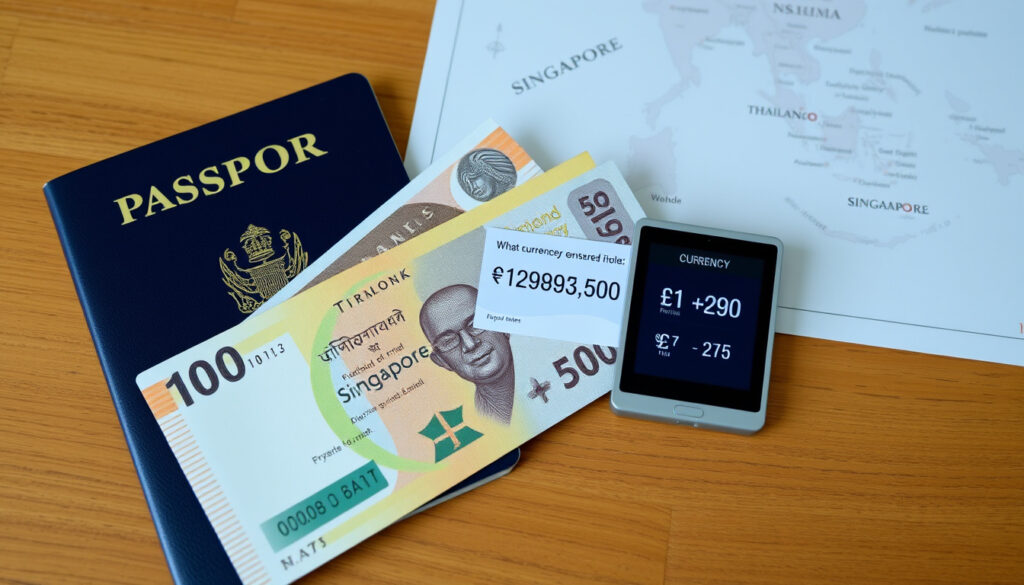
100 Baht to SGD: Exchange Rate, Spending & Entry Rules
100 Thai baht equals roughly 4 Singapore dollars at the mid-market rate, but the actual amount you receive depends on where you exchange. As of mid-March 2026, the mid-market exchange rate places 100 THB at roughly 4.01 Singapore dollars, according to Xe, a leading currency data platform.
Current mid-market rate: 1 THB = 0.04005 SGD ·
100 THB equals: 4.01 SGD ·
1 SGD equals: 24.97 THB ·
SGD vs THB strength: SGD is approximately 25 times stronger ·
Typical spread (buy/sell): 0.5% – 3% depending on provider
Quick snapshot
- Mid-market rate: 100 THB = 4.01 SGD (Xe)
- SGD is stronger than THB by a factor of ~25 (MEXC, a cryptocurrency exchange and currency guide)
- Thailand requires 10,000 THB cash per person for entry (Western Union travel advice)
- Exact rate you get depends on provider fees and spread
- Future exchange rate direction is uncertain
- Enforcement of the 10,000 THB cash rule varies by immigration officer
- THB has weakened vs SGD over the past year; in early 2025, 100 THB was worth ~3.85 SGD, now ~4.01 (Xe historical data)
- Watch Bank of Thailand monetary policy meetings for rate direction
- Check live rates before exchanging – mid-market shifts daily
Below are the key conversion facts for quick reference.
| Item | Value |
|---|---|
| 1 THB to SGD | 0.04005 |
| 100 THB to SGD | 4.01 |
| 1 SGD to THB | 24.97 |
| 100 SGD to THB | 2,497 |
| Thai Baht symbol | ฿ |
| Singapore Dollar symbol | S$ |
How much is 100 baht in Singapore dollars?
Current THB to SGD rate
As of 11 March 2026, the mid-market exchange rate from Xe (Xe, a leading currency data platform) shows 1 Thai baht equals 0.04005174 Singapore dollars. That means 100 THB is worth about 4.01 SGD. This mid-market rate is the midpoint between buy and sell prices in global currency markets – you won’t get this exact rate when exchanging cash, but it’s the fairest benchmark.
Travelers exchanging at airport counters or hotels often lose 3–5% off the mid-market rate. For 100 THB, that could mean receiving only 3.85 SGD instead of 4.01 SGD – a small difference that adds up on larger amounts.
Calculation for 100, 500, 1000 baht
Here’s a quick reference table using the current mid-market rate:
Three common amounts, one pattern: the SGD value scales linearly with the mid-market rate.
| THB amount | SGD value (mid-market) |
|---|---|
| 100 THB | 4.01 SGD |
| 500 THB | 20.03 SGD |
| 1,000 THB | 40.05 SGD |
The implication: even a modest 1,000 baht – about the cost of a nice dinner in Bangkok – converts to roughly 40 Singapore dollars, enough for a hawker meal in Singapore.
Is SGD stronger than baht?
Exchange rate comparison
The Singapore dollar is significantly stronger than the Thai baht. At the current rate, 1 SGD buys about 24.97 THB (MEXC, a cryptocurrency exchange and currency guide). That means SGD is roughly 25 times more valuable than THB on a unit-for-unit basis.
Historical strength
The Monetary Authority of Singapore (MAS, Singapore’s central bank) manages a strong-dollar policy, while the Bank of Thailand (BOT, Thailand’s central bank) allows the baht to float. Over the past five years, the SGD has appreciated against the THB by roughly 10–15%, driven by Singapore’s stronger economic fundamentals and higher interest rates.
Regional currency context
SGD is one of the strongest currencies in Southeast Asia, alongside the Brunei dollar. Compare it to the Malaysian ringgit (1 SGD ≈ 3.3 MYR) or Indonesian rupiah (1 SGD ≈ 11,500 IDR). The Thai baht sits in the middle – weaker than SGD but stronger than the Vietnamese dong or Philippine peso.
For Singaporean travelers heading to Thailand, the strong SGD means your money buys more meals, massages, and accommodation. Conversely, Thai travelers visiting Singapore face higher costs – 100 baht won’t even cover a kopi at a coffee shop.
The pattern: SGD’s strength gives Singaporeans a clear advantage when traveling to Thailand.
How far does your money go in Thailand?
Is $100 a lot in Thailand?
Yes, 100 US dollars (about 3,500 THB) is considered a substantial amount in Thailand. According to Wise, a money transfer service with local guides, a budget traveler can live comfortably on 1,000 THB per day (about 40 SGD), covering street food, local transport, and a basic guesthouse. So $100 USD would stretch for 3–4 days.
Is 1000 baht a lot?
1,000 THB is a moderate sum – it covers a day’s basic expenses for a budget traveler. A typical local meal costs 50–100 THB (Western Union travel advice). A ride on Bangkok’s BTS Skytrain is about 40–60 THB. So 1,000 THB gets you a full day of modest living.
Cost of living examples
- Street pad thai: 50–80 THB (~2–3 SGD) – Wise
- Bottle of water: 7–20 THB (~0.30–0.80 SGD)
- Taxi from Suvarnabhumi to central Bangkok: 400–600 THB (~16–24 SGD)
- Budget hotel room: 800–1,200 THB per night (~32–48 SGD)
The pattern: your Singapore dollar goes a long way in Thailand, but the reverse is sharp – 100 baht barely covers a single coffee in Singapore.
Is it mandatory to carry 10,000 Thai Baht?
Entry cash requirement
Yes, Thailand’s Immigration Bureau (Thailand Immigration Bureau, the official government agency) requires foreign nationals entering visa-exempt to show proof of at least 10,000 THB per person or 20,000 THB per family (or equivalent in foreign currency). This rule is part of the immigration regulations and is technically enforceable at any port of entry.
Enforcement and exceptions
In practice, enforcement is rare – most travelers are not asked to show cash. However, there have been anecdotal reports of immigration officers turning away travelers who cannot prove they have sufficient funds (Western Union travel advice). The requirement can be satisfied with cash, travelers cheques, or a credit card showing available credit (though cash is preferred).
Practical advice
Carry at least 10,000 THB in cash when entering Thailand, just to be safe. Use reputable exchange providers like SuperRich (MEXC exchange guide) to avoid poor rates. Avoid exchanging at airport counters, which offer the worst rates (Western Union travel advice).
The 10,000 THB rule is a low bar – it’s only about 400 SGD. But if you’re caught without it, you could be denied entry. A few hundred baht in cash is a cheap insurance policy.
The catch is a low bar, but non-compliance can lead to denied entry.
How much is 1 Singapore Dollar in Thai Baht?
1 SGD to THB rate
At the current mid-market rate, 1 Singapore dollar buys approximately 24.97 Thai baht (Xe, a leading currency data platform). Using the MEXC guide (MEXC, a cryptocurrency exchange and currency guide), the rate was 24.7738 as of 4 March 2026 – slight variations occur daily.
Converting larger amounts
Here is the conversion for common SGD amounts.
| SGD amount | THB equivalent (mid-market) |
|---|---|
| 1 SGD | 24.97 THB |
| 50 SGD | 1,248.50 THB |
| 100 SGD | 2,497 THB |
| 500 SGD | 12,485 THB |
The takeaway: for travelers from Singapore to Thailand, every $100 SGD gives you over 2,500 baht – enough for several days of budget travel.
Comparison with other currencies
- 1 SGD = 3.30 Malaysian ringgit (MAS exchange rate data)
- 1 SGD = 11,500 Indonesian rupiah (approx.)
- 1 SGD = 16.50 Philippine peso (approx.)
The regional context: SGD is the strongest major currency in Southeast Asia, far outpacing the Thai baht. For those planning trips to other destinations, you can check the Singapore to Hong Kong dollar exchange rate. Singapore to Hong Kong dollar exchange
The implication: for Singapore travelers, each SGD gives substantial spending power in Thailand.
Comparison of Exchange Methods
Five exchange methods, one pattern: convenience costs you. The table below compares popular ways to convert THB to SGD or vice versa.
| Method | Rate type | Fees | Best for |
|---|---|---|---|
| Mid-market (XE/Wise) | Real-time mid-market | 0% (display only) | Benchmarking rates |
| Money changer (SuperRich, Arcade) | Buy/sell spread ~1–2% | No commission | Cash exchange in person |
| Bank counter | Spread ~3–5% | May include fee | Emergency last resort |
| Multi-currency card (YouTrip) | Wholesale rate + 0% fee | No monthly fee | Card payments abroad |
| Airport exchange | Spread ~5–8% | High fee often hidden | Avoid if possible |
The implication: using a multi-currency card or a reputable money changer saves you 2–5% compared to airport or hotel counters.
For the inverse conversion, see our guide on 100 SGD to Thai Baht.
How to Convert THB to SGD
Follow these steps to get the best rate when exchanging Thai baht for Singapore dollars (or vice versa).
- Check the live mid-market rate on Xe or Wise (Wise live rate). This gives you a fair benchmark.
- Compare provider rates – use a comparison tool or visit 2–3 money changers. SuperRich in Bangkok and The Arcade in Singapore are known for competitive rates (MEXC guide).
- Avoid airport counters and hotel desks – they offer the worst spreads (Western Union travel advice).
- Consider a multi-currency card like YouTrip (MEXC recommends it) for zero-fee spending at wholesale rates.
- Carry some cash for small vendors and the 10,000 THB entry requirement. Exchange only what you need in cash, use cards for larger purchases.
Follow these steps to minimize fees and get the best rate.
For obtaining cash in Singapore, check DBS Notes Exchange Machine Locations.
Confirmed facts vs. What remains unclear
Confirmed facts
- 100 THB = 4.01 SGD at mid-market (11 Mar 2026) (Xe)
- SGD is stronger than THB by ~25x (MEXC)
- Thailand requires 10,000 THB per person for entry (Thailand Immigration Bureau)
- Thai baht is the only legal currency in Thailand (Wise)
- Major credit cards accepted at large businesses in Thailand (Wise)
What remains unclear
- Exact rate you get from a specific provider at a given time
- Future direction of THB/SGD exchange rate
- Enforcement consistency of the 10,000 THB cash rule at border checkpoints
- Whether a credit card statement is accepted as proof of funds
Expert perspectives
The mid-market rate is the fairest benchmark for any currency conversion. Always compare against it before exchanging.
— Bank of Thailand (Bank of Thailand, the nation’s central bank), official exchange rate page
Singapore adopts a managed float for the Singapore dollar, allowing it to strengthen gradually against trading partner currencies.
— Monetary Authority of Singapore (MAS, Singapore’s central bank and financial regulator)
Foreign nationals entering Thailand must have at least 10,000 baht or equivalent in foreign currency per person.
— Thailand Immigration Bureau (Thailand Immigration Bureau, government agency), entry requirements
The trade-off for travelers is straightforward: the strong SGD gives Singaporeans significant purchasing power in Thailand, but the 10,000 THB cash rule means you can’t rely solely on cards. For the best conversion, use a multi-currency card for payments and a reputable money changer for cash – avoiding airport counters that add a 5–8% spread. For a traveler from Singapore heading to Bangkok, the choice is clear: carry a small amount of baht cash (about 1,000–2,000 THB) for taxis and street food, use your YouTrip card for everything else, and keep the 10,000 THB entry requirement in mind as a cheap insurance policy – not a burden.
Frequently asked questions
What is the best way to exchange THB to SGD?
The best way is to use a multi-currency card like YouTrip for payments (wholesale rate, no fee) and exchange cash at a reputable money changer such as SuperRich in Thailand or The Arcade in Singapore. Avoid airport counters and hotel exchange desks (Western Union travel advice).
Do currency converters charge fees?
Online converters like Xe show the mid-market rate for free. But when you actually exchange money, the provider adds a spread (the difference between buy and sell rates). Money changers typically take 1–3%, banks 3–5%, and airport counters up to 8%. There may also be a flat fee (Xe).
Where can I check the live THB to SGD rate?
You can check the live mid-market rate on Xe (Xe.com), Wise (Wise.com), or the Bank of Thailand website (BOT). These are updated in real-time during market hours.
Is it better to exchange money in Thailand or Singapore?
If you are converting SGD to THB, it is often slightly better to do so in Thailand at a money changer like SuperRich, as they offer competitive rates with no commission. If you are converting THB to SGD, exchanging in Singapore (e.g., at The Arcade or Mustafa Centre) may give you a better rate than Thai banks (MEXC).
Can I use Singapore dollars in Thailand?
No, the Thai baht is the only legal currency in Thailand (Wise). Some large hotels and tourist shops may accept SGD at a poor exchange rate, but you should always convert to baht for the best value.
What factors affect the THB/SGD exchange rate?
Key factors include interest rate differentials between the Bank of Thailand and the Monetary Authority of Singapore, tourism revenues (Thailand is sensitive to visitor numbers), trade balances, and global risk sentiment. Political stability also plays a role (MAS).
How much Thai baht should I carry for a week trip?
For a week in Thailand, carry about 10,000–15,000 THB in cash (around 400–600 SGD) for small purchases, taxis, street food, and tips. Use a multi-currency card for larger expenses like hotels and restaurants. This also covers the mandatory 10,000 THB entry requirement.
More related posts
 Samsung Galaxy Z Series: Fold vs S vs A Comparison (2026)
 SGD to INR Rate: Live Conversion, History & Best Exchange Tips
 Google Earth Day Quiz: Answers & How to Get Woolly Mammoth
 Moltres & Zapdos & Articuno GX: Prices & Variants Guide
 Chee Cheong Fun Calories: How Many in a Serving
 Singtel SIM Only Plan Promotion: Cheapest $6 Seniors Deals
 Abu Dhabi Grand Prix 2026: Date, Tickets & Schedule Guide
 FairPrice Extended Hours Chinese New Year 2026: Price Freeze
