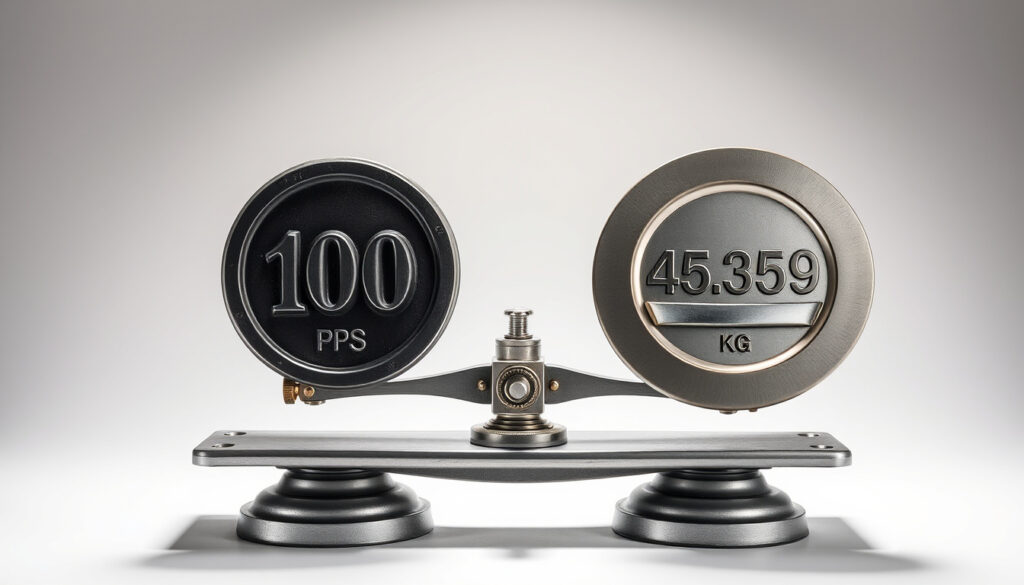
100 Pounds in KG – Exact Conversion to 45.359 kg
When converting 100 pounds to kilograms, the result is precisely 45.359237 kg according to the international avoirdupois standard established in 1959. This exact factor of 0.45359237 kg per pound, traceable to the International System of Units through the National Institute of Standards and Technology and the International Bureau of Weights and Measures, applies universally to all non-precious metal weight measurements in the United States and United Kingdom.
For everyday purposes, 100 lb converts to approximately 45.36 kg when rounded to two decimal places. The avoirdupois pound, standardized at exactly 0.45359237 kilograms, differs from the troy pound used for precious metals, which weighs 0.373241722 kg. This distinction matters significantly when calculating conversions for gold, silver, and other commodities traded in troy ounces.
The conversion formula follows a straightforward mathematical relationship: kilograms equal pounds multiplied by 0.45359237. For quick mental estimation, dividing 100 pounds by 2 yields 50, then subtracting 10 percent produces approximately 45 kilograms. The exact calculation produces 45.359237 kg, a figure commonly rounded depending on the required precision level for different applications.
How Many Kilograms in 100 Pounds?
- Exact conversion factor: 1 lb = 0.45359237 kg (defined internationally since 1959)
- The precise result for 100 pounds equals 45.359237 kilograms
- Rounded for everyday use: 45.36 kg (to two decimal places)
- Mental math shortcut: divide by 2 (=50), subtract 10% (5), yields ~45 kg
- The avoirdupois pound contains exactly 7,000 grains, standardized from the medieval French “avoir de pois” system
- For fitness contexts, 100 lb body weight represents approximately 45 kg on metric scales
- Luggage limits commonly reference these weights: a 50 lb bag equals roughly 22.7 kg
| Pounds (lb) | Kilograms (kg) |
|---|---|
| 1 | 0.45359237 |
| 10 | 4.5359237 |
| 50 | 22.6796185 |
| 90 | 40.8233133 |
| 100 | 45.359237 |
| 110 | 49.895161 |
| 120 | 54.431084 |
| 200 | 90.718474 |
Convert Nearby Weights: 90, 110, 120 Pounds to KG
Understanding conversions for weights near 100 pounds proves useful across multiple contexts, from fitness tracking to luggage allowance calculations. The same conversion factor applies uniformly, though different rounding conventions may appear depending on the specific application or regional preferences.
90 Pounds to Kilograms
Converting 90 pounds using the standard factor of 0.45359237 yields 40.8233133 kg. This weight commonly appears in fitness contexts, where individuals tracking body weight or lifting progress often need metric equivalents. For those comparing their weight on international scales or understanding luggage weight limits in countries using the metric system, this conversion provides clarity.
110 Pounds to Kilograms
The conversion of 110 pounds produces 49.895161 kg using the exact factor. This calculation follows the established formula: 110 × 0.45359237 = 49.895161. Rounded to two decimal places, 110 pounds equals approximately 49.90 kg. This weight frequently appears in travel contexts, as many international airline baggage policies specify limits around this range for checked luggage.
120 Pounds to Kilograms
Applying the conversion formula to 120 pounds yields 54.431084 kg (120 × 0.45359237). This figure rounds to 54.43 kg when expressed to two decimal places. Weight conversions at this level commonly arise in shipping contexts, where freight charges often depend on exact metric declarations for international shipments.
For every 10-pound increment above 100, add approximately 4.54 kg. For every 10-pound increment below 100, subtract the same amount. This provides a reliable mental reference when exact calculations are unavailable.
100 Pounds to Stone, Grams, or Gold KG Equivalent?
Beyond kilograms, several alternative weight units require consideration depending on the specific application. The stone, grams, and precious metal contexts each involve distinct conversion considerations that may affect how 100 pounds is expressed in practical terms.
100 Pounds in Stone
The stone remains the dominant weight unit in the United Kingdom and Ireland for measuring body weight, despite the official metric transition. One stone equals exactly 14 pounds or 6.35029318 kilograms. Converting 100 pounds to stone yields approximately 7 stone 2 pounds, calculated by dividing 100 by 14 (100 ÷ 14 ≈ 7.14 stones). The remainder of 2 pounds represents the fractional portion beyond the whole stone count.
100 Pounds in Grams
For scientific and culinary applications requiring gram-level precision, 100 pounds converts to 45,359.237 grams. This calculation follows directly from the kilogram equivalent: 45.359237 kg × 1,000 = 45,359.237 grams. Pharmaceutical, laboratory, and high-precision manufacturing contexts typically require this level of detail when working across measurement systems.
100 Pounds in Gold Context
The precious metals industry employs the troy system rather than avoirdupois for gold, silver, and platinum measurements. One troy pound contains 12 troy ounces (5,760 grains) compared to the avoirdupois pound’s 16 ounces (7,000 grains). Consequently, 100 avoirdupois pounds of gold equals 45.359237 kg, but this differs from 100 troy pounds, which would equal only 37.3241722 kg. Buyers and sellers of precious metals should verify which pound definition applies to their transactions to avoid costly misunderstandings.
Smaller Conversions: 1, 2, 10 Pounds to KG
Understanding how smaller weights convert provides context for the broader conversion scale. These fundamental conversions serve as building blocks for calculating any weight in the avoirdupois system.
1 Pound to Kilograms
The base conversion unit establishes the foundation for all higher values. One pound equals exactly 0.45359237 kilograms, a factor defined by international agreement in 1959 and maintained by NIST and BIPM. This single conversion underpins every calculation in the avoirdupois-to-metric translation process.
2 Pounds to Kilograms
Doubling the base conversion factor produces the result for 2 pounds: 2 × 0.45359237 = 0.90718474 kg. This weight appears frequently in cooking measurements, particularly for ingredients sold by the pound in markets still using imperial units. Recipe conversions from pounds to grams often require this intermediate calculation step.
10 Pounds to Kilograms
Ten pounds convert to 4.5359237 kg using the standard multiplication factor. This conversion commonly applies to smaller package weights, personal items, and fitness equipment specifications. The result rounds to 4.54 kg for most practical purposes, though scientific and commercial applications may require the full precision figure.
To convert any weight from pounds to kilograms, multiply the pound value by 0.45359237. For reverse conversions (kg to lb), divide by 0.45359237 or multiply by the reciprocal factor 2.2046226218. These formulas apply universally to avoirdupois pounds used in the United States.
Precision and Certainty in the Conversion
The conversion of 100 pounds to kilograms carries no uncertainty or variation. The international agreement reached in 1959 between the United States, United Kingdom, Canada, Australia, and other nations established the exact definition of the avoirdupois pound as precisely 0.45359237 kilograms. This value has remained constant since its adoption, providing absolute certainty in all calculations. For the exact conversion of 100 pounds to kilograms, please visit 110 pounds to euro.
The kilogram itself underwent a definitional change in 2019, transitioning from a physical platinum-iridium artifact to a definition based on Planck’s constant. However, the numerical equivalence between the avoirdupois pound and kilogram remained unchanged through this transition, preserving the exact conversion factor of 0.45359237 for all practical and scientific purposes.
The troy pound (0.373241722 kg) used for precious metals differs from the avoirdupois pound (0.45359237 kg). Applying the wrong conversion system can result in approximately 17% error when measuring gold, silver, or platinum. Always confirm which pound definition applies to your specific context.
The Avoirdupois System in Context
The avoirdupois weight system originated in medieval France, derived from the Old French phrase “avoir de pois” meaning “goods of weight.” This system was designed specifically for weighing bulk commodities rather than precious items, which historically used the troy system. The English standardized the avoirdupois pound at 7,000 grains in 1758, distinguishing it from the troy pound’s 5,760 grains.
The International System of Units, maintained by BIPM, adopted the avoirdupois pound definition following the 1959 international agreement. This alignment enabled consistent trade and scientific exchange between nations using different primary measurement systems. Today, NIST continues to maintain official conversion tables ensuring U.S. customary measurements remain traceable to the SI.
Applications of this conversion span fitness assessment, international travel, shipping and freight documentation, medical contexts, and everyday commerce. The widespread adoption of digital scales capable of displaying both measurement systems has increased familiarity with the relationship between pounds and kilograms, though the exact conversion factor remains essential for precise calculations.
Sources and Standards Bodies
The exact conversion from avoirdupois pounds to kilograms is 1 lb = 0.45359237 kg, a value traceable to the International System of Units through NIST and BIPM standards.
— National Institute of Standards and Technology (NIST)
The avoirdupois pound was standardized internationally in 1959 at exactly 0.45359237 kilograms, aligning national measurement systems for global trade and scientific collaboration.
— International Bureau of Weights and Measures (BIPM)
Summary
The conversion of 100 pounds to kilograms produces exactly 45.359237 kg according to the internationally standardized avoirdupois definition. This precise factor, established in 1959 and traceable through NIST and BIPM, applies consistently across all applications involving non-precious metal weight measurements. For practical purposes, rounding to 45.36 kg suffices in most contexts, though scientific, commercial, and legal documentation may require the full precision value. Understanding the distinction between avoirdupois and troy systems remains essential when working with precious metals, as the difference can significantly affect calculations and financial transactions.
What does 100 lbs mean?
100 lbs (pounds) is a weight measurement in the avoirdupois system used in the United States and United Kingdom. It equals 45.359237 kilograms in the metric system. The term “lbs” derives from the Latin “libra pondo,” though the modern avoirdupois pound was standardized separately from the Roman libra.
How do you convert 50 pounds to kg?
50 pounds multiplied by 0.45359237 equals 22.6796185 kg. For quick estimation, 50 lb ÷ 2.205 ≈ 22.67 kg. This conversion uses the same formula applicable to any avoirdupois weight.
What is 130 pounds in kg?
130 pounds converts to 58.9670081 kg (130 × 0.45359237). Rounded to two decimal places, this equals approximately 58.97 kg. This weight commonly appears in fitness tracking and medical BMI calculations.
How many kg is 120 pounds?
120 pounds equals 54.431084 kg using the exact conversion factor. This calculation follows the standard formula: 120 × 0.45359237 = 54.431084. Shipping and freight documentation often requires this level of precision.
What is the formula to convert pounds to kilograms?
The conversion formula is: kilograms = pounds × 0.45359237. For reverse conversions, pounds = kilograms ÷ 0.45359237, or equivalently, pounds = kilograms × 2.2046226218.
More related posts
 Huaikhwang Chicken Broth Noodle: Bangkok Street Food at Sim Lim
 B&O Singapore: Store, Prices & Airline Partnership
 The Rookie Season 7: Release, Renewal & Where to Watch
 Beds for Queen Size – Dimensions, Types and Buying Guide
 Dixon Technologies Share Price Analysis: Buy, Sell or Hold
 Man U vs Brighton 2026: FA Cup Upset & League Revenge
 Baccarat t2(www.pgroyal88.com): Latest Verified Info & Guide
 Sembawang Hot Spring Park Photos: A Complete Guide to Visiting
