Hanging Gardens of Babylon: Mystery, Location & Theories
Few ancient wonders spark as much debate as the Hanging Gardens of Babylon. For centuries, they were described in glowing terms by Greek writers—terraced greenery rising in the desert, a gift from a king to his homesick wife.
Status: One of the Seven Wonders of the Ancient World, but existence disputed ·
Approximate construction date: c. 600 BCE under Nebuchadnezzar II ·
Possible location: Babylon (modern-day Iraq) or Nineveh (Iraq) ·
Primary ancient sources: Greek historians (Berossus, Diodorus Siculus) ·
Alternative theory: Gardens may have been in Assyrian Nineveh
Quick snapshot
- Listed as a Wonder by Hellenic sources (Encyclopaedia Britannica)
- Babylon was a major Mesopotamian city (Encyclopaedia Britannica)
- Ancient writers described elaborate terraced gardens (The Archaeologist)
- Exact location (Encyclopaedia Britannica)
- Whether they were in Babylon or Nineveh (Encyclopaedia Britannica)
- Appearance, height, and irrigation method (The Archaeologist)
- c. 600 BCE: Nebuchadnezzar II reign; gardens supposedly built (Encyclopaedia Britannica)
- 1990s: Stephanie Dalley proposes Nineveh as true location (Biblical Archaeology Society)
- 2020s: Ongoing scholarly debate and remote sensing surveys (Archaeology magazine)
- Further remote sensing and excavation in both Babylon and Nineveh (Archaeology magazine)
- Analysis of ancient water engineering at Nineveh (Biblical Archaeology Society)
- Re-evaluation of Greek and Roman texts (The Archaeologist)
Key facts at a glance help frame the debate over this elusive Wonder.
| Full Name | Hanging Gardens of Babylon |
| Status | Disputed existence |
| Ancient Wonder Number | 2 of 7 (traditionally) |
| Builder (legend) | Nebuchadnezzar II |
| Purpose | To please homesick wife Amytis |
| Possible alternative | Nineveh (Assyrian gardens) |
Do the Hanging Gardens of Babylon still exist?
What archaeological evidence exists?
No definitive ruins have been found in Babylon that can be linked to the gardens. Robert Koldewey, the German archaeologist who excavated Babylon in the early 1900s, uncovered foundation chambers and vaults in the northeastern corner of the palace—which some later writers connected to the gardens—but those excavations did not produce certain traces of the Hanging Gardens, according to Encyclopaedia Britannica (a leading reference work).
By the beginning of the 21st century, the site of the Hanging Gardens had not been conclusively established, the same source notes. The Archaeologist (online archaeology journal) also reports that no definitive archaeological evidence has been found at Babylon to confirm the gardens.
Without physical proof, the gardens remain a literary ghost. The absence of remains is the single biggest reason scholars doubt they ever stood in Babylon.
Are there any remains?
Some ancient structures at Babylon have been proposed as possible garden foundations, but the link remains speculative. The most promising candidate—a set of vaulted chambers near the palace—was dismissed by later archaeologists as likely being a storeroom, not a garden base. As The Archaeologist puts it: “No definitive archaeological evidence has been found.”
The implication: if the gardens were real and located in Babylon, they have vanished without a trace—unlike the Ishtar Gate or the city walls, which left clear archaeological signatures.
What’s so special about the Hanging Gardens of Babylon?
What did ancient writers describe?
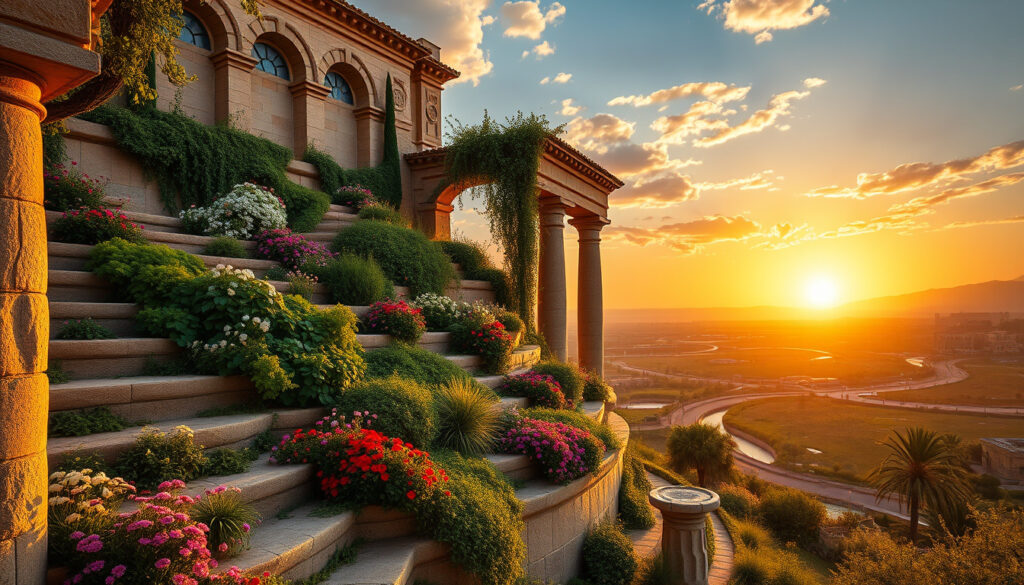
The primary literary descriptions come from Greek and Roman authors writing centuries after the supposed construction, including Strabo and Philo of Byzantium, according to The Archaeologist. Diodorus Siculus, writing in the 1st century BCE, described a square garden with vaulted terraces, planted with trees and rare plants, irrigated by water drawn from the Euphrates.
A traditional legend attributes the gardens to King Nebuchadnezzar II, who ruled from 605 to 562 BCE, built to please his wife Amytis of Media, who missed the green hills of her homeland. This story—though widely repeated—relies on later tradition rather than contemporary records. Encyclopaedia Britannica notes that some descriptions say the gardens were near the royal palace and set upon vaulted terraces.
How were they engineered?
The medieval Greek author Philo of Byzantium described an irrigation system that lifted water from the Euphrates to the top of the terraces—a feat that would have required advanced hydraulic engineering. Some modern engineers have proposed that an Archimedes’ screw (likely invented later) or a chain of buckets could have done the job, but no physical traces survive to confirm the method.
Recent research into Assyrian waterworks suggests that the Assyrians built large-scale canals and aqueducts. Archaeologists have found traces of an 80-kilometre canal, dam, and aqueduct system at Nineveh attributed to Sennacherib by inscriptional evidence, as reported by Biblical Archaeology Society (scholarly organization). If the gardens were at Nineveh, the engineering becomes far more plausible.
Why is the Hanging Gardens of Babylon controversial?
What do skeptics say?
Skeptics point to the total lack of archaeological evidence in Babylon and the fact that Herodotus, who wrote a detailed account of Babylon around 450 BCE, never mentioned the gardens. The earliest descriptions come centuries later, raising the possibility that the gardens were a literary invention or a confusion of sources.
Some scholars argue that the gardens may have been a literary or symbolic creation rather than a real monument, as noted by The Archaeologist.
What is the Nineveh theory?
A major modern alternative theory places the Hanging Gardens in Nineveh rather than Babylon. Stephanie Dalley of Oxford University proposed that the gardens were actually the well-documented gardens of Sennacherib, king of Assyria from 705/704 to about 681 BCE. Dalley argued that later writers confused Babylon and Nineveh over time, according to Wikipedia (collaborative encyclopedia).
The theory is strengthened by the fact that Nineveh had a wetter climate than Babylon and that Sennacherib built a sophisticated canal and aqueduct system to water his gardens. Archaeology magazine (published by the Archaeological Institute of America) notes that Nineveh lies about 300 miles north of Babylon in present-day northern Iraq—a region with more rainfall and better conditions for terraced gardening.
If Dalley is right, one of the Seven Wonders wasn’t in Babylon at all. The debate hinges on whether ancient Greek writers confused two great Mesopotamian cities.
The catch: no single theory has enough evidence to close the case, leaving the gardens suspended between archaeology and legend.
Who destroyed the Hanging Gardens of Babylon?
What happened after the Persian conquest?
No clear record of the gardens’ destruction exists—because no clear record of their existence in Babylon has been found. If the gardens were real and located in Babylon, they likely would have declined after the Persian conquest in 539 BCE and the later fall of the city to Alexander the Great in 331 BCE. Babylon gradually fell into ruin over the following centuries.
Did the gardens fall into ruin?
By the time European archaeologists began excavating Babylon in the 19th century, the city had been abandoned for centuries. If the gardens had ever stood there, they would have been dismantled for building materials or eroded away. The same fate likely befell any gardens at Nineveh, which was destroyed in 612 BCE—well before the Greek historians wrote about the gardens. This chronological mismatch further complicates the story.
The pattern: destruction is not the puzzle—the puzzle is that the gardens themselves may never have existed as described.
What country is Babylon in today?
Where is Babylon located?
Babylon was an ancient city in Mesopotamia, located in what is now modern-day Iraq, about 50 miles south of Baghdad. The ruins of Babylon, including the reconstructed Ishtar Gate, are a UNESCO World Heritage site. The city’s name in the Bible (Genesis 11:9) has become synonymous with decadence and downfall.
What is the modern name?
Today, the site is known simply as Babylon (Arabic: بابل, Babil). It lies in the Babil Governorate of Iraq. The modern town of Hillah is nearby. Tourists can visit the archaeological park, but no trace of the Hanging Gardens has been identified there.
For travelers and history enthusiasts, the takeaway is clear: while you can walk through the ruins of Babylon, the legendary gardens remain invisible—perhaps forever.
Timeline
- — Nebuchadnezzar II reign; gardens supposedly built (Encyclopaedia Britannica)
- — Herodotus writes about Babylon but does not mention gardens (The Archaeologist)
- — Diodorus Siculus provides detailed description (The Archaeologist)
- — European archaeologists excavate Babylon; no garden ruins found (Encyclopaedia Britannica)
- — Stephanie Dalley proposes Nineveh as the true location (Biblical Archaeology Society)
- — Ongoing scholarly debate and remote sensing surveys (Archaeology magazine)
Confirmed facts
- Gardens are listed as a Wonder by Hellenic sources (Encyclopaedia Britannica)
- Babylon was a major city in Mesopotamia (Encyclopaedia Britannica)
- Ancient writers described elaborate terraced gardens (The Archaeologist)
- Traces of canals and aqueducts exist at Nineveh (Biblical Archaeology Society)
What’s unclear
- Exact location
- Whether they were in Babylon or Nineveh
- Appearance, height, and irrigation method
- Actual builder and date
Key perspectives
“The Hanging Gardens of Babylon are the only one of the Seven Wonders of the Ancient World whose location has not been definitively established.”
Encyclopaedia Britannica
“The evidence for the gardens at Babylon is entirely literary—no archaeological trace has ever been found.”
The Archaeologist
“The Nineveh theory is strengthened by the argument that Nineveh had a wetter climate than Babylon and that Sennacherib built a sophisticated canal system to water his gardens.”
Archaeology magazine
For anyone fascinated by the ancient world, the Hanging Gardens represent a tantalizing puzzle: a wonder celebrated for centuries, yet possibly a product of mistaken identity or literary imagination. The evidence—or lack of it—forces us to question how history gets written and which stories we choose to believe.
Related reading: What Is Good Friday? Meaning, History & Traditions · How Many Days Till Christmas? 2026 Countdown & History
Frequently asked questions
What does ‘Hanging’ refer to in the name?
The term “hanging” is a translation of the Greek “kremastos” or Latin “pensilis,” meaning a terraced or overhanging garden, not literally suspended in the air.
How tall were the Hanging Gardens?
Ancient descriptions are vague but suggest the terraces rose to a height of about 75–80 feet (23–24 meters). No precise measurements survive.
Were the Hanging Gardens built by Nebuchadnezzar or Sennacherib?
Tradition attributes them to Nebuchadnezzar II, but the competing theory credits Sennacherib at Nineveh. The evidence favors Sennacherib’s engineering works.
What happened to the Gardens after the fall of Babylon?
If they existed in Babylon, they likely collapsed or were dismantled over the centuries. If at Nineveh, they were destroyed when the city fell in 612 BCE—well before the Greek accounts.
Are there any surviving ancient depictions?
No contemporary images have survived. Later European paintings are purely imaginative reconstructions based on literary descriptions.
What is the most widely accepted theory today?
There is no consensus. Many scholars remain agnostic, while the Nineveh theory has gained significant traction in academic circles.
Could the gardens have been a myth?
It is possible. The silence of Herodotus and the complete lack of archaeological evidence lead some to conclude the gardens were a literary trope rather than a real structure.
More related posts
 What Is MediShield Life? Coverage, Premiums, Benefits Explained
 English to Spanish Translation – Best Tools Compared
 Moltres & Zapdos & Articuno GX: Prices & Variants Guide
 APA Hotel Man Under Bed: Shocking Tokyo Incident Details
 Red Crowns Senior Living: Reviews, Costs & Services Singapore
 Pondok by June Zack: Latest Verified Info Singapore
 India Women vs Australia Women: Semi-Final Record & Rivalry
 Dixon Technologies Share Price Analysis: Buy, Sell or Hold
