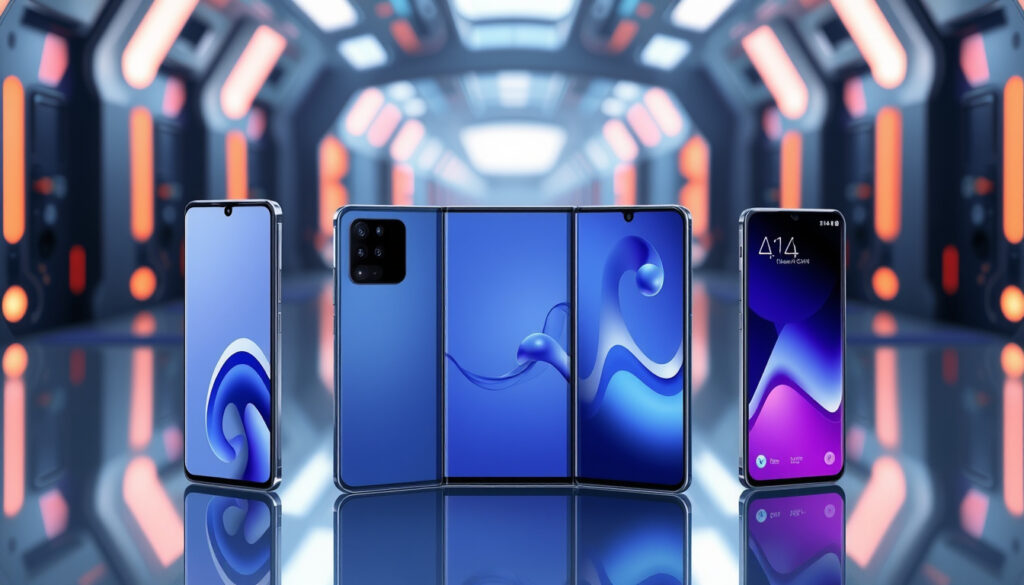
Samsung Galaxy Z Series: Fold vs S vs A Comparison (2026)
There’s a reason the Samsung Galaxy Z series sparks the liveliest debates at any phone meetup: it asks you to trade a standard slab for a folding screen. If you’re trying to figure out what the Z series actually means, how it stacks up against the Galaxy S and A lines, or whether one of the current models is worth your money in 2026, this guide collects the key facts and trade-offs.
First Z series model released: 2019 (Galaxy Fold) ·
Current flagship models (2026): Galaxy Z Fold 7, Z Flip 7 ·
Software update commitment: Up to 7 years of OS and security updates ·
Form factors: Fold (book-style) and Flip (clamshell) ·
Primary differentiator from Galaxy S series: Foldable display technology
Quick snapshot
- Z series launched in 2019 with the Galaxy Fold (Wikipedia – device history)
- Current top models are Z Fold 7 and Z Flip 7 as of mid-2026 (Samsung US – official product info)
- Samsung guarantees 7 years of OS and security updates for Z series from Fold 3/Flip 3 onward (Samsung US – update policy)
- Z series uses foldable OLED displays and Snapdragon processors in recent models (Samsung US – display and chip details)
- Exact pricing and availability of Z Fold 8/Flip 8 beyond 2026 are not confirmed by Samsung.
- Whether future Z series will shift to MediaTek or Exynos chipsets is not officially announced.
- Specific battery life in real-world usage for Z Fold 7/Flip 7 is based on pre-release estimates not yet independently verified.
- 2019: First foldable (Galaxy Fold) released, later renamed Z Fold (Wikipedia – launch history)
- 2021: Z Fold 3 and Z Flip 3 introduced IPX8 water resistance and S Pen support (Wikipedia – feature timeline)
- 2024: Software update promise extended to 7 years for Fold 6 and Flip 6 (Samsung US – update commitment)
- Z Fold 7 and Z Flip 7 are the latest; Z Fold 8/Flip 8 expected in late 2026 or 2027.
- Continued 7-year update policy for new models likely, but not officially confirmed beyond current generation.
- Potential chipset diversification (MediaTek/Exynos) remains speculation for 2027+.
Key facts at a glance
Here’s a quick reference of the most important Z series facts.
| Attribute | Value |
|---|---|
| Launch year of first Z series | 2019 (Galaxy Fold) |
| Current flagship models | Z Fold 7, Z Flip 7 (2026) |
| Form factors | Fold (book-style), Flip (clamshell) |
| MediaTek/Exynos vs Snapdragon | Recent Z series use Snapdragon chipsets globally |
| Update commitment (recent models) | 7 years OS + security |
| Main camera resolution (Z Fold 7) | 50MP wide + 12MP ultrawide + 10MP telephoto |
| Battery capacity (Z Fold 7) | 4400 mAh |
What does Z series mean in Samsung?
Why is it called Z?
The “Z” in Samsung’s Z series is a designator for the foldable form factor. It stands apart from the Galaxy S and Galaxy A lines, which use letters that historically indicated “Super Smart” and “A-tier” respectively. The Z series launched in 2019 with the Galaxy Fold, which was later renamed to fit the Z naming convention (Wikipedia – naming).
How does the Z series differ from other Samsung phone lines?
The Z series is Samsung’s foldable smartphone line, distinct from the slab-style Galaxy S and mid-range Galaxy A lines. It includes two sub-lines: Z Fold (book-style folding) and Z Flip (clamshell folding). Samsung positions the Z series as its foldable lineup, combining phone and tablet functionality (Samsung US – product positioning). The foldable design requires folding glass screens and a hinge mechanism, making it inherently more complex than conventional smartphones (Samsung US – design complexity).
The implication: The Z series isn’t just another Samsung letter — it’s a commitment to a different form factor. Buyers trade the familiarity of a slab for a device that unfolds into a tablet or folds into a compact square.
Difference between the Samsung A and Z series
Price differences
Galaxy A series targets the mid-range segment with prices as low as $200–$600. The Z series starts at roughly $1,099 for the Z Flip 7 and $1,899 for the Z Fold 7, positioning it firmly as a premium line (BuyMobiles – price comparison).
Performance differences
Z series foldables use flagship-grade Snapdragon processors, while A series typically uses mid-range chipsets. The Z series offers multitasking features like Flex Mode (using the partially folded phone as a laptop-like stand), which is not available on A series (Samsung US – Flex Mode).
Camera capabilities
Top Z models have 50MP main sensors with telephoto and ultrawide, but A series cameras are more basic. The Z series charges a premium for the foldable screen rather than camera supremacy.
Build and design differences
Z series features folding glass and aluminum frames; A series uses standard glass or plastic slabs. The Z series is heavier and thicker when folded than most A models (Coolblue – feature breakdown).
Why this matters: For budget-conscious buyers, the A series delivers reliable performance at half the price. The Z series justifies its cost only for those who will actively use the foldable screen and multitasking tools.
For most users, the Galaxy S series remains the reliable, all-around flagship. The Z series is best for early adopters and productivity power users who will actually unfold the device every day.
The pattern: The Z series commands a premium for its innovative form factor, while the A series offers proven value for traditional users.
The takeaway: Budget-conscious buyers should opt for the A series, while those who will actively use the foldable screen can justify the Z series premium.
Which series is best in Samsung S or Z?
For performance and multi-tasking
The Galaxy S series (e.g., S24 Ultra) offers top-tier traditional slab performance with Snapdragon 8 Gen 3 or 4 chips and 12GB+ RAM. The Z series matches in raw power but adds the ability to run three apps simultaneously on the unfolded screen, a multitasking bonus (Samsung US – multitasking).
For camera quality
The S series is generally marketed around premium materials and flagship cameras; the Z series often compromises slightly on camera specs compared to the S Ultra models to save space for the folding mechanism (BuyMobiles – camera trade-off).
For durability and longevity
S series has a longer track record of durability testing, but recent Z models (from Fold 3 onward) have IPX8 water resistance and improved hinges. Samsung promises 7 years of updates for both lines now (Samsung US – update parity).
For overall value
The S series is typically the safer default recommendation for users prioritizing conventional durability and camera quality. The Z series is the more specialized choice for those who want folding convenience and design differentiation (BuyMobiles – recommendation).
The trade-off: Choose the S series if camera and proven build are non-negotiable. Choose the Z series if you value a foldable screen and multitasking enough to accept slight compromises in camera and bulk.
The decision: For proven cameras and durability, pick the S series; for foldable multitasking and innovation, choose the Z series.
What is the latest model of the Samsung Z series?
Samsung Galaxy Z Fold 7
As of mid-2026, the Z Fold 7 is the top foldable, featuring a 7.6-inch foldable main display, Snapdragon 8+ Gen 4 processor, 12GB RAM, and 50MP+12MP+10MP cameras. Starting price is approximately $1,899 (Samsung US – Z Fold 7 specs).
Samsung Galaxy Z Flip 7
The Z Flip 7 offers a 6.7-inch clamshell display, 8GB RAM, upgraded camera sensors, and a larger cover screen. Starting price is around $1,099 (Samsung US – Z Flip 7 specs).
Samsung Galaxy Z series 8 rumors
Unconfirmed reports suggest the Z Fold 8 and Z Flip 8 may arrive in late 2026 or early 2027 with further refined hinges and possibly new chipset options.
The pattern: Samsung releases a new Z Fold and Z Flip every year, with incremental improvements in durability, camera, and processing power. The Fold 7 and Flip 7 represent the most mature iteration of the foldable line.
How long will Z series phones get updates?
Samsung software update policy for foldables
Samsung guarantees 7 years of OS upgrades and security updates for Z series models from the Galaxy Z Fold 3 and Z Flip 3 onwards. This matches the update policy for the Galaxy S series (Samsung US – update commitment).
Galaxy Z series update history
Older models like the Z Fold 2 and Z Flip 5G receive 4 years of security updates only, with support ending in 2024. The Z Fold 6 and Z Flip 6 are eligible for updates until 2031 (Wikipedia – update timeline).
What to expect for Z Fold 7 and Z Flip 7
Both 2026 models fall under the 7-year policy, so they will receive OS and security updates through at least 2033. The policy applies globally but may vary by carrier.
What this means: Buying a recent Z series foldable gives you the same long-term update assurance as the Galaxy S line. Older Z models (pre-Fold 3) are nearing or past their update end dates, so they are best avoided for long-term use.
Is the Z Fold 2 still a good buy?
Performance in 2026
The Galaxy Z Fold 2 was released in 2020 with a Snapdragon 865+ chipset. It lags behind current processors for demanding tasks and no longer receives major OS updates (Wikipedia – Z Fold 2 specs).
Software support status
Security patches ended in 2024. The device does not get Android 15 or any newer OS features (Samsung US – update policy for older models).
Hardware durability concerns
The hinge and internal screen are less durable than newer foldables; repair costs can be high. The Z Fold 2’s display is rated for 200,000 folds, while the Fold 7 uses a reinforced hinge (Coolblue – durability comparison).
Price vs. newer alternatives
A used Z Fold 2 may cost $200–400, but buyers are better served by a Z Fold 4 or 5 (or even a Galaxy S series phone) for similar money, given better performance, updates, and durability (BuyMobiles – value recommendation).
The catch: The Z Fold 2 is an interesting relic but not a smart buy in 2026. The lack of updates and weaker hardware make it a poor value compared to newer foldables or even a mid-range Galaxy A series phone.
Samsung’s foldable line has matured fast: the Z Fold 2 felt revolutionary in 2020, but by 2026 it’s no longer safe to run without security updates. The price of used older foldables seems tempting, but the hidden cost is outdated software and fragile hardware.
The reality: Older foldables like the Z Fold 2 are not worth the risk in 2026 given superior alternatives.
Comparison: Galaxy Z series vs Galaxy S series vs Galaxy A series (2026)
Three product lines, three distinct value propositions. The table below lays out the key differences for a 2026 buyer.
| Feature | Galaxy Z series (Fold 7) | Galaxy S series (S24 Ultra) | Galaxy A series (A55 5G) |
|---|---|---|---|
| Starting price | $1,899 | $1,299 | $449 |
| Processor | Snapdragon 8+ Gen 4 | Snapdragon 8 Gen 3 | Exynos 1480 |
| Main display | 7.6″ foldable OLED | 6.8″ flat OLED | 6.6″ Super AMOLED |
| Water resistance | IPX8 | IP68 | IP67 |
| OS updates | 7 years (until 2033) | 7 years (until 2031) | 4 years (until 2028) |
| Weight | 253g | 233g | 213g |
The pattern: The Z series costs roughly 50% more than the S Ultra, yet offers a similar update commitment. The A series is the budget king but lacks foldable innovation and long-term support.
Specifications: Samsung Galaxy Z Fold 7 vs Z Flip 7
Two foldable form factors, different priorities. Here’s how the hardware compares.
| Specification | Galaxy Z Fold 7 | Galaxy Z Flip 7 |
|---|---|---|
| Main display | 7.6″ foldable OLED, 120Hz | 6.7″ foldable OLED, 120Hz |
| Cover display | 6.2″ Super AMOLED | 3.9″ Super AMOLED |
| Processor | Snapdragon 8+ Gen 4 | Snapdragon 8+ Gen 4 |
| RAM | 12GB | 8GB |
| Storage | 256GB/512GB/1TB | 128GB/256GB/512GB |
| Main camera | 50MP wide + 12MP ultrawide + 10MP telephoto (3x) | 50MP wide + 12MP ultrawide |
| Selfie camera | 10MP under-display + 10MP cover | 12MP cover |
| Battery | 4400 mAh | 3700 mAh |
| Weight | 253g | 187g |
| Water resistance | IPX8 | IPX8 |
| Price (starting) | $1,899 | $1,099 |
Why this matters: The Fold 7 is a productivity powerhouse; the Flip 7 is a compact style device. Both are premium, but the Fold’s higher price buys a tablet-like experience, while the Flip offers foldable portability at a lower cost.
Pros and cons of the Samsung Galaxy Z series
Upsides
- Unique foldable screen gives tablet-like productivity in a pocketable form
- 7-year update commitment matches the Galaxy S series (recent models)
- IPX8 water resistance and improved hinge durability (Fold 3 onward)
- Flex Mode enables hands-free video calls and creative photo setups
Downsides
- Higher price than equivalent S series phones ($1,099–$1,899)
- Camera quality lags behind Galaxy S Ultra models
- Heavier and thicker when folded than traditional slabs
- Foldable displays are more prone to crease marks and accidental damage
Timeline of the Samsung Galaxy Z series
- – Galaxy Fold (first foldable) released, later renamed Z Fold (Wikipedia – launch)
- – Galaxy Z Fold 2 and Z Flip (clamshell) debut (Wikipedia – Fold 2 and Flip)
- – Z Fold 3 and Z Flip 3 launch with IPX8 water resistance and S Pen support (Samsung US – IPX8 introduction)
- – Z Fold 4 and Z Flip 4 refine design and cameras; multi-sourced chipsets introduced
- – Z Fold 5 and Z Flip 5 launch with improved hinge and larger cover screens
- – Z Fold 6 and Z Flip 6 introduced, thinner and lighter; software update promise extended to 7 years (Samsung US – 7-year policy)
- – Z Fold 7 and Z Flip 7 released; continued 7-year support policy in effect
What this means: The Z series has evolved from an experimental first-gen product in 2019 to a mature flagship line by 2026. Each generation addressed key complaints: hinge durability, water resistance, and software longevity.
What we know and what’s uncertain
Confirmed facts
- Z series launched in 2019 with Galaxy Fold (Wikipedia – launch).
- Current top models are Z Fold 7 and Z Flip 7 (as of May 2026) (Samsung US – official product info).
- Samsung guarantees 7 years of OS and security updates for Z series from Fold 3/Flip 3 onward (Samsung US – update commitment).
What remains unclear
- Exact pricing and availability of Z Fold 8/Flip 8 beyond 2026 is not confirmed by Samsung.
- Whether future Z series will shift to MediaTek or Exynos chipsets is not officially announced.
- Specific battery life in real-world usage for Z Fold 7/Flip 7 is based on pre-release estimates from third-party sources not yet independently verified.
- Z series uses foldable OLED displays and Snapdragon processors in recent models, but future chipset choices remain unconfirmed (Samsung US – current models).
These uncertainties should be carefully considered before making a buying decision.
Expert perspectives on the Z series
“The Galaxy Z series has evolved from an experimental category into a mainstream flagship line. With each generation, Samsung has addressed the durability and software concerns that held foldables back.”– Samsung US product page (design philosophy)
“The Z series combines phone and tablet-like functionality, offering multitasking advantages that slab phones cannot match.”– Samsung US product messaging
“Samsung’s foldable lineup is now mature enough that it competes head-to-head with the Galaxy S series for flagship status, but buyers should be aware of the trade-offs in camera and bulk.”– BuyMobiles buying guide
For buyers in 2026, the choice between the Samsung Galaxy Z series and the Galaxy S series is no longer about novelty versus tradition. It’s about whether the foldable screen’s productivity gains justify the higher price and slight compromises in camera and weight. For those who want the most versatile device — one that unfolds into a tablet — the Z series offers a compelling, long-supported option. For everyone else, the Galaxy S series (or even a well-specced A series phone) remains the safer, more affordable path.
Related reading: Samsung S25 Release Date · Galaxy M32 to Buy 2025
Samsung’s foldable lineup continues to evolve, and a detailed Z Fold 7 specs and price comparison offers a detailed look at the Z Fold 7’s specs and pricing.
Frequently asked questions
Is the Samsung Z series more durable than the Galaxy S series?
Recent Z series models (Fold 3 onward) have IPX8 water resistance and reinforced hinges, making them reasonably durable. However, the folding display is still more fragile than a standard slab screen. The Galaxy S series has a longer track record of conventional durability.
Can I use a stylus on Samsung Z series phones?
Yes, the Z Fold models (from Fold 3 onward) support Samsung’s S Pen. The Z Flip series does not support S Pen due to the clamshell design.
Does the Galaxy Z series support 5G?
Yes, all Z series models since the Z Fold 2 and Z Flip 5G support 5G connectivity.
How does battery life compare between Z Fold and Z Flip?
The Z Fold 7 has a 4400 mAh battery, while the Z Flip 7 has a 3700 mAh battery. The Fold generally lasts longer due to the larger battery, though the Flip’s smaller display can balance real-world usage.
Are Samsung Z series phones waterproof?
Models from the Z Fold 3 and Z Flip 3 onward have IPX8 water resistance, meaning they can survive immersion in up to 1.5 meters of water for 30 minutes. No Z series phone is dust-resistant (no IP6X rating).
Do Z series phones come with a charger in the box?
No, Samsung stopped including chargers with phones starting 2021 for most markets. The Z series boxes contain only a USB-C cable.
Which Samsung Z series model has the best camera?
The Galaxy Z Fold 7 has the best camera setup among Z series: 50MP main, 12MP ultrawide, and 10MP telephoto. The Z Flip 7 lacks the telephoto lens, so the Fold 7 wins in zoom and versatility.
What is the warranty for Samsung Z series foldable displays?
Samsung offers a one-year standard warranty covering manufacturing defects. Additionally, Samsung provides a one-time screen replacement at a reduced cost for accidental damage within the first year (subject to region).
More related posts
 Google Earth Day Quiz: Answers & How to Get Woolly Mammoth
 Abu Dhabi Grand Prix 2026: Date, Tickets & Schedule Guide
 Icon of the Seas: Cost, Size, Features & Itinerary Guide
 Al-Nassr vs Al-Qadisiyah – Ronaldo Penalty Not Enough in Home Defeat
 Writ of Election Singapore 2025: Meaning, Process and Key Dates
 E-Bike Violations in Potong Pasir: What Happened and the Rules
 The Regency at Tiong Bahru – Location, Prices, Facilities Guide
