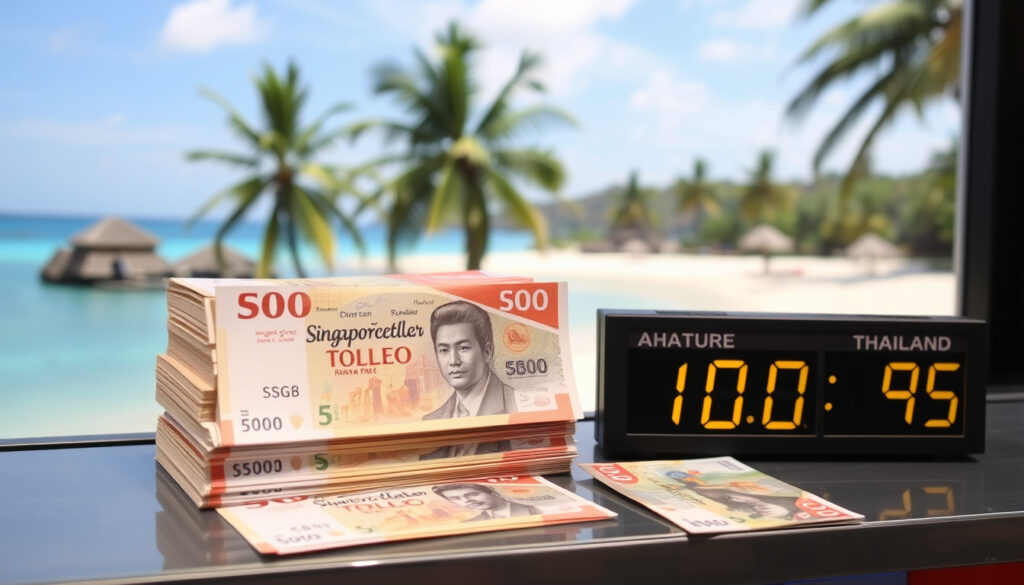
100 SGD to Thai Baht: Live Rates and Exchange Tips for Travelers
If you’re heading from Singapore to Thailand, the exchange rate is probably the last thing you check before packing — and one of the first you’ll want to understand on the ground. Converting 100 SGD today nets you roughly 2,518 THB at the mid-market rate, but the provider you choose and where you exchange can shift that number by 50 baht or more. This guide lays out the current rates, the providers that actually deliver, and the travel-tested tips that HSBC and seasoned Bangkok visitors swear by.
100 SGD to THB (XE): 2,518.52 THB · Rate per 1 SGD (XE): 25.1852 THB · 100 SGD to THB (RIA): 2,518.62 THB · 1 SGD to THB (RIA): 25.1862 THB · Common conversion: 10 SGD: 251.86 THB
Quick snapshot
- Exact bank fees vary by institution and branch
- Future rate movements depend on MAS and BOT policy
- Precise ATM withdrawal fees at Thai banks for SGD cards
- Wise 30-day high: 25.5898 THB per SGD (March 22, 2026) (Wise)
- Wise 90-day low: 25.1591 THB per SGD (January 2026) (Wise)
- October 2023 range: SGD 1 = THB 24–25 (SingaporeBoleh9)
- Book flights: SGD weakness may spike before peak travel season
- Pre-load Revolut or Wise cards before departure
- Check live XE rate the morning of your exchange
The table below summarizes what you get from seven major providers when converting 100 SGD, ranging from mid-market benchmarks to specific transfer services.
| Provider | 100 SGD equals | Rate per 1 SGD |
|---|---|---|
| Xe.com (mid-market) | 2,518.52 THB | 25.1852 THB |
| Ria Money Transfer | 2,518.62 THB | 25.1862 THB |
| Wise | 2,517.10 THB | 25.1710 THB |
| Revolut | 2,501.04 THB | 25.0104 THB |
| Instarem | 2,514.36 THB | 25.1436 THB |
| Remitly (special rate) | 2,463.00 THB | 24.6300 THB |
| Xe NZ (as of 11:38 UTC) | 2,492.91 THB | 24.9291 THB |
How much is $1 SGD in Thai?
The short answer: roughly 25.19 THB per Singapore dollar as of mid-April 2026. That figure represents the mid-market rate — the honest midpoint between what banks pay when they buy SGD and what they charge when they sell THB. XE.com lists it as 25.1852 THB per SGD (Xe.com (currency converter authority)), while Ria Money Transfer sits just a hair higher at 25.1862 THB (Ria (remittance rate comparison)). The consistency across major platforms suggests the true mid-market rate genuinely clusters around 25 THB per SGD.
Current rate details
What you actually receive depends entirely on which service you use. Wise quotes 25.171 THB per SGD for 100 SGD, translating to 2,517.10 THB total (Wise (mid-market rate source)). Revolut comes in at 25.0104 THB per SGD, delivering 2,501.04 THB for 100 SGD — roughly 17 baht less than the XE mid-market (Revolut (travel fintech provider)). Instarem sits between the two at 25.1436 THB per SGD (Instarem (live conversion data)).
100 SGD equivalent
At the current mid-market rate, 100 SGD converts to approximately 2,518 THB. That buys a decent street food budget for two to three days in Bangkok — roughly 25 meals at local markets, or a mix of transport and meals if you’re pacing yourself. The spread between providers adds up fast: choose Remitly’s special rate and you’ll receive only 2,463 THB, a 55-baht penalty on a single conversion.
Historical trends
Wise’s 30-day data shows the rate has ranged from a high of 25.5898 THB per SGD to a low of 25.1591 THB per SGD, with an average of 25.3950 (Wise (historical trend data)). That 0.43 baht swing matters for larger transfers — convert 5,000 SGD and you’re looking at roughly 2,150 baht in difference depending on timing. The rate has dipped slightly since the March high, suggesting a modest softening of the Singapore dollar against the baht.
The implication: timing your exchange within a 30-day window can yield meaningful differences, but waiting for the absolute peak is impractical for most travelers. A weekday morning check on XE or Wise gives you enough information to act without chasing the perfect rate indefinitely.
Is it better to change Thai baht in Singapore or Thailand?
The conventional wisdom among Bangkok visitors holds that Singapore offers better exchange rates than Thailand itself — even when converting twice. “Singapore has always been known as the best place to exchange money even if you have to change twice,” noted one TripAdvisor contributor with on-the-ground experience (TripAdvisor Forum (traveler consensus)). That said, the fintech revolution has complicated this picture: Revolut, Wise, and Instarem now deliver rates that rival or beat traditional money changers in Singapore.
Exchange options in Singapore
Your options break into three tiers: bank branches, dedicated money changers, and fintech apps. HSBC advises exchanging during weekday bank hours for optimal rates, noting that weekends consistently yield the worst deals (HSBC Singapore (banking guidance)). Dedicated money changers in downtown Singapore — particularly in the Bugis and Raffles Place areas — compete aggressively on SGD-THB, and some advertise rates within 0.1% of the mid-market.
Fintech apps beat cash exchanges when you need precision: Revolut and Wise both quote rates within 0.07% of XE’s mid-market, while physical money changers may shave 0.2–0.5% off the top. The difference on 100 SGD equals roughly 2–12 baht — small but real.
Thailand airport vs city rates
If you arrive in Bangkok without Thai baht, the airport exchange counter is a trap. “Hotels often offer less favourable rates compared to banks and booths,” noted the SingaporeBoleh9 travel blog (SingaporeBoleh9 (travel advice blog)), and airports perform even worse than hotels. Superrich Thailand and competing currency booths in central Bangkok — particularly on Sukhumvit Road near Nana and Asoke stations — post rates competitive with Singapore money changers. Legend Travel Group confirms that banks offer better rates than airports or hotels across the board (Legend Travel (regional budget guide)).
ATM and card alternatives
ATMs in Bangkok accept most Singapore-issued cards and dispense THB directly. The catches: Thai banks typically charge a 150–220 THB flat fee per withdrawal, and your home bank may add a foreign transaction fee (often 1–3%). SingaporeBoleh9 notes that ATMs, banks, and booths offer varying rates and fees across Thailand (SingaporeBoleh9 (travel advice blog)). For amounts under 2,000 THB, this flat fee makes ATM withdrawal poor value — you’re better off pre-loading a multi-currency card like Revolut or using Wise.
GrabPay and LINE Pay link to Singapore bank accounts in urban Bangkok, making digital payment viable for meals, transport, and convenience stores. In rural markets and smaller temples, however, cash in small THB denominations remains essential — carry 500–1,000 THB in small bills for street vendors who can’t make change for large notes.
The catch: Revolut’s 25.0104 THB per SGD beats most Thai exchange counters, but only if your home bank doesn’t charge foreign transaction fees on card purchases abroad. Check your card’s fee schedule before assuming the app is always the winner.
Why is SGD dropping against THB?
The Singapore dollar has weakened modestly against the Thai baht over the past year, slipping from the 25.58 high in March 2026 down toward 25.16 in recent weeks — a roughly 1.6% softening according to Wise’s 30-day data (Wise (30-day rate tracking)). Several interlocking factors drive this movement.
Recent trends
The SGD-THB pair reflects diverging monetary policy signals from the Monetary Authority of Singapore (MAS) and Bank of Thailand (BOT). Thailand’s tourism recovery — which contributes roughly 12% of GDP — has strengthened demand for baht, while Singapore’s export-heavy economy faces headwinds from slower electronics demand cycles. The SingaporeBoleh9 blog recorded typical rates of 24–25 THB per SGD as recently as October 2023 (SingaporeBoleh9 (historical rate context)), suggesting the pair has been range-bound rather than in a clear trend.
Economic factors
Interest rate differentials between Singapore and Thailand influence the pair. When Thai domestic rates rise to combat inflation or stabilize the baht, the differential narrows and SGD weakens relatively. BOT’s rate decisions — influenced by tourism receipts, food price inflation, and domestic consumption — ripple into the SGD-THB cross. Singapore’s peg to trade-weighted baskets means MAS movements are less directly correlated to the THB pair than one might expect, but global risk sentiment matters: periods of risk-off typically strengthen SGD as a safe-haven regional currency.
Forecast outlook
No authoritative body publishes formal SGD-THB forecasts at the retail traveler level. The 30-day range of 25.16–25.59 gives a reasonable band: unless Thailand’s tourism surges unexpectedly or MAS raises rates sharply, expect the pair to remain in the 25.0–25.6 range through mid-2026. For travelers converting less than 2,000 SGD, the timing cost of waiting for a better rate rarely exceeds the baht savings from perfect execution.
What this means: if your trip is in the next 3–6 months, lock in a rate today rather than gambling on a further softening. The 50 baht you might save by waiting is worth less than the certainty of a known budget.
How strong is the Singdollar against the ringgit, yen, thai baht and yuan?
Singaporeans often gauge their dollar’s purchasing power across Southeast Asia and East Asia. Against the Thai baht, the Singdollar holds reasonably strong — roughly 25 THB per SGD places Bangkok at a favorable cost point for Singapore visitors, where daily budgets of 1,000–2,500 THB stretch further than equivalent SGD spending at home.
SGD vs THB specifics
The baht has strengthened against the SGD over the past decade from historical highs of THB 28–30 per SGD in earlier periods to the current 25.1–25.6 band. This 10–15% improvement in Thai purchasing power makes Singapore trips to Bangkok, Chiang Mai, and the islands significantly more affordable in real terms for SGD holders. The Legend Travel Group notes that Thailand’s daily budget can range from $20–$120 depending on style, with SGD holders sitting comfortably in the mid-range (Legend Travel (Southeast Asia budget guide)).
Regional currency strength
Compared to other regional neighbors: SGD to MYR sits around 3.5–3.6 (SGD buys less ringgit than it did three years ago), SGD to JPY has swung widely from 90 to 110 depending on yen carry trade dynamics, and SGD to CNY holds near 5.1–5.3. The baht ranks as one of the stronger regional currencies from a Singapore travel perspective — your SGD goes further in Bangkok than in Kuala Lumpur or Tokyo, though not as far as it once did.
Key drivers
Singapore’s Monetary Authority manages SGD through a trade-weighted basket, insulating it from the extreme swings that affect tourism-dependent baht. Thailand’s BOT, meanwhile, allows more two-way movement, which can create opportunities but also risk. For Singapore-Thailand travel specifically, the current rate represents a fair to favorable window — not the cheapest historically, but stable enough to budget with confidence.
The trade-off: SGD holders enjoy meaningful purchasing power in Thailand today, but the baht’s appreciation over the past decade means the “cheap Thailand” of 2015–2018 no longer applies at current rates. Budget accordingly and avoid the trap of assuming everything is discounted in baht.
Is Singapore as cheap as Thailand?
Short answer: no. Singapore ranks among the most expensive cities in Southeast Asia, while Thailand spans a wide cost spectrum from budget Bangkok street markets to resort-heavy island chains. The currency exchange rate doesn’t change this fundamental gap — it simply determines how far your Singapore dollars stretch when you arrive.
Cost of living breakdown
Singapore’s food and transport costs dwarf Thailand’s across every category. A hawker meal in Singapore runs SGD 4–8; a comparable Thai street dish in Bangkok costs THB 35–80 (roughly SGD 1.40–3.20 at current rates). Public transport in Singapore starts at SGD 0.92 per trip; Bangkok’s BTS skytrain charges THB 16–59 (roughly SGD 0.64–2.35). The gap closes for imported goods — electronics, branded clothing, and alcohol cost similar amounts in both currencies — but local services and food heavily favor Thailand.
Travel expenses
Flights from Singapore to Bangkok run SGD 80–200 roundtrip on budget carriers, making short trips feasible on a weekend budget. Accommodation in Bangkok ranges from THB 800–1,500 for a clean hostel room to THB 3,000–8,000 for a four-star hotel — SGD 32–60 and SGD 120–320 respectively. The same hotel tier in Singapore costs SGD 150–400, making Thailand accommodation roughly 4× cheaper in SGD-equivalent terms.
Currency impact on budgets
For a Singapore visitor, the 25.19 THB per SGD rate means 100 SGD converts to 2,518 THB — enough for 2–3 nights of mid-range accommodation, 15–25 street food meals, and a week of local transport in Bangkok. The same 100 SGD buys roughly 3–4 days of basic living expenses in Singapore. The SGD-THB rate amplifies Thailand’s cost advantage, making even modest SGD savings translate to meaningful baht spending power.
Don’t let favorable exchange rates lull you into overspending on tourist zones. Patong Beach, Koh Samui, and central Bangkok’s Sukhumvit strip price in USD and SGD tourists — your baht goes further in markets and local neighborhoods than in areas built for international visitors.
How to get the best SGD to THB exchange rate
Converting Singapore dollars to Thai baht doesn’t require special skills, but a few deliberate choices separate travelers who get 2,518 THB for their 100 SGD from those who walk away with 2,463 THB. Here’s the practical sequence.
- Check the mid-market rate first. Open XE.com or Wise’s currency converter before doing anything else. The mid-market rate (around 25.1852 THB per SGD) is your benchmark — every provider will be worse, but you want to know how much worse. Write down the number.
- Download Revolut or Wise. Both apps quote rates within 0.1% of the XE mid-market. Revolut charges no foreign transaction fees on its metal card for most users (Revolut (travel fintech provider)). Wise offers transparent fees with no hidden charges (Wise (mid-market rate source)). Set up the account and load SGD before you leave Singapore.
- Skip the airport exchange. Bangkok’s Suvarnabhumi Airport exchange counters consistently post rates 1–3% below the mid-market. “Avoid exchanging at hotels due to poor rates” is the cardinal rule from SingaporeBoleh9’s travel guide (SingaporeBoleh9 (travel advice blog)), and the same applies doubly to airports.
- Use bank hours if exchanging cash. HSBC’s travel FX tips are clear: weekday hours yield the best rates, while weekends deliver the worst (HSBC Singapore (banking guidance)). If you must exchange cash in Thailand, visit a bank branch between Monday and Thursday mornings.
- Keep small denominations. Thai merchants — especially market vendors and temple donation boxes — frequently cannot make change for 1,000 THB notes. Request 100 THB and 500 THB notes when exchanging, and carry at least 500 THB in small bills before heading to street markets.
- Use digital payments where accepted. Grab (Southeast Asia’s ride-hailing and delivery platform), convenience stores, and modern malls accept cards and QR payments seamlessly in urban Bangkok and major resort areas. Legend Travel Group endorses digital payments via Grab and Wise in urban Thailand (Legend Travel (Southeast Asia budget guide)), reducing your cash needs and the associated exchange costs.
Confirmed
- XE mid-market rate: 25.1852 THB per SGD as of April 2026
- Ria quotes 2,518.62 THB for 100 SGD
- Wise 30-day range: 25.1591–25.5898 THB per SGD
- HSBC advises weekday bank hours for optimal rates
- Fintech apps (Revolut, Wise) beat airports and hotels
Unclear
- Exact fees at individual Thai ATM networks
- Future rate movements through 2026
- Precise rate differences between Bangkok city booths
What real travelers and experts say
You’ll get the best rates when you exchange currency during bank hours. Weekday evenings are ok, but the worst time to exchange is on the weekends.
— HSBC (Singapore banking guidance)
Singapore has always been known as the best place to exchange money even if you have to change twice.
— TripAdvisor Forum contributor (on-the-ground traveler)
Hotels often offer less favourable rates compared to banks and booths. Thailand’s ATMs, banks, and booths offer varying rates and fees.
— SingaporeBoleh9 travel blog (SGD-Thailand travel advice)
Revolut always offers great exchange rates without hidden fees.
— Revolut (fintech provider statement)
Related reading: 100 Pounds in KG · Chocolate Finance Interest Rate
Frequently asked questions
What is the best app for SGD to THB conversion?
Revolut and Wise are the strongest options for Singapore-Thailand travelers. Both quote rates within 0.1% of the XE mid-market and charge minimal or no fees. Revolut offers in-app conversion with no hidden charges, while Wise provides transparent fees and historical rate charts.
How do I send 100 SGD to Thailand?
Open a Wise or Revolut account, load SGD from your Singapore bank account, and convert to THB within the app. Western Union also offers an SGD-to-THB converter for quick transfers if you need the money to arrive at a specific Thai bank account.
What fees apply to SGD-THB transfers?
Wise and Revolut charge low or no transfer fees, typically a small percentage or flat fee per transaction. Thai bank ATM withdrawals add a 150–220 THB flat fee plus any foreign transaction fee your Singapore bank charges. Airport exchange counters may add a 1–3% margin on top of the mid-market rate.
Is the THB strengthening against SGD?
Modestly. The 30-day trend shows SGD softening from 25.59 THB (March 2026 high) toward 25.16 THB (recent low), a roughly 1.6% move in the baht’s favor. The longer-term trend over the past three years shows the pair range-bound between 25.0 and 25.6, with occasional spikes above 26.
Where to exchange SGD in Bangkok?
Superrich Thailand and competing booths on Sukhumvit Road near Nana and Asoke stations post competitive rates. Downtown bank branches (Krungsri, SCB, Bangkok Bank) offer reliable rates during weekday hours. Avoid airport and hotel exchanges at all costs.
How accurate are online converters?
XE, Wise, and Revolut converters pull real-time mid-market data and update continuously. The XE mid-market rate represents the honest midpoint between buy and sell prices — the rate you see is what the market actually offers. Actual conversion costs depend on provider fees and margins.
What documents for currency exchange in Thailand?
Thai bank branches require a passport for cash exchanges of 20,000 THB or more (per transaction). ATM withdrawals work with any Singapore-issued card bearing a Mastercard or Visa logo. Fintech apps like Revolut and Wise operate entirely digitally and require only identity verification at signup.
For Singaporeans planning a Thailand trip, the 100 SGD to THB conversion is straightforward if you follow the fintech-first approach: load a Revolut or Wise card, check the XE rate before departure, and skip the airport counter. The 55-baht difference between the best and worst providers compounds quickly on larger transfers, making it worth five minutes of setup before you board.
More related posts
 Digimon Story Time Stranger Guide & Cyber Sleuth Comparison
 Dr. Ville Shampoo Review: Effective for Hair Loss
 Uni$ to Miles: How to Convert UOB Rewards to KrisFlyer & Asia Miles
 English to Spanish Translation – Best Tools Compared
 Samsung Galaxy Z Series: Fold vs S vs A Comparison (2026)
 Bihar Election Results 2025: NDA Wins 202 Seats
 Bluetooth Not Connecting to Car – Step-by-Step Fixes
 Bullet Train Explosion 2025: Cast, Plot, True Story & Reviews
