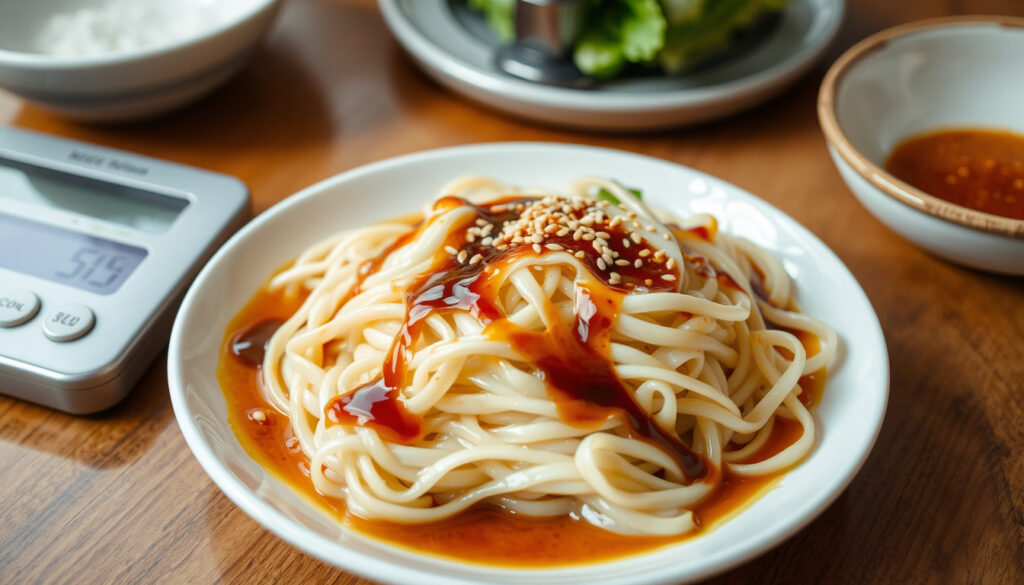
Chee Cheong Fun Calories: How Many in a Serving
Anyone who has wandered through a Singapore hawker centre has seen the steam rising from those stacked bamboo steamers. The silky-white rice noodle rolls, known as chee cheong fun, are a beloved breakfast or dim sum staple. But if you are watching your calorie intake or managing blood sugar, you might wonder what is actually in that plate. This guide breaks down the numbers and offers practical tips for making healthier choices.
Calories per plain roll: 133 kcal ·
Calories per 100g: 140 kcal ·
Calories per serving (2 slices with sauce): 196 kcal ·
Protein per plain roll: 2.09 g ·
Carbs per plain roll: 25.95 g
Quick snapshot
- Plain roll: 133 kcal (Fatsecret Singapore)
- Sweet sauce (27g) adds 67 kcal (Fitia)
- Char siew per piece: 322 kcal (HealthXchange (SingHealth))
- Two slices with sauce: ~196 kcal (Zalora Blog)
- Exact sugar content of house-made sweet sauces varies by vendor (AsiaOne)
- Prawn chee cheong fun lacks standardised nutritional data (AsiaOne)
- Hawker portion sizes can range from 150g to 250g per serving (Singapore Calorie)
- A typical Singapore portion (200–250g) roughly doubles the calories and carbs of a 100g reference serving (Singapore Calorie)
- Health authorities have flagged sweet sauce as a blood sugar concern for diabetics (AsiaOne)
- No major regulatory update on nutritional labelling for hawker foods in Singapore (Singapore Calorie)
- Choose plain rolls with minimal sauce to keep calories under 150 per serving
- Add protein (egg, chicken) to improve satiety and reduce blood sugar impact
- Pair with vegetables or a side of clear soup for a balanced meal
- Limit portion to 1–2 rolls; avoid char siew or prawn variants if counting calories
The snapshot shows a clear divide: the plain roll itself is moderate, but extras quickly change the equation.
| Calories (plain roll) | 133 kcal |
|---|---|
| Calories (100g) | 140 kcal |
| Protein (per roll) | 2.09 g |
| Carbs (per roll) | 25.95 g |
| Fat (per roll) | 2.10 g |
| Sugar (sweet sauce serving) | ~15 g |
The spec table confirms the core problem: low protein and fiber, with nearly all calories coming from refined carbohydrates.
How many calories are in chee cheong fun?
Calories per roll (plain)
- A single plain chee cheong fun roll contains about 133 calories, based on data from Fatsecret Singapore (calorie tracking database).
- This serving provides 25.95 g of carbohydrates, 2.09 g of protein, and 2.10 g of fat.
Calories per 100g
- Per 100 grams, chee cheong fun supplies roughly 140 calories, according to the same Fatsecret Singapore entry.
- Other sources place the figure between 107 and 110 kcal per 100 g (NutriScan; Singapore Calorie), reflecting slight variation by recipe.
Calories with sweet sauce
- The sweet sauce typically poured over chee cheong fun adds about 67 calories per 27 g serving (Fitia (nutrition app)).
- A common serving of two slices with sauce totals roughly 196 calories (Zalora Blog).
Calories with char siew
- A single piece of char siew (barbecued pork) chee cheong fun packs 322 calories, as reported by HealthXchange (SingHealth’s health portal).
- That serving is about 149 g and contains 18 g of fat and 25 g of carbohydrates.
Calories with prawn
- Prawn (shrimp) chee cheong fun is estimated at around 125 kcal per 100 g (NutriScan).
- Standardised data for prawn variants is scarce, so actual calorie counts depend heavily on the size of the prawns and any added oil.
The pattern across variants is clear: the plain roll is the only option that stays under 150 kcal per serving. Adding sauce or meat more than doubles the energy load.
Is chee cheong fun healthy?
Nutritional breakdown
- Chee cheong fun is almost entirely refined carbohydrates — 25.95 g of carbs per roll with only 2.09 g of protein (Fatsecret Singapore).
- Fiber is negligible (0.5 g per 100 g according to Singapore Calorie).
Protein and fiber content
- With only 2 g of protein per roll, chee cheong fun does not promote satiety. HealthXchange notes that many dim sum items are low in protein and high in refined starch.
- The lack of fiber means the carbohydrates are rapidly digested, which can lead to a quick blood sugar spike.
Sodium and fat content
- The rice noodle itself is low in fat (2.10 g per roll), but the accompanying sweet soy sauce can add significant sodium — up to 400–500 mg per serving (Fitia).
- Char siew variant, by contrast, contains 18 g of fat per piece (HealthXchange).
Comparison to other breakfast options
- Compared to a bowl of oat porridge (about 150 kcal with 5 g fiber), chee cheong fun is less nutrient-dense for the same calories.
- HealthXchange ranks chee cheong fun as a dim sum item that is “often high in calories and fat” when served with meat or sauce.
The implication: what makes chee cheong fun unhealthy is not the noodle itself, but the near-total absence of protein and fiber.
Is chee cheong fun high in sugar?
Sugar in the rice noodle itself
- The rice noodle roll contains less than 1 g of sugar per roll (Fatsecret Singapore). The sugar concern comes entirely from the accompaniments.
Sugar in sweet sauce
- One serving of sweet sauce (27 g) adds about 15 g of sugar — roughly 3 teaspoons (Fitia).
- An AsiaOne report warns that two pieces of chee cheong fun can contain the equivalent of seven teaspoons of sugar — more than the sugar in three bowls of laksa.
Hidden sugars in char siew
- Char siew is coated with a sweet glaze that adds sugar. HealthXchange data shows that a single char siew piece has 322 calories, with a significant portion coming from added sugars.
Sugar comparison with other dim sum
- Compared to steamed dumplings (har gow: ~1 g sugar per piece), chee cheong fun with sauce delivers a much higher sugar load.
- The combination of refined carbs and added sugar makes it one of the sweeter dim sum options.
The rice noodle itself is sugar-free, but the sweet sauce transforms a modest dish into a sugar bomb. For someone with diabetes, that sauce can undo a whole day’s careful planning.
The pattern: the noodle is innocent; the sauce is the offender. Skipping it cuts sugar content by 80%.
Is chee cheong fun fattening?
Calorie density analysis
- At roughly 140 kcal per 100 g, chee cheong fun is calorie-dense compared to vegetables or lean proteins, but moderate compared to fried noodles (which can exceed 250 kcal per 100 g).
- The Zalora Blog notes that a serving of two slices with sauce is about 196 kcal — not an outlier, but easily doubled if you add char siew or extra sauce.
Portion control
- Hawker portions often exceed a single serving. Singapore Calorie warns that a typical plate is 200–250 g, which can push the calorie count to 300–350 kcal before any extras.
How it fits into a daily calorie budget
- For a 2,000 kcal daily target, a 250 g serving of plain chee cheong fun (about 350 kcal) uses 17.5% of your budget — reasonable, but without much protein or nutrition to show for it.
- Adding char siew (322 kcal) would bring the meal to over 600 kcal, leaving little room for other meals.
Healthier alternatives
- Steamed rice rolls are not the worst hawker choice — but they are not the best either. Swapping sauce for a splash of light soy and adding a side of vegetables can improve the balance.
- For weight management, opt for plain rolls (1–2) and skip the sweet sauce entirely.
What this means for weight watchers: the dish itself is moderate, but the way it is typically eaten — with sauce and meat — pushes it into high-calorie territory.
Can chee cheong fun be part of a diabetes-friendly diet?
Glycemic index of rice noodles
- Rice noodles have a high glycemic index (GI above 70), meaning they are rapidly digested and cause a sharp rise in blood sugar (HealthXchange).
- This is especially problematic for diabetics, who need to manage post-meal glucose spikes.
Impact of sauces on blood sugar
- The sweet sauce adds a concentrated sugar load. AsiaOne explicitly calls the sauce “dangerous for blood sugar levels” in people with diabetes.
- Even a moderate serving can contain 15 g of sugar — equivalent to half the daily added sugar limit recommended by the World Health Organization for an adult.
Tips for diabetics eating chee cheong fun
- Choose plain chee cheong fun with minimal or no sauce. Ask for the sauce on the side and use it sparingly.
- Add a source of protein such as a poached egg, steamed chicken, or tofu to slow glucose absorption.
- Pair with a side of vegetables or a clear soup to increase fiber and lower the overall glycemic load.
- Limit portion size to one serving (two rolls maximum) and monitor blood sugar after eating to understand your personal response.
Portion size recommendations
- HealthXchange recommends that diabetics avoid high-GI dim sum items or eat them in very small quantities.
- Stick to 100–150 g of chee cheong fun (about 2 small rolls) and skip the meat and sauce to keep the meal under 200 kcal and 30 g of carbs.
For a diabetic, chee cheong fun is a high-risk food. The combination of high-GI noodles and sugary sauce can spike blood sugar within 30 minutes. The trade-off: you can still enjoy it, but only with strict portion control and protein pairing.
The catch: even with protein pairing, the high glycemic index of the rice noodle itself means blood sugar management requires vigilance.
Six variants, one pattern: the calorie and sugar content escalates sharply from plain to char siew. The plain roll is the only option that stays under 150 kcal per serving — adding sauce or meat more than doubles the energy load.
| Variant | Calories per serving | Carbs (g) | Protein (g) | Fat (g) | Added sugar (approx.) |
|---|---|---|---|---|---|
| Plain (1 roll, ~95g) | 133 kcal | 25.95 | 2.09 | 2.10 | 0 g |
| Plain with sweet sauce (2 rolls + 27g sauce) | 196–200 kcal | ~35 | ~4 | ~3 | ~15 g |
| Char siew (1 piece, 149g) | 322 kcal | 25 | 18 | 18 | ~10 g |
| Prawn (1 serving, ~150g) | ~188 kcal | ~22 | ~8 | ~6 | ~1 g |
Sources: Fatsecret Singapore, HealthXchange, Fitia, NutriScan
The comparison table makes the arithmetic obvious: plain is safe, sauce doubles the calories, and char siew triples them.
| Nutrient | Amount per 100g |
|---|---|
| Energy | 140 kcal |
| Carbohydrates | 25.95 g |
| Protein | 2.09 g |
| Fat | 2.10 g |
| Fiber | 0.5 g |
| Sugar | <1 g |
| Sodium | ~400 mg (with sauce) |
Sources: Fatsecret Singapore, Singapore Calorie
The spec table confirms the low protein and fiber, while the comparison table shows how quickly calories and sugar escalate. The plain roll is the safest choice, but even it offers little nutritional value.
Upsides
- Low in fat (2g per roll) if eaten plain
- Moderate calorie count for a small serving
- Gluten-free (rice-based noodles)
- Can be paired with protein to make a balanced meal
- Widely available and affordable across Singapore hawker centres
Downsides
- Very low in protein and fiber — poor satiety
- High glycemic index — spikes blood sugar
- Sweet sauce adds significant sugar (15g per serving)
- Char siew variant is high in calories and fat
- Portion sizes at hawker stalls are often larger than a single serving
The verdict: the upsides are real but conditional on eating plain and in small portions. The downsides apply to the majority of how chee cheong fun is actually eaten in Singapore — with sauce and often with meat.
“Chee Cheong Fun With Char Siew Dim Sum, Per serving size 149 (1pc) Energy (kcal) 322.”
HealthXchange (SingHealth’s health portal)
“Chee Cheong Fun per 1 roll – Calories: 133kcal | Fat: 2.10g | Carbs: 25.95g | Prot: 2.09g.”
Fatsecret Singapore (calorie tracking database)
“CHEE CHEONG FUN Roughly 160 calories (plain with sauce) … 196 calories for two slices.”
Zalora Blog
Three sources, three data points that converge on the same message: a plain roll is around 130 kcal, and adding sauce brings it to 160–200 kcal. The addition of char siew pushes the total well above 300 kcal.
For the average Singaporean who eats chee cheong fun as a quick breakfast or snack, the decision is not about eliminating it — it is about controlling the extras. The sauce is the single biggest source of hidden sugar and calories. Skipping it or using it sparingly can cut the meal’s sugar content by 80%.
Related reading: Green Chilli Chicken Rice: Recipe, Where to Eat, and Reviews · Song Garden Chinese Restaurant Menu: Dim Sum & Set Lunch Prices
snapcalorie.com, recipes.sparkpeople.com, hitungkalori.com, nutriscan.app, nutriscan.app, mylovelyrecipes.com, instagram.com, caloriqueapp.com
Frequently asked questions
What is the calorie difference between plain and char siew chee cheong fun?
A plain roll has about 133 kcal, while a single piece of char siew chee cheong fun contains 322 kcal — nearly 2.5 times more. The difference comes from the fatty pork and sweet glaze.
Is chee cheong fun gluten-free?
Yes, because it is made from rice flour and water, chee cheong fun is naturally gluten-free. However, the soy sauce used may contain wheat, so those with celiac disease should ask for a gluten-free sauce alternative.
How many calories in prawn chee cheong fun?
Prawn chee cheong fun is estimated at around 125 kcal per 100 g, or about 188 kcal for a 150 g serving. Data is limited, so actual values depend on the size of the prawns and any oil used.
Can I eat chee cheong fun on a low-carb diet?
Not really. A single roll contains 26 g of carbohydrates, which is already more than half the daily allowance on a strict low-carb (under 50 g) diet. Even a small serving is carb-heavy.
Are there any healthy versions of chee cheong fun?
Some stalls now offer whole-grain or brown rice versions, but they are rare. The healthiest option is plain chee cheong fun with minimal sauce, paired with a side of vegetables or a protein source.
What is the serving size for chee cheong fun?
A typical hawker serving is 2–3 rolls (about 150–200 g). Some stalls serve a single large roll that is cut into slices. Always ask for the portion size if you are tracking calories.
Does chee cheong fun contain MSG?
MSG is not a standard ingredient in the rice noodle itself, but some hawkers add it to the sauce or to the savoury broth that sometimes accompanies the dish. If you are sensitive, ask the vendor to skip MSG.
How to make chee cheong fun lower in calories?
Request no sweet sauce, ask for the sauce on the side, choose plain over char siew or prawn, and limit your portion to 1–2 rolls. Adding a poached egg or steamed chicken increases protein without adding much fat.
The takeaway for anyone tracking calories or managing diabetes: chee cheong fun can be part of your diet, but only if you treat the sauce as the main variable you control.
More related posts
 USB-A to USB-C Adapter: Compatibility, Charging & Tips
 178 cm in Feet: Exact Conversion to Inches + Height Guide
 Best Interest Rate for Savings Account – Top Rates April 2026
 Bluetooth Not Connecting to Car – Step-by-Step Fixes
 Flippin’ Good Menu: Prices, Items & Halal Singapore
 Sum of Geometric Series: Formula & How to Use It
 Yangzijiang Shipbuilding Share Price: Is It a Buy
 Where to Use CDC Vouchers in Singapore: Food & Supermarkets
