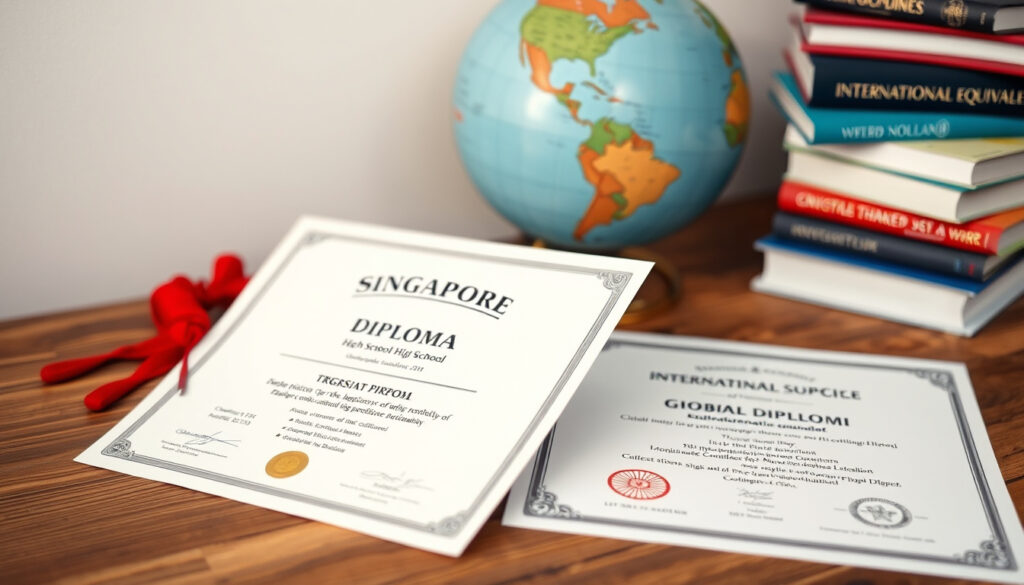
High school diploma Singapore equivalent: Full guide
If you’re moving to Singapore or helping a child navigate the education system here, one of the first questions you’ll ask is: what counts as a high school diploma in this country? The short answer is that Singapore doesn’t issue a general diploma the way the US does. Instead, students earn credentials like the GCE O-Level or the International Baccalaureate.
Secondary education duration in Singapore: 4–5 years ·
Typical age for GCE O-Level examination: 16–17 ·
Polytechnic diploma duration: 3 years ·
IB high school diploma offered by: multiple international schools
Quick snapshot
- 6 years primary, 4–5 years secondary (Ministry of Education, Singapore’s national education authority)
- National exams: PSLE, O-Level, N-Level (Ministry of Education, Singapore’s national education authority)
- Post-secondary: JC, Poly, ITE (Ministry of Education, Singapore’s national education authority)
- GCE O-Level (most common) (MOE’s JAE guidance)
- GCE N-Level (Normal Academic/Technical) (MOE’s JAE guidance)
- International Baccalaureate (at international schools) (MOE’s JAE guidance)
- 3-year post-secondary qualification (MOE overview)
- Vocational and industry-focused (MOE overview)
- Not equivalent to high school; above high school level (MOE overview)
- IB Diploma offered by many international schools
- American high school diploma (accredited schools)
- GED accepted for some purposes
A quick look at the key facts about Singapore’s secondary credentials shows a system that doesn’t fit the US high school diploma mold neatly.
| Label | Value |
|---|---|
| Official high school diploma in Singapore | None |
| Most common secondary certification | GCE O-Level (MDIS, Singapore’s oldest graduate institution) |
| Age of secondary completion | 16–17 |
| Post-secondary options after O-Level | Junior College (2 years), Polytechnic (3 years), ITE (1–2 years) (MOE JAE pathways) |
| International Baccalaureate offered by | Approximately 20 international schools |
What is the high school equivalent in SG?
What is the equivalent of a high school diploma in Singapore?
Singapore does not issue a single “high school diploma” like the US. The closest national equivalent is the Singapore-Cambridge GCE O-Level certificate, taken after 4–5 years of secondary education. According to the Ministry of Education (Singapore’s national education authority), O-Level is treated as G3 under the post-secondary placement framework and is broadly comparable to GCSE in international contexts (MDIS). For students in the Normal Academic track, the N-Level serves a similar purpose at a slightly lower level.
International students expecting a single diploma will find a system built on streaming and external exams. The O-Level is what most institutions recognise as the Singapore high school equivalent, but it’s a subject-by-subject certification, not a general diploma.
Polytechnic diploma vs high school diploma
A polytechnic diploma is a 3-year post-secondary qualification, not a high school equivalent. The MOE overview describes polytechnics as offering “hands-on, practice-based learning” at a level above secondary. In the US context, a polytechnic diploma is closer to an associate degree than a high school diploma.
O-Level vs high school diploma
The GCE O-Level is taken at age 16–17 and certifies individual subjects. A US high school diploma, by contrast, requires completing a set curriculum over four years. However, many US universities and employers accept O-Levels as equivalent to a high school diploma when combined with a transcript of coursework. The MOE’s mapping table shows that O-Level grades A1–B3 map to Grade 1 in the G2 scale, and B4–C6 map to Grade 2.
What is High School in Singapore?
Structure of secondary education in Singapore
Secondary education in Singapore lasts 4–5 years. Students are placed in Express (4 years, O-Level), Normal Academic (5 years, N-Level then O-Level), or Normal Technical (5 years, N-Level) streams. According to the MOE overview, this streaming allows students to progress at a pace suited to their abilities.
Subjects and examinations
At the end of secondary school, students sit for the Singapore-Cambridge GCE O-Level or N-Level examinations. Subjects range from languages and math to sciences and humanities. The exact examination framework is set by the Singapore Examinations and Assessment Board (SEAB) in partnership with Cambridge Assessment. For polytechnic admission, students must meet the ELR2B2 aggregate score, which uses G3 and G2 subject grades as defined by the MOE placement framework.
Types of secondary schools
Singapore offers government schools, government-aided schools, independent schools, specialised schools (e.g., sports, arts), and international schools. International schools typically offer the IB Diploma or the American high school diploma. For example, ISS International School (a leading IB school in Singapore) provides an IB high school diploma recognised worldwide.
The pattern: Singapore’s secondary system is exam-driven and streamed from the start. The O-Level is the linchpin, not a blanket diploma. Understanding the stream is key to knowing what credential a student holds.
What is grade 12 equivalent to in Singapore?
Grade 12 in the US vs. Singapore
In the US, Grade 12 is the final year of high school. In Singapore, that corresponds to either Junior College Year 2 (for A-Level or IB students) or the second or third year of a polytechnic diploma. The MOE’s JAE guidance shows that students who complete 2 years of Junior College receive the GCE A-Level, which is often considered equivalent to Grade 12 plus some first-year college credit.
What credential represents Grade 12 completion in Singapore?
There is no single Grade 12 qualification in Singapore. Different tracks lead to different credentials:
- Junior College → GCE A-Level (after 2 years) (MOE JAE pathways)
- Polytechnic → Diploma (after 3 years) – considered above high school level
- ITE → Nitec/Higher Nitec (after 1–2 years) – vocational
Singapore Polytechnic accepts O-Level, A-Level, IB, and ITE qualifications for its diploma programmes, illustrating the diverse pathways.
International equivalences
For US college admissions, a combination of O-Levels (or N-Levels) plus an additional year of high school coursework (or A-Levels) is often required. The IB Diploma, offered by international schools, is explicitly designed as a high school diploma equivalent and is widely accepted. The MOE notes that meeting the subject requirements for JC or MI is sufficient for many overseas applications.
The catch: There’s no automatic Grade 12 equivalent. The closest is the A-Level for JC students, but polytechnic students are already at a post-secondary level.
GED vs. High School Diploma: What’s the Difference?
What is the GED?
The GED (General Educational Development) is a high school equivalency test used primarily in the United States and Canada. It measures skills in four subject areas. Unlike a US high school diploma, which requires completing a course of study, the GED is a single exam. According to the MOE, Singapore does not use the GED as a standard credential; local equivalents like O-Level or N-Level are required for admission to post-secondary institutions.
How does GED compare to a US high school diploma?
Holders of a US high school diploma have completed a full curriculum over four years, while GED holders pass a test. In terms of perception, some employers and universities view the GED as less rigorous. However, the GED is accepted for college admission in the US.
Is GED recognized in Singapore?
The GED is not a recognised credential in Singapore’s education system. Students seeking admission to local universities or polytechnics must present O-Level, A-Level, IB, or an equivalent local qualification. The Temasek Polytechnic admissions page lists Singapore-Cambridge GCE O Levels as the primary local qualification; GED is not mentioned.
The trade-off: GED may be a quick route to an equivalency in the US, but in Singapore it carries no official weight. O-Level remains the gold standard for secondary equivalency here.
Diploma vs. Degree: What’s the Difference?
Diploma in Singapore’s context
In Singapore, a diploma is a post-secondary qualification, typically earned after 3 years at a polytechnic. The MOE overview describes polytechnic education as “hands-on, practice-based” and vocational in nature. Diplomas are designed to prepare students for the workforce or for further studies at the degree level.
Bachelor’s degree vs. diploma
A bachelor’s degree is a university-level qualification that usually takes 3–4 years. Degrees are more academic and required for many professional roles such as law, medicine, and engineering. Singapore Polytechnic notes that diploma holders may advance to degree programmes through articulation agreements.
When to choose a diploma over a degree
Diplomas suit students who want to enter the workforce quickly or who prefer practical, industry-focused training. Degrees are better for careers that require deep academic knowledge. According to Eipimath (education blog), polytechnic diplomas are considered above high school level but below degree level in the Singapore hierarchy.
Why this matters: Many international students confuse polytechnic diplomas with high school diplomas. In Singapore, a diploma is a post-secondary achievement, not a secondary one. That distinction affects everything from university admissions to job applications.
Four credentials, one key difference: US high school diplomas require course completion, while Singapore uses external exams and streams.
| Criteria | US High School Diploma | GCE O-Level | IB Diploma | Polytechnic Diploma |
|---|---|---|---|---|
| Duration | 4 years | 4–5 years (subject-based) | 2 years (Grades 11–12) | 3 years post-secondary |
| Purpose | General secondary completion | Subject certification (MOE) | International high school diploma | Vocational / applied learning (SP) |
| Post-secondary pathway | College entrance (SAT/ACT often required) | JC / Poly / ITE (TP) | University worldwide | University degree (advanced standing) |
Clarity: What we know and what’s unclear
Confirmed facts
- GCE O-Level is considered equivalent to a high school diploma by many international institutions (MOE PSE framework).
- Polytechnic diplomas are post-secondary, not high school equivalent (MOE overview).
- International schools in Singapore issue accredited high school diplomas (e.g., IB, American).
What’s unclear
- Whether a polytechnic diploma is accepted as a high school equivalent in the US depends on the institution.
- Exact equivalence of Singapore’s N-Level to a high school diploma is not universally standardized.
Expert perspectives
“Polytechnics provide hands-on, practice-based learning in a dynamic and progressive environment.”
Ministry of Education (Singapore’s national education authority)
“The Joint Admissions Exercise is conducted annually by MOE for Singapore-Cambridge GCE O-Level certificate holders applying to JC, MI, polytechnics and ITE.”
Summary
Singapore’s system dodges a one-size-fits-all high school diploma. Instead, students earn credentials like O-Levels, N-Levels, or IB diplomas, each with its own purpose and recognition. For international students and expat families, the implication is clear: know your stream and your exam before assuming equivalency. The O-Level is the safest bet for a universal high school equivalent, but a polytechnic diploma is a step above, not a replacement. For those seeking a straightforward high school diploma in Singapore, international schools offering the IB or American curriculum are the most direct path.
What this means for families: Students and parents must actively verify which credential their target institution requires, rather than assuming a single document covers all pathways.
Related reading: How to Differentiate e^x: Formula, Proof, and Examples · Semiconductor Companies in Singapore: Top Firms 2025
eipimath.com, en.wikipedia.org, sp.edu.sg, moe.gov.sg, sp.edu.sg, superprof.sg, ancourage.academy, np.edu.sg
For students exploring alternatives to traditional qualifications, the city-state also offers various private diploma pathways that can be considered alongside standard high school equivalencies.
Frequently asked questions
How many years is high school in Singapore?
Secondary education in Singapore lasts 4–5 years, depending on the stream (Express, Normal Academic, Normal Technical). There is no single “high school” duration.
Can I get a high school diploma online in Singapore?
Online high school programs exist, but they are not part of the national system. International schools may offer online options, but the local MOE does not provide an online high school diploma.
Are polytechnic diplomas recognized as high school equivalents in the US?
It depends on the institution. Some US colleges accept a polytechnic diploma as meeting high school requirements, but many see it as a post-secondary credential. Always check with the admissions office.
What is the difference between O-Level and N-Level?
O-Level (Ordinary Level) is taken after 4 years in the Express stream or 5 years in Normal Academic. N-Level (Normal Level) is taken after 4 years in the Normal Academic or Normal Technical stream and is a lower-tier exam. According to the MOE placement framework, G3 (O-Level) is equivalent to a higher grade than G2 (N-Level).
Do international schools in Singapore issue high school diplomas?
Yes. International schools accredited by bodies like the Western Association of Schools and Colleges (WASC) or offering the IB Diploma issue high school diplomas recognised globally.
What is the IB high school diploma in Singapore?
The International Baccalaureate Diploma is a rigorous 2-year programme offered by many international schools in Singapore. It is accepted by universities worldwide as a high school diploma equivalent.
Is a GED accepted for university admission in Singapore?
No. Singapore universities require O-Level, A-Level, IB, or equivalent local qualifications. GED is not recognised in the local system.
More related posts
 Our Yishun Family Clinic: Services, Doctors & Appointments
 Citi Points to Miles: Conversion Guide (2026)
 HDB Buy Back Scheme: Eligibility & Payouts for Seniors
 ANA Singapore to Tokyo: Boeing 787-9 Flight & Comfort Guide
 Things to Do in Hokkaido: First-Timer Guide & Itinerary
 Singapore Telecom Share Price – Live Z74 Chart and Key Metrics
 Food at Changi City Point: Best Restaurants, Halal Options & More
 Nature Landscapes Pte Ltd: Services, Contact & Reviews
