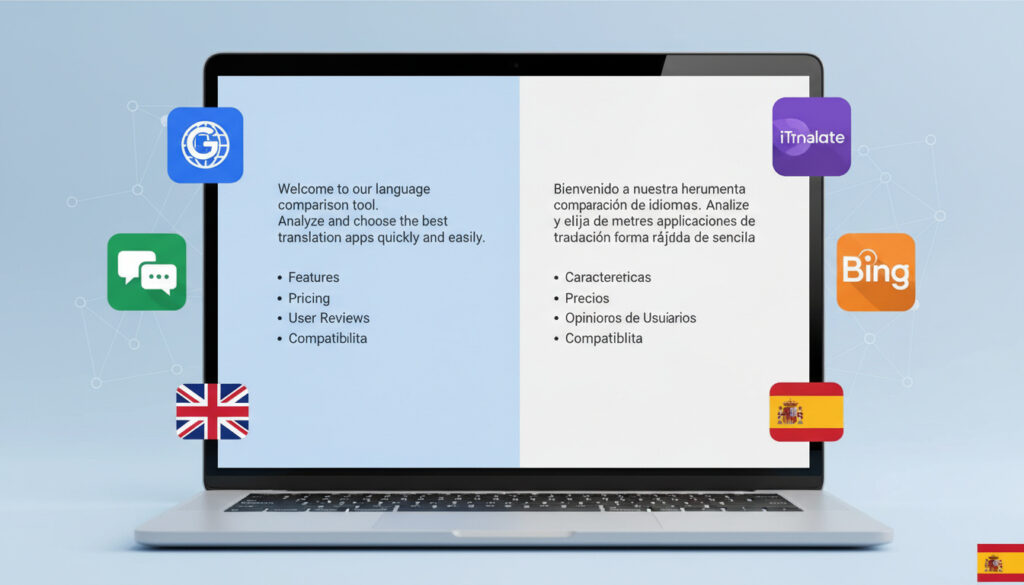
English to Spanish Translation – Best Tools Compared
English to Spanish translation tools now support 249 languages and offline functionality across multiple platforms. While Google Translate dominates market coverage, specialized alternatives offer superior contextual accuracy for European language pairs.
Users navigate between free mobile applications and professional hardware solutions depending on connectivity constraints and accuracy requirements. The American Translators Association has evaluated multiple platforms, noting significant variation in handling complex sentence structures and regional dialects.
This analysis examines the leading digital solutions, their specific limitations, and the scenarios where automated systems complement human expertise.
What is the best English to Spanish translator?
- Google Translate supports 249 languages with offline functionality for over 100 of them, according to the American Translators Association.
- DeepL provides alternative sentence suggestions that consider different Spanish formality levels (usted, tú, vosotros forms), which Google Translate lacks.
- Microsoft Translator demonstrates strong accuracy in business and technical translations, though its user interface can be less intuitive than competitors.
- Neural machine translation systems achieve 90%+ accuracy for simple text but struggle with idioms and cultural context.
- Privacy concerns exist regarding Google Translate’s data collection practices, while offline-capable tools mitigate this risk.
- Hardware solutions like Pocketalk claim 99% confidence for Spanish-to-English translations and include built-in two-year data plans.
- Voice-to-text capabilities are standard across major platforms including Reverso Context and iTranslate.
| Tool | Free Option | Languages | Offline Mode | Voice-to-Text | Document Support |
|---|---|---|---|---|---|
| Google Translate | Yes | 249 | Yes (100+) | Yes | Yes |
| DeepL | Yes | 35 | No | Yes | Limited |
| Microsoft Translator | Yes | 100+ | Yes (limited) | Yes | Yes (Office integration) |
| Reverso Context | Yes | 28 | Yes | Yes | No |
| Speak & Translate | Yes (limited) | 100+ | Yes | Yes | No |
| iTranslate | Yes (basic) | 100+ | Yes (certain languages) | Yes | No |
How do I translate English to Spanish for free?
Free access points include web platforms and mobile applications. Google Translate provides comprehensive coverage without subscription fees across web and mobile interfaces. SayHi Translate offers conversational functionality at no cost, though it requires internet connectivity.
WordReference and SpanishDict Translator specialize in dictionary-style lookups with community-validated translations. iTranslate operates on a freemium model, providing basic dictionary and offline features without charge while reserving advanced capabilities for premium subscribers.
Where can I find a free English to Spanish translator?
The most accessible entry point remains Google’s ecosystem, supporting text, voice, and image translation without fees. For users prioritizing contextual examples, Reverso Context delivers phrase-based learning tools at no cost, offering offline use for 28 languages.
Download offline language packs before traveling to avoid connectivity charges. Google Translate offers offline functionality for Spanish among 59+ languages, while Reverso Context provides offline access for its supported 28 languages.
How accurate is English to Spanish translation online?
Accuracy depends on text complexity and regional variation. Neural machine translation systems now handle literal translation with high proficiency, yet cultural idioms remain problematic. DeepL demonstrates particular strength in distinguishing between formal and informal Spanish registers, automatically suggesting alternatives for usted versus tú usage that reflect regional differences between Spain and Latin America.
Google Translate shows inconsistency with complex sentence structures, according to comparative testing by translation professionals. Microsoft Translator maintains strong accuracy in business and technical domains but presents a less intuitive interface.
What are common errors in English to Spanish translations?
False cognates and literal idiom translation generate the most frequent mistakes. Regional slang varies significantly between Latin American and Iberian Spanish, creating ambiguity that algorithms struggle to resolve. The tools often miss subjunctive mood nuances that English lacks.
Are there professional English to Spanish translation services?
When precision is paramount, human translators remain essential. Hardware solutions like Pocketalk target travelers with dedicated devices claiming 99% confidence rates for Spanish-to-English conversion. For document certification or legal proceedings, certified human services provide liability protection that automated systems cannot offer.
Google Translate’s data collection practices raise privacy concerns for sensitive communications. Tools with offline capabilities, such as Microsoft Translator’s downloaded language packs, mitigate these risks by processing text locally without cloud transmission.
How to translate documents from English to Spanish?
Document workflows require format preservation and terminology consistency. Google Translate handles document uploads directly through its web interface, maintaining basic formatting while converting text. DeepL offers limited document support in its free tier, with expanded capabilities for subscribers.
For professional requirements, Microsoft Translator integrates with Office 365 applications, allowing real-time translation within Word and PowerPoint. This ecosystem approach proves valuable for enterprise users handling confidential business materials.
DeepL automatically provides multiple formality options reflecting regional variations between Spain and Latin America, a capability lacking in Google Translate’s standard output. This distinction is critical for business correspondence.
How has English to Spanish translation technology evolved?
- : Google Translate launches, initially using statistical machine translation methods.
- : Neural machine translation (NMT) rolls out across major platforms, dramatically improving Spanish accuracy by processing entire sentences rather than individual words.
- : DeepL adds Spanish support with advanced contextual awareness, introducing automatic formality level detection for regional variations.
- : Multimodal translation combining voice, image, and text processing becomes standard across mobile applications, with hardware devices like Pocketalk achieving 99% confidence ratings.
What capabilities are proven versus uncertain in translation technology?
| Established Information | Information That Remains Unclear |
|---|---|
| Google Translate processes 249 languages with offline support for over 100. | The extent to which rapidly evolving internet slang is accurately captured varies by region and update cycle. |
| DeepL requires internet connectivity to function and cannot operate offline. | Long-term privacy implications of cloud-based translation services for sensitive professional communications remain under scrutiny. |
| Neural networks power modern translation engines with measurable accuracy improvements over statistical methods. | Cultural nuance in humor and metaphorical expression continues to challenge algorithmic interpretation consistently. |
| Hardware translators like Pocketalk provide dedicated devices with 99% confidence for Spanish and extended battery life. | Accuracy rates for spoken dialects versus text input vary significantly by regional accent. |
Why does English to Spanish translation require specialized consideration?
Spanish ranks among the world’s most spoken languages, yet its dialectical variation creates unique computational challenges. The language spans twenty countries with distinct vocabulary, pronunciation, and grammatical preferences. European Spanish utilizes vosotros for plural informal address, a form absent in Latin American variants. These distinctions demand sophisticated contextual analysis that simple dictionary substitution cannot provide.
Machine translation must navigate grammatical gender, verb conjugation complexity, and subjunctive mood usage that English lacks. Technological advancement in translation algorithms shares research foundations with institutions like Delft University of Technology – 2026 Rankings and Key Facts, where computational linguistics research continues to influence natural language processing development.
What do experts say about modern translation capabilities?
Neural networks power accurate translations through deep learning pattern recognition.
Google AI Blog
AI excels in literal translation but requires human oversight for culturally sensitive materials.
DeepL Research
Which English to Spanish translation solution fits your needs?
Selection depends on context sensitivity and connectivity constraints. Casual travelers benefit from Google Translate’s offline capabilities and broad language support. Professionals requiring nuanced formality handling should consider DeepL. For confidential business documents, Microsoft Translator’s enterprise integration or certified human services provide necessary security and accuracy guarantees. For a detailed comparison, see English to Spanish Translation – Best Tools Compared.
Common Questions About Translation Tools
What are common errors in English to Spanish translations?
Literal idiom translation and false cognates cause frequent errors. Regional slang variations between Spain and Latin America create additional ambiguity that automated systems often miss.
Are there professional English to Spanish translation services?
Yes, certified human translators remain essential for legal, medical, and business documents requiring absolute accuracy and liability protection.
Does Google Translate work offline for Spanish?
Yes, Google Translate supports offline functionality for Spanish among over 100 languages, though initial download requires internet connectivity.
Which translator handles Spanish formality levels best?
DeepL automatically provides alternative suggestions for usted, tú, and vosotros forms, addressing regional variations between European and Latin American Spanish.
Are hardware translators worth the investment?
Devices like Pocketalk offer 99% confidence ratings and two-year data plans, proving valuable for frequent travelers in areas with limited smartphone reliability.
Is DeepL completely free?
DeepL offers free web translation with usage limits. Document translation and API access require premium subscriptions, and the service requires internet connectivity.
How accurate is machine translation for Spanish?
AI achieves over 90% accuracy for simple, literal text but struggles with complex sentences, cultural references, and technical jargon requiring specialized knowledge.
What privacy risks exist with online translators?
Cloud-based services like Google Translate store translation data, creating potential exposure for sensitive information. Offline modes and local processing reduce these risks.
More related posts
 www.pglucky88.win: What Is Verified About This Slot Domain
 Brilliant Stars Card List: Complete Set Guide with Prices & Top 10
 Indonesia vs Saudi Arabia: Match Result and Key Comparisons
 Flight to Sabah from Singapore: Cheap Direct Flights & Times
 Single Trip Travel Insurance: Ireland’s 2025 Guide
 iHerb Promo Code Singapore: 20% Off + Free Shipping
 American Express Credit Card: Eligibility, Benefits & Tips 2025
 Guangzhou Weather March 2026: Temperature, Packing & Travel Tips
