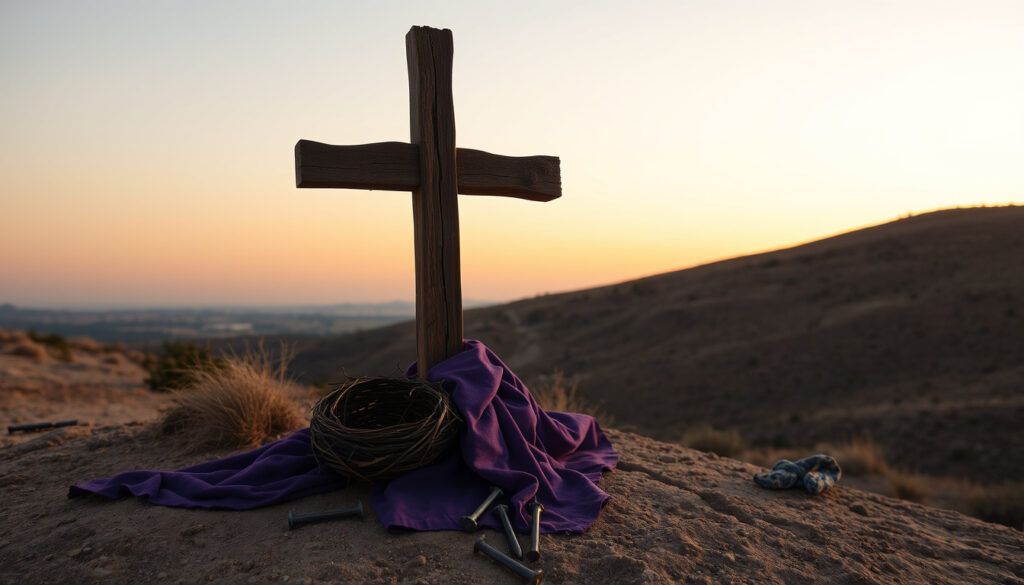
What Is Good Friday? Meaning, History & Traditions
Good Friday is Christianity’s most striking paradox—a day of mourning marked by the word “good.” The crucifixion of Jesus of Nazareth was a brutal Roman execution, yet Christians call this day “good” because they believe it marks the moment when divine salvation became concrete through Christ’s suffering. This article walks through the biblical timeline, the theological meaning behind the name, and the specific ways Christians observe this solemn holy day.
Commemorates: Crucifixion of Jesus ·
Date: Friday before Easter ·
Observed by: Christians worldwide ·
Part of: Holy Week ·
Key events: Trial, crucifixion, death at Calvary
Quick snapshot
- Crucifixion at Calvary (Golgotha) (Catholic Online)
- Day of supreme goodness and salvation (CTS Books)
- Liturgy traditionally held at 3pm (CTS Books)
- Exact hour-by-hour sequence of events (Catholic Online)
- Pilate’s precise wording during sentencing (Catholic Online)
- Whether some details in Gospel accounts overlap chronologically (Catholic Online)
- Morning: Trial before Pontius Pilate (Catholic Online)
- Noon–3pm: Darkness falls; crucifixion occurs (Catholic Online)
- 3pm: Jesus breathes his last (Catholic Online)
- Holy Saturday: day of quiet waiting (Boston Public Library)
- Easter Vigil begins Saturday night (Boston Public Library)
- Easter Sunday: resurrection celebrated (Boston Public Library)
What Is Good Friday Celebrated For?
Good Friday commemorates the crucifixion and death of Jesus Christ at Calvary, the hill outside Jerusalem where the Gospels place his execution. It falls during Holy Week, the final stretch of Lent, and marks the somber midpoint of the Paschal Triduum—the three-day liturgical sequence that includes Maundy Thursday, Good Friday, and the Easter Vigil (Wikipedia). For Christians, the day carries the weight of central events in salvation history.
Historical background
The liturgical observance of Good Friday dates to the earliest days of the Church, with practices developing as Christian communities formalized their remembrance of Christ’s Passion (Catholic Online). In Jerusalem, accounts from the 5th century describe the veneration of the True Cross housed in a gold-plated coffer, a tradition that would later spread westward (Catholic Online). St. Helen, mother of Emperor Constantine, reportedly discovered a fragment of the True Cross in 326 AD, lending historical weight to cross veneration practices (Catholic Online).
Christian significance
The cross stands at the center of Christian theology. For Catholics, the events of Good Friday represent the moment when Christ’s sacrifice made salvation possible—a act of love that church teaching holds redeems humanity from sin. The inscription on the cross read “Iesus Nazarenus, Rex Iudaeorum,” abbreviated as INRI, identified Jesus before his accusers (Catholic Online). One of the two criminals crucified alongside Jesus repented during the final hours, a moment the Gospels present as a sign of the universal reach of salvation (Catholic Online).
Why Do They Call This Friday Good?
The name “Good Friday” puzzles many people. The crucifixion was a brutal execution—the death of an innocent man on a cross. How does that become “good”? The answer lies in etymology and theology rather than in describing the events themselves.
Theological reasons
The theological interpretation holds that what appears tragic is actually the mechanism of salvation. “The day is ‘good’ because it is the day that our salvation was won for us by Christ on the Cross,” explains CTS Books, a Catholic publisher (CTS Books). In this reading, the suffering and death are not the final word—they are the means through which Christians believe God’s love and forgiveness become available to humanity.
Historical naming
The word “good” may derive from an old English term meaning “holy” or “pious,” or from “God’s Friday.” In Anglo-Saxon England, the day was called “Lang Fredag” or “Long Friday,” emphasizing its solemn significance rather than its moral character (CTS Books). “Good” in this context suggests something sacred or set apart, not something pleasant or positive in the modern sense.
The name works as a theological inversion: what the world sees as an execution, Christians understand as the supreme act of love that enables salvation.
What Happened to Jesus on Good Friday?
The Gospel accounts—particularly those of Matthew, Mark, Luke, and John—provide the narrative framework for what Christians believe occurred on this day. The biblical timeline places Jesus before Pontius Pilate, the Roman governor of Judea, who ultimately ordered the crucifixion.
Trial and sentencing
According to Gospel accounts, Jesus was tried before the Sanhedrin at night and then brought to Pilate the following morning. The governor sought to release Jesus, but the crowd, according to the accounts, called for Barabbas instead. The titulus affixed to the cross read “Iesus Nazarenus, Rex Iudaeorum”—”Jesus of Nazareth, King of the Jews” (Catholic Online). The exact chronology across Gospel writers varies slightly, with some details potentially overlapping in time.
Crucifixion and death
Jesus carried his cross—or a portion of it—to Golgotha, the place of the skull, where the crucifixion took place. The Gospel of John records that Jesus spoke from the cross, including the declaration “It is finished” before his death (John 19:30). Catholic liturgical tradition holds the liturgy at 3pm, the hour traditionally associated with Christ’s death (CTS Books). Some churches hold a Three Hours’ Agony service from noon to 3pm, a period of solemn reflection on the final hours (Wikipedia).
What Is Forbidden on Good Friday?
Catholic tradition imposes specific restrictions on Good Friday, treating it as a day of penance comparable to Ash Wednesday. These observances distinguish the day as set apart from ordinary Fridays.
Fasting practices
Catholics who have reached their 18th birthday but not yet their 60th are bound to fast on Good Friday, traditionally defined as one full meal and two smaller collations that together do not equal a full meal (Wikipedia). Additionally, Catholics abstain from meat on Good Friday—a practice that extends to Fridays throughout the year in some traditions (CTS Books). This abstinence serves as an act of penance, uniting the observer with Christ’s sacrifice.
Church observances
The Catholic Church does not celebrate Mass on Good Friday. Instead, the liturgy centers on the distribution of Holy Communion reserved from the previous day’s Mass (Catholic Online). The liturgy begins with the priest and deacon prostrating themselves in silence, a gesture of reverence and mourning (CTS Books). The Passion is read from the Gospel of John during the liturgy, placing scriptural narrative at the center of the observance (Wikipedia).
How Is Good Friday Celebrated?
Observance practices vary between Catholic, Protestant, and Orthodox traditions, with each bringing distinct liturgical emphases to the day. The common thread is solemn reflection on Christ’s suffering and death.
Catholic traditions
The Veneration of the Cross stands as one of Catholic Good Friday’s signature practices. During this rite, an unveiled cross or crucifix is displayed, and the faithful approach to kiss or touch it—a gesture of reverence for the instrument of Christ’s death (CTS Books). Rome adopted this practice from Jerusalem in the 7th century, where earlier accounts describe the veneration of a gold-plated coffer holding a fragment of the True Cross (Catholic Online). The cross used in veneration is traditionally made from ash tree wood, according to some accounts (CTS Books).
The veneration ritual connects contemporary believers to a tradition stretching back to 4th-century Jerusalem, creating continuity across nearly two millennia of Christian practice.
General Christian services
Many Protestant denominations hold services on Good Friday, though without the formal liturgy of Catholic tradition. Topics typically include the Stations of the Cross—a series of reflections on events from Jesus’ condemnation to his burial—prayed in the evening in Catholic tradition (Wikipedia). Some churches observe the day with Taizé services, contemplative music, or extended silent prayer. The 40 Hours’ Devotion, a vigil extending from 3pm Good Friday to Easter morning, is observed in some communities as a period of continuous prayer (FishEaters).
The Biblical Timeline of Good Friday
The sequence of events on Good Friday, as reconstructed from Gospel accounts, shows a compressed series of events from early morning through late afternoon.
| Period | Event | Source |
|---|---|---|
| Morning | Trial before Pontius Pilate | Gospels (Matthew 27, John 18) |
| Mid-morning | Jesus sentenced; carrying the cross to Golgotha | Gospels (Mark 15, John 19) |
| Noon–3pm | Crucifixion; darkness falls over the land | Gospels (Matthew 27, Luke 23) |
| 3pm | Jesus’ death | Gospels (Matthew 27, Mark 15) |
Four Gospel writers present the Passion narrative, with each adding distinct details and emphases. John places the cleansing of the temple earlier in Jesus’ ministry, while the Synoptic Gospels (Matthew, Mark, Luke) arrange events in a more continuous sequence.
The pattern shows all four accounts converging on core events—trial, crucifixion, and death—while differing on chronological details that biblical scholars continue to examine.
Denominational Variations
Good Friday is observed across Christian traditions, but the specifics—dates, names, and liturgical practices—vary based on theological traditions and calendar systems.
| Tradition | Name | Date variation |
|---|---|---|
| Western Catholic / Protestant | Good Friday | Follows Gregorian calendar |
| Eastern Orthodox | Great and Holy Friday | Follows Julian calendar; typically later |
| Example: 2019 | — | Western: April 19; Orthodox: April 26 |
The Eastern Orthodox Church observes Good Friday according to the Julian calendar, which currently runs approximately 13 days behind the Gregorian calendar used in Western Christianity. This means Orthodox Good Friday typically falls after the Western observance in years when the calendars diverge (Boston Public Library). Byzantine tradition begins the observance Thursday night with Matins of Twelve Passion Gospels, a distinctive practice not found in Western rites (Wikipedia).
The calendar difference means that in some years, Western and Orthodox Christians observe the key days of Holy Week weeks apart, a visible reminder of the theological and administrative divisions within Christianity.
When calculating when Easter falls, denominational differences in the calendar create observances that may be weeks apart—a reminder that “Christian unity” encompasses significant liturgical diversity.
Confirmed Facts and Uncertainties
Research on Good Friday draws from scriptural sources, liturgical documents, and historical accounts. Several points rest on solid evidence, while others remain matters of interpretation or tradition.
Confirmed facts
- Crucifixion occurred at a site identified as Golgotha, outside Jerusalem
- The event fell on a Friday before the Jewish Sabbath
- Jesus died before sunset, traditional Jewish day-end
- The day has been observed since the earliest Christian communities
- Cross veneration spread from Jerusalem to Rome in the 7th century
Uncertain or debated
- Exact hour-by-hour reconstruction of the day’s events
- Precise wording of Pilate’s pronouncement
- Whether some Gospel details describe simultaneous events
- Archaeological evidence for the True Cross discovery in 326 AD
The balance between what is historically verifiable and what remains matters of faith shapes how Christians approach the day—the certainties provide a foundation, while the uncertainties leave room for theological interpretation.
“The day is ‘good’ because it is the day that our salvation was won for us by Christ on the Cross.”
— CTS Books (Catholic publisher)
“Good” in Good Friday does not describe these events; it actually comes from old English when “good” meant “holy.”
— Boston Public Library
For Christians observing Good Friday, the historical uncertainties matter less than the theological certainty expressed in the liturgical tradition: that through Christ’s suffering and death, salvation became possible. The cross that once signified criminal execution became the central symbol of Christian faith—transformed by belief in what occurred on that Friday.
Related reading: Last Day of CNY 2026: Date, Events & Traditions
Good Friday’s solemn events draw from biblical history while encompassing diverse global traditionsglobal traditions among Christian communities worldwide.
Frequently asked questions
What is Good Friday in the Bible?
The Bible describes Good Friday events in the four Gospels, with the Passion narratives recounting Jesus’ trial, crucifixion, and death. Key chapters include Matthew 27, Mark 15, Luke 23, and John 18–19. The accounts describe Jesus before Pontius Pilate, his crucifixion at Golgotha, and his death around the ninth hour (3pm).
What is the connection between Good Friday and Easter?
Good Friday and Easter Sunday are linked through the Paschal Triduum, a three-day liturgical sequence. Good Friday commemorates Christ’s death; Holy Saturday is a day of quiet waiting; Easter Sunday celebrates the resurrection. For Christians, the resurrection only holds meaning because of the sacrifice remembered on Good Friday.
Why is Good Friday on a different date each year?
Good Friday falls on the Friday before Easter, and Easter’s date is calculated using a complex formula tied to the vernal equinox and lunar cycles. This system, established at the Council of Nicaea in 325 AD, places Easter on the first Sunday after the first full moon after March 21. Eastern Orthodox churches use the Julian calendar, causing Good Friday to fall on a different Gregorian date.
Do Protestants observe Good Friday differently?
Protestant observance varies by denomination. Many hold special Good Friday services, often featuring hymnody, scripture readings, and reflection on the cross. Unlike Catholic tradition, most Protestant churches do not formally venerate the cross through a liturgical rite. Some denominations with high liturgical practice (Anglicans, Lutherans) may observe traditions closer to Catholic practice.
What foods are avoided on Good Friday?
Catholic tradition requires abstaining from meat on Good Friday. Some Catholics also fast, limiting food intake to one full meal and two smaller meals. Fish is traditionally permitted as an alternative protein source. Other Christian traditions vary—some avoid meat entirely, while others observe no specific dietary restrictions.
Is Good Friday a public holiday?
Good Friday is a public holiday in many countries with Christian majorities, including much of Europe, parts of Latin America, Canada, and parts of the United States. However, its status varies widely: some countries observe it as a full public holiday, others as a bank holiday, and some—notably France and several other European nations—do not designate it as an official public holiday.
What prayers are said on Good Friday?
Catholic Good Friday liturgy includes the “Collect” prayer, the Passion narrative from John, solemn intercessions for the Church, the world, and specific intentions, and concludes with veneration of the cross. The prayer “Lord Jesus, who died for us, have mercy on us” is commonly recited. Many Christians also pray the Stations of the Cross, a devotion tracing Jesus’ final hours through fourteen stations.
More related posts
 iPhone 16 Pro Max – Specs Release Date Comparison
 Marina Bay Financial Centre Tower 3: MRT, Floors & Parking
 Tiong Bahru Hainanese Boneless Chicken Rice: Michelin Guide & Review
 USB-A to USB-C Adapter: Compatibility, Charging & Tips
 Bihar Election Results 2025: NDA Wins 202 Seats
 How to Clean a Hairbrush with Baking Soda (Salon Method)
 Tom Cruise and Ana de Armas: Romance Timeline & Split
 RV Living Full Time: Guide, Costs, Rules, and Legal Tips
