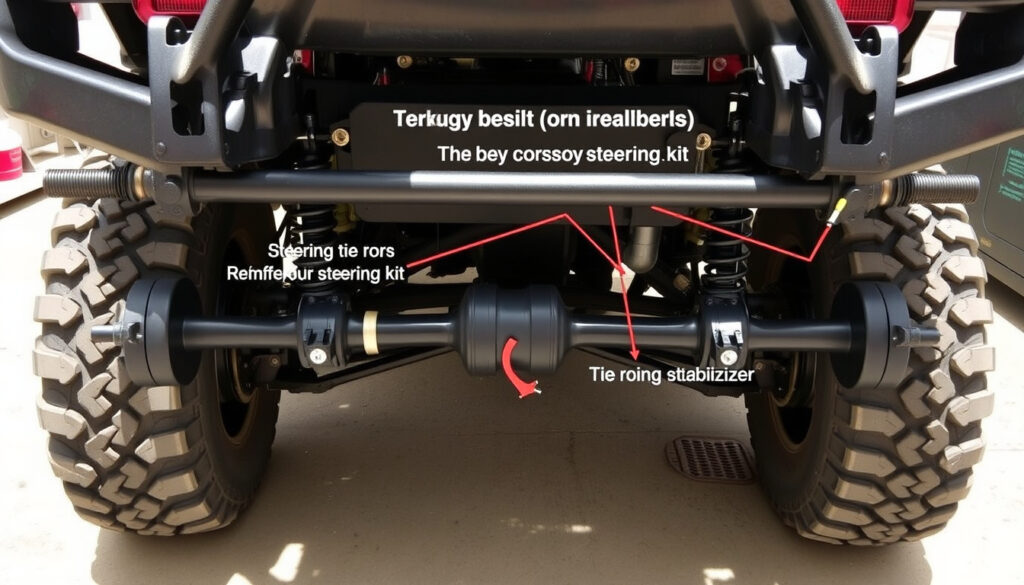
HD Crossover Steering Kit: Top Picks for Jeep XJ, TJ, ZJ
Anyone who’s wheeled a lifted Jeep XJ or TJ knows the vague, wandering feeling that comes with stock Y-link steering. HD crossover steering kits replace that factory setup with parallel drag-link and tie-rod geometry, tightening the response and nearly killing bump steer.
Compatible front axles: Dana 30 and Dana 44 ·
Steering rod material: 1.5-inch DOM tubing ·
Price range: $300 – $350 ·
Number of models supported: 5 (XJ, TJ, ZJ, MJ, LJ)
Quick snapshot
- HD crossover kits convert factory Y-link to crossover steering (Barnes 4WD, aftermarket steering specialist)
- Most kits use 1.5-inch DOM tubing with 4 heim joints (Barnes 4WD)
- Crossover steering requires a lifted suspension to avoid interference (Trail Forged, premium Jeep steering brand)
- Long-term durability of budget heim joints under daily driving
- Exact fitment for non-standard axle swaps (e.g., Dana 60)
- Long-term durability of heim joints in wet/salty environments
- Consistency of misalignment spacer quality across brands
- Effect of crossover steering on steering wheel centering
- Installation typically takes 2-4 hours for an experienced DIYer (Trail Forged install guide)
- Drilling knuckles to 5/8 inch adds about 30 minutes per side (Trail Forged install guide)
- After install, a professional alignment is strongly recommended
- Pair with a quality steering stabilizer for best on-road feel
Five key specs, one pattern: crossover kits trade factory simplicity for precision and clearance. Here’s the data.
| Spec | Value |
|---|---|
| Factory steering type | Y-link |
| Typical heim joint thread size | 5/8-18 |
| Tie rod material | 1.5-inch DOM tubing |
| Number of heim joints | 4 |
| Approximate weight | 15-20 lbs |
Cheap heim joints can wear out in a year of daily driving. The difference between a $300 kit and a $400 kit is often the quality of those four joints. Getting the cheap ones means replacing them sooner.
What is an HD crossover steering kit?
- Crossover steering replaces the factory Y-link system with a parallel drag link and tie rod (Barnes 4WD, aftermarket steering specialist).
- A typical kit includes a tie rod, drag link, four heim joints, mounting brackets, and all hardware.
- It enhances steering precision and under-axle clearance for larger tires.
How does it differ from factory steering?
Factory Y-link steering uses a single drag link from the pitman arm to the passenger knuckle, with a tie rod connecting that knuckle to the driver side. That Y shape creates a leverage difference between the two sides, which is why lifted Jeeps get bump steer. Crossover steering keeps the drag link and tie rod parallel, eliminating that leverage mismatch. It’s the same principle used by desert racers and rock crawlers.
What components are included?
- Tie rod (typically 1.5-inch DOM tubing)
- Drag link (same material, often bent for clearance)
- 4 heim joints (chromoly or Teflon-lined depending on brand)
- Jam nuts, washers, bolts, and misalignment spacers
- Drilled steering arms or replacement knuckles in some kits
How does an HD crossover steering kit improve off-road performance?
- Eliminates bump steer by keeping drag link and tie rod parallel to the axle (Trail Forged, premium Jeep steering brand).
- Provides more clearance for tires up to 35 inches and beyond.
- Increases steering durability with heim joints that replace weak factory tie-rod ends.
How does it reduce bump steer?
Bump steer happens when the drag link and tie rod pivot on different arcs. In a Y-link system, the pitman arm and passenger knuckle are at different heights, so as the suspension compresses, the toe angle changes. Crossover steering mounts the drag link and tie rod in the same plane — parallel to the axle beam — so the steering stays neutral through the suspension cycle. Trail Forged’s install guide emphasizes checking axle droop to avoid binding, which confirms the geometry is critical.
Does it improve turning radius?
Not directly. The turning radius is determined by the knuckle stops and wheelbase. However, because crossover steering uses heim joints that can handle more angularity than rubber bushings, you can often adjust the stops to gain a few degrees of turn. Most owners report the same or slightly tighter turning circle after fitting crossover.
A lifted Jeep on Y-link steering that wanders at highway speed becomes a safety hazard. Crossover steering fixes the root cause — geometry — not just the symptoms. That’s why experienced builders like CavFab (fabrication specialists) and Trail Forged (premium Jeep steering brand) recommend it for any Jeep lifted 3 inches or more.
Crossover steering vs Y-link steering: What’s the difference?
Three systems, one clear progression. Here’s how they compare.
| Feature | Factory Y-link | HD crossover (heim joint) | High steer (crossover + raised arms) |
|---|---|---|---|
| Drag link location | Pitman arm to passenger knuckle | Pitman arm to passenger knuckle | Pitman arm to passenger knuckle (raised) |
| Tie rod location | Passenger knuckle to driver knuckle (below axle) | Knuckle to knuckle (above axle) | Knuckle to knuckle (above axle, raised) |
| Bump steer resistance | Poor once lifted | Good | Excellent |
| Clearance under axle | Low | High | Highest |
| Install complexity | Factory (N/A) | Bolt-on, minor drilling | Requires new steering arms or knuckles |
Which is better for lifted Jeeps?
Crossover, without question. The Y-link’s single pivot point creates a seesaw effect that gets worse as the lift increases. With crossover, the drag link and tie rod move together, so the toe stays constant whether you’re on flat pavement or a rock ledge. That’s why serious off-roaders on forums consistently recommend crossover over any Y-link upgrade.
Can crossover steering be used on stock height?
Generally no. The drag link and tie rod sit higher than factory, so on a stock-height Jeep they’d hit the oil pan and steering box. Most manufacturers specify a minimum 3-inch lift for their crossover kits. If you’re not lifted, stick with a heavy-duty Y-link replacement.
What are the best HD crossover steering kits for Jeep XJ and TJ?
Five brands, one goal: strong, precise steering. The differences are in heim joint quality, tubing thickness, and ease of install.
| Brand | Heim joint type | Tubing material | Price range | Fitment notes |
|---|---|---|---|---|
| Barnes 4WD | 3/4-inch Magnum heim | 1.5-inch solid steel | $310–$330 | XJ, TJ, ZJ, MJ, LJ; Dana 30/44; drill knuckles |
| CavFab | Heat-treated chromoly heim | 1.5-inch DOM | $340–$370 | XJ, TJ, ZJ, MJ, LJ; includes misalignment spacers |
| Trail Forged | Teflon-lined chromoly heim | 1.5-inch DOM | $350–$390 | XJ, TJ, ZJ, MJ, LJ; Grade 8 hardware |
| BKFABWORKS | 3/4-inch chromoly heim | .250 wall DOM (USA) | $300–$320 | XJ, TJ, ZJ; drill knuckles if using upgraded joints |
| Rough Country | Standard heim (replacement type) | 1.25-inch DOM | $280–$310 | XJ, TJ, ZJ; budget option, smaller tubing |
Five kits, one trade-off: heim joint quality correlates directly with street durability. Trail Forged (Teflon-lined chromoly heim joints) and CavFab (heat-treated chromoly) lead for longevity. Barnes 4WD offers the best value if you’re comfortable drilling your knuckles.
Which brand offers the best value?
Barnes 4WD is the sweet spot for DIYers who don’t mind drilling. At roughly $320, you get quality Magnum heim joints and 1.5-inch solid steel. CavFab edges ahead if you want complete hardware and misalignment spacers included. Trail Forged is the top pick for daily drivers who want Teflon-lined heims that resist grit and noise.
What materials should I look for?
- Heim joints: Chromoly with Teflon lining (Trail Forged) or heat-treated chromoly (CavFab) for street life. Cheap uncoated steel heims wear fast.
- Tubing: 1.5-inch DOM (domestic oriented material) with at least .120 wall. BKFABWORKS uses .250 wall — overkill unless you rock-bash constantly.
- Hardware: Grade 8 or better. Trail Forged uses 5/8-inch Grade 8 fine-thread with metal lock nuts — that’s the gold standard.
A $300 kit with marginal heim joints may need new joints within 18 months of daily driving. Spending $370 on CavFab or Trail Forged gives you joints that last 3-5 years. The math: cheaper kits cost more in the long run if you actually drive the Jeep.
How to install an HD crossover steering kit
Six steps, one goal: get the geometry right. The install is bolt-on for most models, but accuracy matters more than torque.
- Jack and secure the front axle on jack stands so the suspension hangs at ride height. Remove both front wheels.
- Remove factory steering: Unbolt the tie rod and drag link from the knuckles and pitman arm. Remove the steering stabilizer if present.
- Drill the knuckles and pitman arm to 5/8 inch (if required — Barnes 4WD and BKFABWORKS kits need this). Use a drill press or a steady hand with a step bit.
- Assemble the drag link with heim joints: attach to pitman arm (Trail Forged recommends the heim above the arm for standard lifts) and to passenger knuckle. Torque to spec.
- Attach the tie rod between the knuckles, using misalignment spacers as needed. Set toe-in roughly by eye (1/8 inch is a good starting point).
- Cycle the suspension through full droop and compression. Check that no heim binds on any component. Reinstall wheels and lower. Get a professional alignment immediately.
Trail Forged’s install guide emphasizes checking axle droop so heims don’t bind under flex — especially on higher lifts. That step alone saves you from bent tie rods.
What tools are needed?
- Floor jack and two jack stands
- 1/2-inch and 3/8-inch socket sets with extensions
- Torque wrench (for heim jam nuts and tie-rod bolts)
- Drill with 5/8-inch bit (if drilling required)
- Ball joint separator (for factory tie-rod ends)
- PB Blaster or similar for rusted bolts
Do I need to drill or weld?
Most crossover kits for XJ/TJ are drill-only. No welding. The knuckles come pre-drilled from the factory at 5/8 inch. If your kit uses 3/4-inch heims (BKFABWORKS), you’ll need to drill out to that size. Barnes 4WD explicitly says drilling to 5/8 inch is required. Welding is only needed if you’re doing a full high-steer conversion with new steering arms.
Tips for alignment
Set toe-in to 1/16 to 1/8 inch (between the center of the tire treads at the front vs. back). Anything tighter and the tires will scrub on the highway. Caster angle may change with crossover — most lifted Jeeps need 5-7 degrees of caster. A shop with a modern alignment rack can dial this in. CavFab and Trail Forged both recommend professional alignment after install.
Confirmed facts
- HD crossover kits eliminate bump steer on lifted solid axle Jeeps (Trail Forged, premium Jeep steering brand)
- Most kits use 1.5-inch DOM tubing with 4 heim joints (Barnes 4WD, aftermarket steering specialist)
- Crossover steering requires a lifted suspension to avoid interference (Barnes 4WD, aftermarket steering specialist)
- Installation is bolt-on with drilling for most kits (Barnes 4WD, aftermarket steering specialist)
- Trail Forged and CavFab use heat-treated chromoly heim joints (CavFab, fabrication specialists)
What’s unclear
- Long-term durability of cheap heim joints on daily drivers
- Exact fitment for non-standard axle swaps (Dana 60, Ford 8.8)
- Long-term durability of heim joints in wet/salty environments
- Consistency of misalignment spacer quality across brands
- Effect of crossover steering on steering wheel centering
“Unquestionably the strongest, best engineered and fabricated crossover steering kit on the market.”
— Trail Forged (manufacturer of HD crossover steering kits)
“Enhance your Jeep’s off-road performance with our HD High Clearance Crossover Steering Kit.”
— CavFab (fabrication specialist)
Related reading: Cheapest Car Rental Singapore · ERP Timing and Rates 2026: Guide for Singapore Drivers
cavfab.com, bkfabworks17.com, blackbearoff-road.com, youtube.com, bkfabworks17.com, manuals.plus, rpmsteering.com, trailforged.com
For a broader perspective on steering system issues, the Mercedes-Benz steering recall in Canada highlights how even luxury automakers face challenges with steering components.
Frequently asked questions
Do I need a lift kit for crossover steering?
Yes, most kits require at least 3 inches of lift. The drag link and tie rod sit higher than factory, so a stock-height Jeep will have interference with the oil pan and steering box.
Can I use crossover steering with a Dana 30?
Absolutely. Dana 30 and Dana 44 are the standard axles for these kits. Barnes 4WD, CavFab, and Trail Forged all list Dana 30 as compatible.
How much does installation cost?
DIY: zero labor, but plan for 3-5 hours. Shop install: $200-$400 depending on whether drilling and alignment are included. A professional alignment adds $80-$120.
Is crossover steering legal for road use?
Yes, as long as it meets your state’s inspection requirements. Heim joints are legal for road use. Some states may require a steering stabilizer if the original was removed — check local regulations.
How long do heim joints last?
Teflon-lined chromoly heims (Trail Forged) can last 3-5 years on daily drivers. Uncoated steel heims may need replacement in 12-18 months. Inspect annually for play.
Does crossover steering affect turning radius?
No direct effect, but because heim joints allow more angularity, you can often adjust the steering stops to gain a slightly tighter turn. Most owners report the same or slightly improved turning circle.
What is the difference between a crossover kit and a high steer kit?
Crossover steering keeps the drag link at standard height. High steer adds raised steering arms to lift the drag link above the axle, providing even more clearance and better geometry for extreme lifts (6+ inches). Crossover is sufficient for lifts up to 6 inches.
For the Jeep owner who drives a lifted XJ or TJ on pavement and trail, the choice is clear: spend the money on a quality HD crossover steering kit from a brand that uses heat-treated or Teflon-lined heim joints, drill carefully, and get an alignment. The result is steering that tracks straight, turns predictably, and doesn’t fight back on gravel. For daily drivers on 33-inch tires, this is the single highest-return upgrade you can make — better than a locker or a regear if your current steering wanders.
More related posts
 Bihar Election Results 2025: NDA Wins 202 Seats
 Cocido Madrileño Near Me: What It Is & Where to Eat
 HDB Intent to Sell: Registration, CPF Refund & Cash Proceeds
 Gujarat Titans vs Rajasthan Royals IPL 2026: Scorecard & H2H
 Love, Death & Robots: Complete Guide (Seasons, Content, Myths)
 ERP Timing and Rates 2026: Guide for Singapore Drivers
 Harris Resort Waterfront Batam: Reviews, Rates & Guide
 Singapore National Stadium Capacity: 55,000 Seats Guide
